
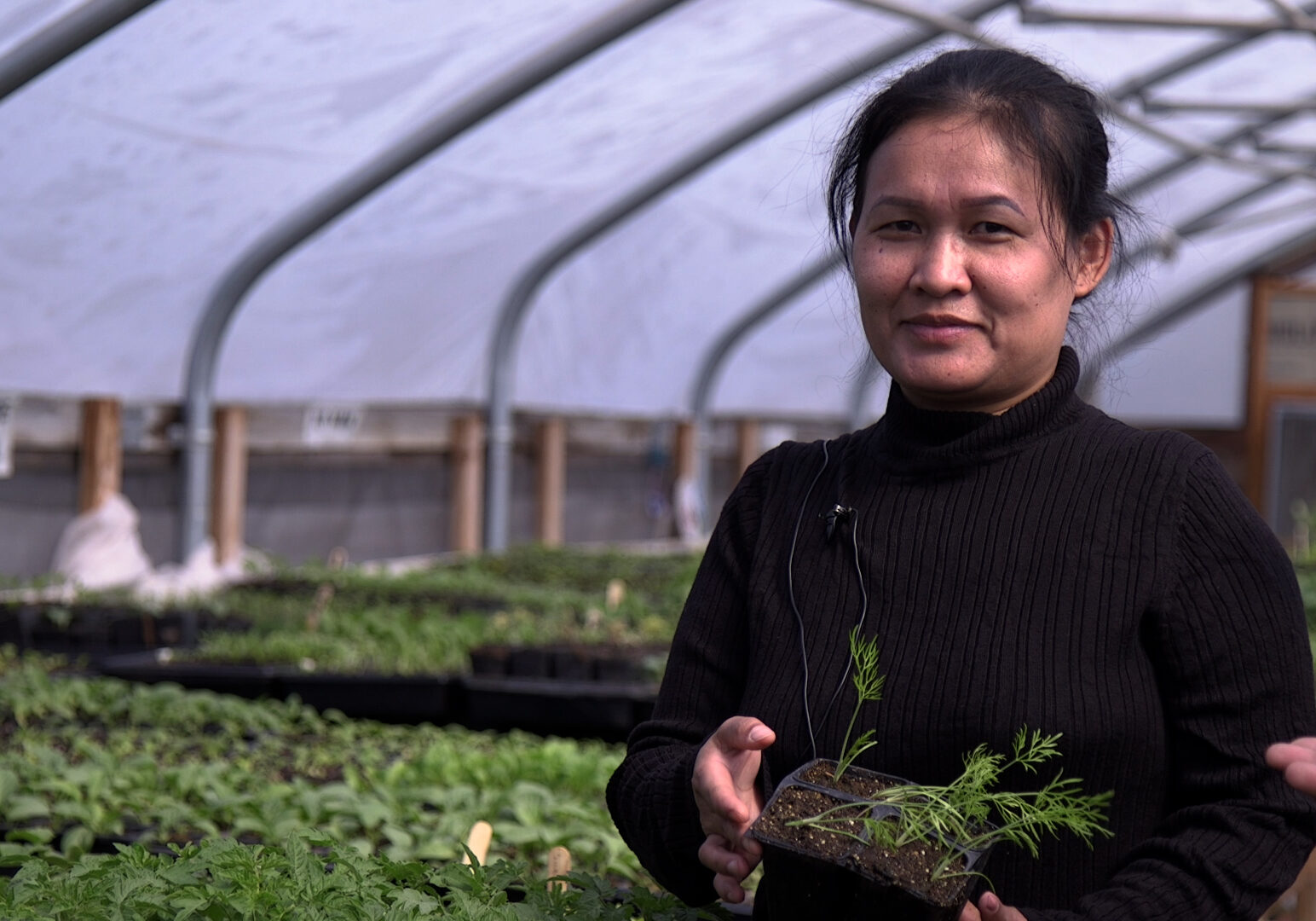
On her plot at the Juniper Gardens farm in northeast Kansas City, Kansas, Biak Par grows vegetables and herbs, including a variety of hot peppers and an herb called Chin Baung, which are commonly used in her home country of Myanmar.
She said it’s best to prepare them in a soup or with vegetables in a curry-like dish.
Biak Par is a graduate of the New Roots farmer training program, a four-year apprenticeship with Catholic Charities of Northeast Kansas and Cultivate KC.
The program provides refugees with an agricultural background a place to cultivate their farming skills, adjust to a new climate, and learn to run a business in the U.S.
Students and graduates of the program come from all over. Many come from Myanmar (also known as Burma) like Biak Par. Others are from Burundi, the Democratic Republic of the Congo and Mexico. On any given day, one can hear four different languages spoken throughout the greenhouses and quarter-acre plots at the farm.
Catholic Charities works to provide interpreters for instruction and to translate various resources.
“There’s so many resources in Kansas City for farmers, they’re just not always accessible in languages other than English,” said Kristin Selby, the New Roots program manager with Catholic Charities.
Selby manages the community supported agriculture (CSA) program where the farmers sell their produce. The program is accepting applications for the early summer/summer seasons and usually has around 150 participants.
Watch Harvesting Change
The New Roots website is stocked with recipes that use items less common in a western diet.
There are currently 11 farmers in the training program and six, like Biak Par, who are leasing land on the site after graduating from the program.
Forty-six families over the past 15 years have graduated from the program and 32 of those families are still actively farming in the community.
New Roots farmers fill the stalls at farmers markets around Kansas City and bring fresh produce and culturally significant foods to the Northeast KCK community.

According to the U.S. Department of Agriculture, urban farms, like New Roots, grow 15-20% of the global food supply.
Urban farms are also climate resilient because they add green spaces to developed neighborhoods and decrease carbon emissions by shortening the food chain. This style of farming can also make a city more socially and economically equitable, especially when they are placed in neighborhoods that lack access to fresh food or are disproportionately affected by climate change.
Rubi Hernandez is in her first year of the program and is just getting started planting some greens on her quarter-acre plot. She comes from an agricultural background in southern Mexico, where her family grows coffee and corn.
She has been in the U.S. for 23 years working in other industries but has always wanted to start her own farm.
Joining New Roots is really a dream come true for Hernandez.
“Your dreams come true every day,” Hernandez said. “Especially here if you do what you love.”
Cami Koons covers rural affairs for Kansas City PBS in cooperation with Report for America. The work of our Report for America corps members is made possible, in part, through the generous support of the Ewing Marion Kauffman Foundation. Laura Fotovich also helped film and edit this story.

Reading these stories is free, but telling them is not. Start your monthly gift now to support Flatland’s community-focused reporting.
Related Stories

The End of the Pesticide Arms Race?
To spray or not to spray, that’s the question for farmers. Pests can be the make-or-break factor for a season’s harvest. Between 20% to 40% of global crop production is lost to pests annually, according to the Food and Agriculture Organization of the United Nations. Conventional chemical pesticides have traditionally addressed this challenge, but their…
Manufacturers Out of Step with Customers on Repairs
Would you want your livelihood to depend on your daughter’s choice of dance escorts? Don’t laugh. Nathan Proctor has heard anecdotes to that effect in his role with PIRG, a Denver-based federation of state-based public interest research groups. Proctor is the senior director of PIRG’s right-to-repair campaign, which aims to break down the barriers that…
Rural communities rely on this USDA agency. Trump’s cuts threaten that
USDA Rural Development is Washington’s chief tool to promote economic growth in rural counties — providing funding for everything from renovating old hospitals to providing faster internet service. Sometimes the agency sweeps in to clean up an urgent mess. For instance, last year in Dunklin County, in Missouri’s Bootheel, a sewer system failure sent raw…