
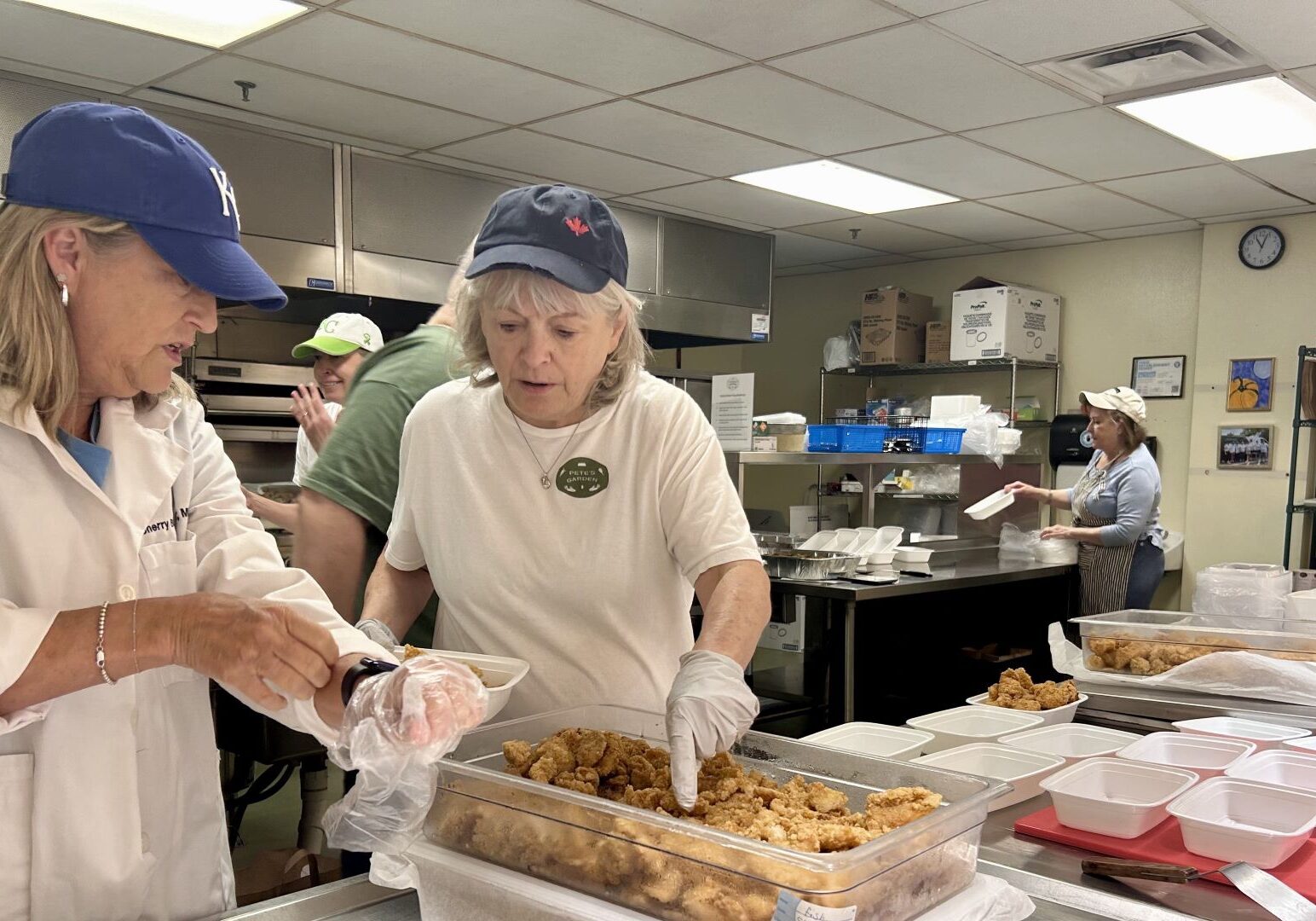
Nestled in downtown Kansas City, in the basement of the Grace & Holy Trinity campus, volunteers buzz around a kitchen filled with large containers of donated meat, veggies and grains.
The volunteers work in rhythm with one another, scooping potatoes into take-home boxes, and passing them on to the next station.
They work with Pete’s Garden, a nonprofit organization that collects excess food from various caterers and other food vendors around the city. The organization repackages the food to reduce food waste while also providing meals for families struggling with food insecurity.
According to recently released data from Feeding America, food insecurity in Kansas jumped from about 9% in 2019 to about 13% in 2022. In Missouri, it jumped from about 13% to about 15% during the same period.
The COVID-19 pandemic was a driving force behind those increases, according to Harvesters, a Kansas City-based regional food bank.
Harvesters serves as a hub that accepts and distributes donated food to more than 760 nonprofit agency partners in 26 counties in Missouri and Kansas, according to Matt Hamer, communications manager at the organization.
In that 26-county region, 1 in 8 people are at risk of hunger, according to Harvesters, citing the study from Feeding America. The numbers are even worse for children — 1 in 6 children in that Harvesters region are at risk of hunger. Furthermore, Harvesters estimates that 1 in 3 Black individuals and 1 in 5 Hispanic individuals struggle with food insecurity.
Harvesters defines food insecurity “as a lack of consistent access to enough food for every person in a household to live an active, healthy life.”
“Food insecurity — there’s kind of the cartoon version of it that you think of where someone opens up their fridge and there’s like, a bottle of spoiled milk and some flies come out or something like that,” Hamer said.
“But in reality, food insecurity is not having consistent access to enough, or healthy, nutritious food. And so, this can range from people not being sure where their next meal is coming from or not being able to afford food that’s actually nutritious for them, and stuff like that.”
Many things can contribute to or cause food insecurity, Hamer said.
“Anything from underemployment or unemployment, mental health struggles, health issues,” Hamer said. “You know, a lot of times any one of us is like one or two horrible things happening (away from ending) up in that situation.”
Food insecurity can be cyclical, and it can also depend on where people live, Hamer said.
“There’s some people that live out in rural areas where there just isn’t a close grocery store, and so we serve a lot of those areas…” Hamer said.
The new data from Feeding America is the first look at how food insecurity has changed since the height of the pandemic, Hamer said.
“But I mean, we’re two years past this now already, so the likelihood is that it’s risen more since that point,” Hamer said. “So, you know, the big thing for us is that as the cost of food has gone up for everyone, it’s also gone up for us. Our operating costs are higher. We are always in need of donations, whether that’s monetary or food or volunteer hours, all that stuff.”
Community-Driven Solutions
In the United States, more than 90 billion pounds of food go to waste each year and more than 50% of that waste comes from the food industry, according to Feeding America.
Tamara Weber, founder and executive director of Pete’s Garden, said the idea for the organization came to her after watching a documentary about food waste with her daughter.
“My daughter and I started looking for nonprofits in Kansas City that we could volunteer at that focused on food waste,” Weber said. “And as I was looking, I realized that … Kansas City was a bit behind the coasts in terms of addressing food waste. It’s become a lot more like — not popular — but we’re catching up now.”
Pete’s Garden often encounters food insecurity, and works primarily with low-income families, Weber said.

“The main service that I feel like we’re giving parents is extra time with their kids so that they’re not having to worry about cooking or going out to pick up food assuming that they live in an area where good food is even available,” Weber said.
Weber said they try to serve wholesome meals to families, and she doesn’t pick up food she wouldn’t feed to her own kids.
“For instance, we don’t pick up bread or sweets, because if you go to a typical food pantry, they have a ton of bread, and they have a lot of day-old baked goods. That, to me, that’s not dinner.”
Weber said she wants the food industry to know that donating food is legal and safe.
“We’re all food safety certified,” Weber said. “Our kitchen is inspected by the Kansas City Health Department. We have a refrigerated van when we’re picking up food so that we know that, you know, it’s being transported and it’s staying at the right temperature.”
Any food that they don’t end up distributing is composted, Weber said.
As more organizations find out about what they do, the demand at Pete’s Garden grows, Weber said. Ultimately, Weber said she wants to promote a habit around family mealtimes.
“What we do makes it easier for families to have that kind of, you know, family mealtime experience,” Weber said.
Julie Freijat is a Flatland contributor.
Reading these stories is free, but telling them is not. Start your monthly gift now to support Flatland’s community-focused reporting.
Related Stories
When Going Under the Knife Does Not Mean Surgery
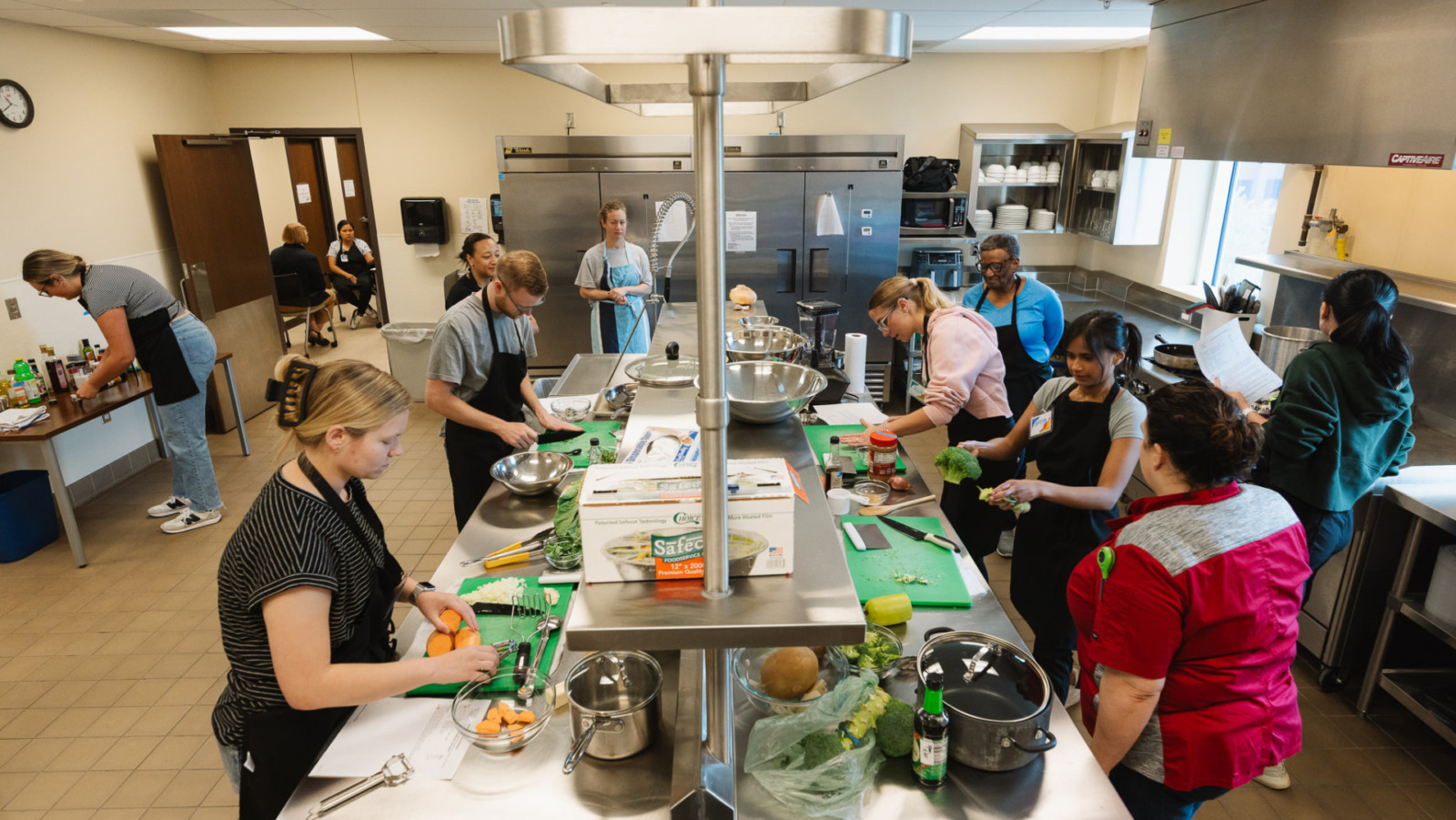
Chef Educator Rachel Ciordas deftly sliced collard greens into a ribbon-like chiffonade as students from the University of Kansas School of Medicine watched with a degree of awe typically reserved for an episode of the Food Network’s “Chopped.” After Ciordas demonstrated how to peel, chop, or grate the raw ingredients, the future physicians donned aprons…
Manufacturers Out of Step with Customers on Repairs
Would you want your livelihood to depend on your daughter’s choice of dance escorts? Don’t laugh. Nathan Proctor has heard anecdotes to that effect in his role with PIRG, a Denver-based federation of state-based public interest research groups. Proctor is the senior director of PIRG’s right-to-repair campaign, which aims to break down the barriers that…
Renters: How to Weatherize Your Home to Reduce Energy Costs
Energy burden is defined as the percentage of gross household income that is spent on energy costs. In some areas of the Kansas City Metropolitan area, residents experience an elevated energy burden. However, some energy costs can be reduced through weatherization. While it may be challenging to tackle as a renter, there are options to…