
A Century Later, Two Prohibition-Era KC Companies Come Back
January 15, 2020 | Vicky Diaz-Camacho | 3 min read
One hundred years ago this week alcohol became illegal – barred from being manufactured and sold – thanks to the National Prohibition Act of 1920.
The new law was the culmination of a decades-long campaign by American Temperance Society and the Women’s Christian Temperance League, which argued drinking booze was an evil vice and amoral. The ban reshaped the American culture.
“(Prohibition) made alcohol a black market item, so the big legitimate businesses were not able to (survive),” said Ryan Maybee, owner of the current-day J. Rieger & Co. distillery at 2700 Guinotte Ave.


During the Prohibition, some alcohol was produced for medicinal purposes, so some folks could get a prescription. (Vicky Diaz-Camacho | Flatland) 
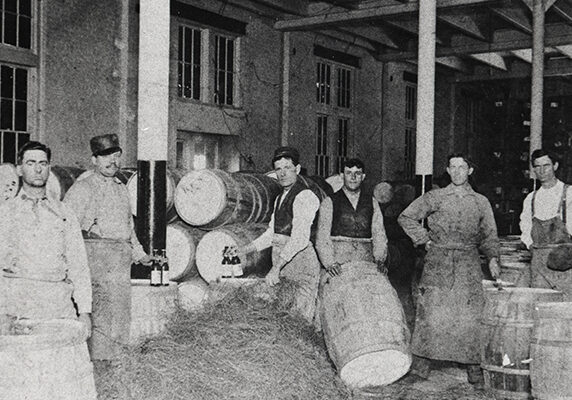
The Heim’s bottling facility is where J. Rieger & Co.’s distillery is today. (Missouri Valley Special Collections | Kansas City Public Library) 
This was the original J. Rieger & Co. bottle, which was produced by Heim’s bottling facility. (Vicky Diaz-Camacho | Flatland) 

Bottles like this were sold for medicinal purposes only. These bottles were discovered during renovations for J. Rieger’s distillery. (Vicky Diaz-Camacho | Flatland) 
Two of the most notable local businesses that would shutter when Prohibition became law were J. Rieger & Co. and Heim’s Brewing Co. In its heyday, J. Rieger was made popular with its mail-order delivery services. And Heim’s was, according to Visit KC, the “largest pre-Prohibition beer producer west of the Mississippi.”
The two companies were linked. Heim’s produced the glass bottles for J. Rieger’s whiskey.
Even while booze continued to be made and sold illegally – some newspapers called it “hell’s own brew” – Prohibition halted Heim’s and J. Rieger’s production. As a result, it severed an economic lifeline in Kansas City’s old Northeast area, where Heim’s building was located.
It’s taken almost 100 years for it to recover.
Maybee revived J. Rieger and in 2014, coincidentally, opened a whiskey distillery in the old Heim’s bottling facility.
“Our bottles were made here, so there’s this romance with this piece of real estate,” said Phil Hopkins, one of J. Rieger’s tour guides.
To top off the comeback, J. Rieger announced Wednesday that it has been named one of the country’s best new attractions by USA Today.
Breweries and Distilleries in KC stunted by Prohibition:
Here’s a list of key Kansas City area breweries and distilleries that closed in the wake of Prohibition.
+ Holladay Distillery
+ Muehlebach Brewing Co.
+ J. Rieger & Co.
+ Kansas City Breweries Co.
+ Imperial Brewing Co.
+ Heim’s Brewing Co.
Where Prohibition booze was sold:
Prohibition may have outlawed booze, but it didn’t quell access to speakeasies, moonshiners and bootleggers in Kansas City. The city was once considered the “wettest” and “wickedest” city during Prohibition, according to author John Simonson, whose latest book surveys the Prohibition in Kansas City. Simonson said these sites were Prohibition-era hubs for booze.
+ Brown and Loe, 429 Walnut
+ Anton’s, 1608 Main
+ The Rieger, 1922 Main
+ Green Lady Lounge, 1809 Grand
+ Manny’s, 207 Southwest Blvd.
+ Rhythm & Booze, 423 Southwest Blvd.
+ Ponak’s, 2856 Southwest Blvd.
+ Zocalo, 620 W. 48th St.
+ Shawnee Indian Mission Roadhouse. Inconspicuous and known as the “chicken dinner farm,” the mission was a roadhouse with gambling and booze.
Reading these stories is free, but telling them is not. Start your monthly gift now to support Flatland’s community-focused reporting.
Related Stories
A Better Big Blue Battlefield in Kansas City | Part III
Editor’s note: This is the final installment of a three-part series on the restoration of the Big Blue Battlefield in Kansas City, Missouri. The engagement on the Big Blue Battlefield was pivotal in the larger Battle of Westport, an October 1864 clash that effectively ended organized Confederate military operations in Missouri. As the years receded,…
A Better Big Blue Battlefield in Kansas City | Part II
Editor’s note: This is the second installment of a three-part series on the restoration of the Big Blue Battlefield in Kansas City, Missouri. In the mid-19th century, overland trail teamsters driving wagons west sometimes followed a branch of the Santa Fe Trail out of Independence, using the shortcut to reach fields where the animals used…
A Better Big Blue Battlefield | Part I
Editor’s note: This is the first installment of a three-part series on the restoration of the Big Blue Battlefield in Kansas City, Missouri. It was cold for late October in Kansas City. In 1864 Lt. Patrick Henry Minor, then leading an artillery battery against Confederate forces, would die the following March, from what likely had…