
Two Documentaries In The Works About KC’s Historic Northeast
October 13, 2025 | | 11 min read
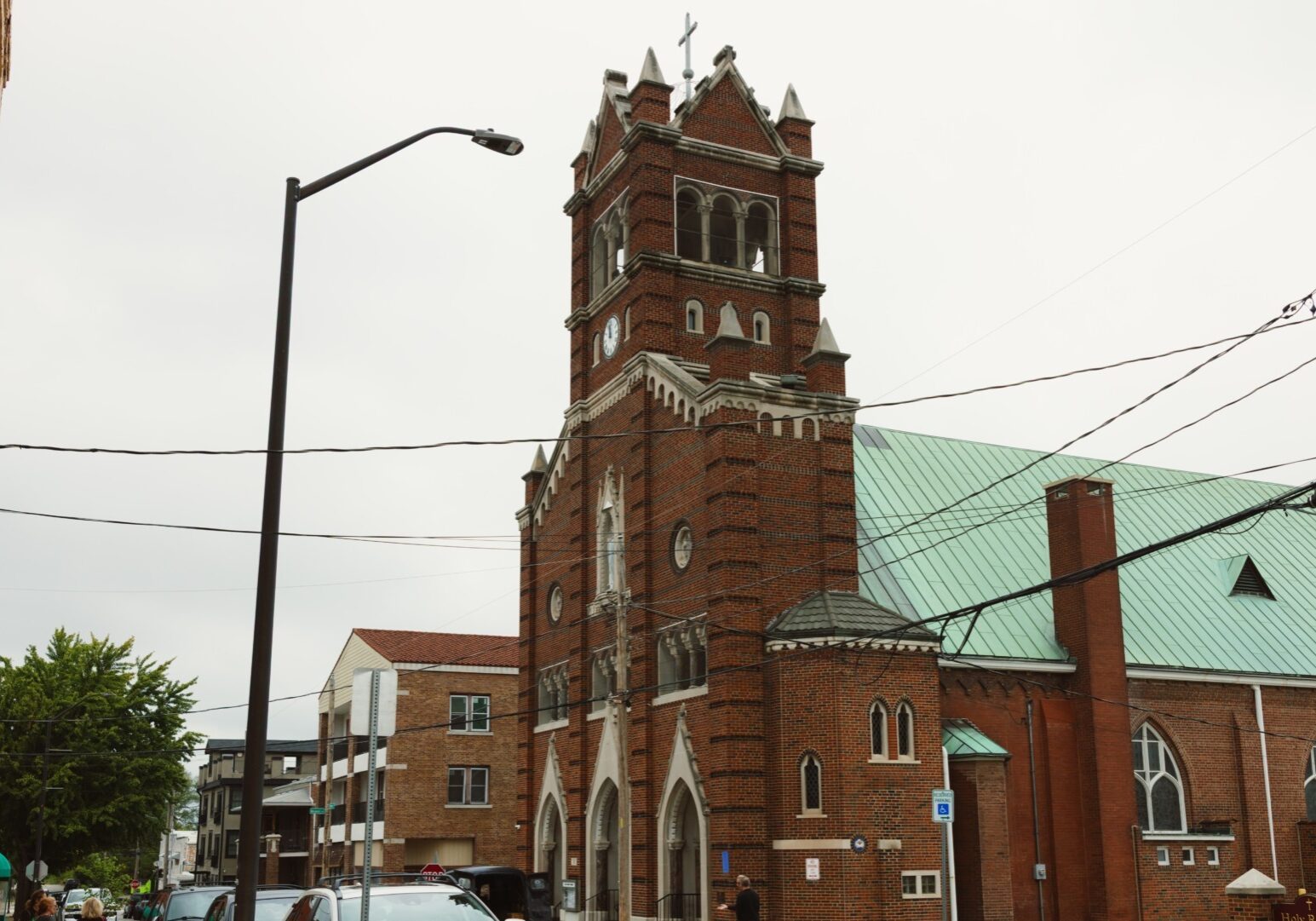
Those seeking to find Kansas City’s Italian-American community can start at Holy Rosary Catholic Church.
Inside, at 526 Campbell St., stand statues of canonized historical figures — Frances Xavier Cabrini and Francis of Assisi among them — venerated by the immigrants who worshipped on this very spot upon their late-19th-century arrival.
Inscribed on the walls are the names of the families — Nigro, Passantino, and many others — that founded the parish in 1891 and laid the foundation for a thriving community.
“It was a wonderful part of the city to grow up in,” Carmen Vigliaturo, 94, said in a recent interview at the Don Bosco Center, just across the street from Holy Rosary. “You had your own family, but you also had everybody’s families.”
The self-appointed neighborhood observers — “watchdogs,” Vigliaturo called them — would note his passing with a nod as he walked home from Holy Rosary school.
“These were retired people,” Vigliaturo said.
“You would say ‘Hi, Mr. Nigro.’ It was a friendly type thing. It was like they were protecting you.
“But if you didn’t talk to them, your parents would hear about it. My mother would get a phone call, or somebody would tell her at church, ‘Your son ignored me.’ ”

Such rich recollections have now inspired not just one, but two, documentary teams to mine the still-retrievable seams of the Kansas City Italian immigrant experience — and to counteract some ugly narratives along the way.
Another consistent throughline is the nod to the 15th-century Italian explorer commemorated through the federal Columbus Day holiday being celebrated today.
One film, entitled “The Neighborhood: the North End Becomes Columbus Park,” concentrates on the small River Market-adjacent enclave anchored by Holy Rosary.
Vigliaturo was among those interviewed by director Jon Trozzolo, who operates Crossroads Media Group, a video and film television production company
“Everything they needed in the world was down here,” Trozzolo said of the neighborhood’s early residents.
“Stores, restaurants, churches, schools. They felt safe down here.”
The documentary will reference the prejudice Kansas City Italian-Americans endured throughout the 20th century.
“It’s interesting to hear the stories as to how Italian-Americans were discriminated against, by police or others,” Trozzolo said.
But the story is bigger than that, he added.
“How does the Italian-American community — or any ethnic or racial group — overcome that? Some of the positive aspects of this project will be discussion of how this community developed culturally as residents became educated and built various businesses.”
The Kansas City chapter of UNICO, an Italian-American service organization, is a partner on the documentary.
“The secret history of the Kansas City Italians is not the ‘Mafia,’ ” said documentary producer Jody Valet. “The secret history is the honest, hard-working, educated people in this community.”
The working title of the other documentary is “Kansas City’s Italians and Sicilians: the Truth.”
The film will include the Holy Rosary district.
But it will also detail the subsequent Italian-American enclaves built in northeast Kansas City — site of the American Sons of Columbus Hall, dedicated in 1966 at 2415 Independence Ave. — and the families who moved to suburbs north and south of the Missouri River.
Co-produced by Toni Farina and Toni De Luca Rinella, the project — as its title suggests — also will debunk the stereotypes that have persisted well after local Italian-Americans demonstrated they were as American as anybody else.
The Documentarians


During World War II, 673 members of Holy Rosary parish, men and women both, served.
“Toni and I, when we were growing up, experienced a lot of discrimination,” said Rinella, an educator who works with special needs students in a Kansas City area suburban school district.
“So many people just think — when they hear about Italians — ‘Mafia.’
“We are trying to push that away and focus on the good.”
Farina, a University of Missouri-Kansas City communications graduate who works in California but spent much of September interviewing local Italian-Americans, has many credits listed on IMDb.
She and Rinella attended Holy Cross Catholic School in northeast Kansas City before attending high school in Lee’s Summit in the 1980s. Farina grew used to the occasional taunting she would receive from classmates there.
But sometimes the snark came from her own educators, said Farina, whose surname then was Sgaraglino.
“One day, we were watching a Holocaust documentary, and the teacher said, ‘Hey, Sgaraglino, wasn’t Mussolini somehow involved with this?’ ”
Her ancestors, Farina knew, had arrived in Kansas City decades before the fascist Italian dictator reached a political and military alliance with Adolf Hitler in 1939.
“It was just something you were used to if your name ended in a vowel.”
Farina and Rinella hope to complete their documentary by next year.
Trozzolo and Valet hope to do the same. Proceeds from the nonprofit production will be put toward the installation of a monument to Italian immigrants in Columbus Square Park.
A 2 p.m. preview has been scheduled at the Central Library, 14 W. 10th St., on Nov. 9.

All Ranks of Life
Kansas City’s Department of Public Welfare, in 1910 the country’s first such municipal agency, dispatched investigators to several ethnic neighborhoods.
One of them, where the city’s Italian-Americans lived, they identified as the “North Side.”
Their 1913 report provided precise coordinates of its boundaries: From the Missouri River on the north, between Woodland Avenue to Locust Street to the east and west, respectively, and Eighth Street on the south.
“All ranks of life are represented in their colony and the people are able to carry on business transactions through their own banker and lawyer, to patronize their own physicians, druggists and merchants or shopkeepers, and to subscribe for papers printed in their own language,” the report read.
In 1929, Giovanni Schiavo, a New York University sociologist, published “The Italians in Missouri.”
He resented, he wrote, how many residents of what he called Kansas City’s “Little Italy” he had found warehoused in “shacks hardly fit for human dwellings.”
But he also described how those same families refused to allow poverty past their doors.
In an almost anthropological way, Schiavo, after entering individual homes, described how “affluence will confront the visitor. Unbelievably clean, with rugs on the floor and pictures on the walls, they often boast of a piano or a radio set — and in some instances tiled bathrooms.”
Schiavo also detailed the district’s deep bench of professionals, listing its judges, physicians, engineers, and architects.
But he also lamented what he called the “fantastic publicity” that had become attached to the area.
“In Kansas City,” he wrote, “the Italian is made to suffer for the crimes of others.”
The ‘North Side’ Bonfire
Schiavo’s book included advertisements placed by Kansas City bankers, car dealers, bottling company owners as well as occasional notable individuals.
One such ad reads “Compliments of John Lazia.”
Operating alongside the Pendergast Machine, Lazia was a gangster who ruled Kansas City’s organized crime underworld until he was killed by two gunmen on the steps of his apartment building in 1934.
This was the kind of publicity Schiavo had been referring to. Some 20 years later, Vigliaturo — who served in the Korean War after graduating from Kansas City Manual High School — was still dealing with the fallout.
“The only thing I regretted about living here was the police,” said Vigliaturo.
“You couldn’t move without worrying about them. Five times a day, you would see a police car going through the neighborhood.”
The acts of the city’s criminals, some of them Italian-American, have been well documented over the decades.
The April 1950 murders of Kansas City political faction leader Charles Binaggio and underworld associate Charles Gargotta — followed by photographs of the crime scene published on the front page of the Kansas City Star — attracted national attention.
That October, U.S. Sen. Estes Kefauver, whose “Kefauver Committee” had been investigating organized crime across the country, convened hearings in Kansas City.
In 1967, members of the North Side Community Council voted to change its name to the Columbus Park Community Council to distance the organization from crime-world connotations.

Its members had requested the name be changed, “thereby removing the stigma,” the group’s president told a Star reporter.
That done, members gathered around an outside bonfire, into which they threw neighborhood signage and anything else bearing the words “North Side.”
Five years later, “The Godfather” premiered at the downtown Empire Theater.
Members of the Italian-American Unification Council spent $2,500 to buy 1,000 seats, assuring the film played to an empty house.
In the lobby, organizers told reporters that while they were protesting the stereotypes reinforced in the movie, they were not asking local film buffs to boycott it but “place the picture in the proper perspective.”
In 1978 Steve Glorioso, a longtime Kansas City political consultant, criticized the Jackson County prosecutor’s office for what he considered its lackluster efforts in investigating the gangland-style killings of nine alleged organized crime figures in Jackson and Clay counties.
Glorioso called for a task force into underworld figures then fighting, he said, over control of local fencing operations and prostitution rings.
“We Italians must ostracize this tiny minority from our environment,” Glorioso said.
Becoming Columbus Park
In 1926, city officials renamed Washington Square Park, a short distance west of Holy Rosary’s front doors, to Columbus Square Park.
By the 1930s, the neighborhood was an urban enclave dense with small businesses.
“We used to have groceries and drug stores on almost every corner,” said Rosemary Bartolomi, 93, whose father operated a funeral home and flower shop.
That was before construction of the country’s interstate highway system.
By 1957, city planners had penciled in what then was called the North Midtown Freeway, a few blocks away from Holy Rosary. Today, that urban corridor is commonly known as the northern east-west stretch of the “Downtown Loop,” where interstates 35 and 70 combine.
A 1967 Star article estimated that one-third of the Holy Rosary neighborhood’s residents had been displaced by highway construction.
And yet the Italian-American community grew regardless, with families settling across northeast Kansas City and north of the Missouri River.
“I don’t think it hurt us any,” said Bartolomi, who has lived on the same block her entire life and still drives her own car.
“All my doctors are north of the river.”

New immigrants, in separate waves, have arrived in the Holy Rosary neighborhood since.
During the Cold War, Cubans fleeing the Fidel Castro regime found homes there; in 1963, resettlement officials organized a reception for 35 such families.
By 1978, an estimated 1,300 Vietnamese had arrived following the fall of South Vietnam three years earlier. Many of the refugees were Catholic, and in 1981 a Vietnamese priest was assigned to Holy Rosary.
Today, just northwest of the church doors stands the Vietnam Cafe, occupying the same storefront where, back in the day, Rosa Nigro & Brothers Drugs could be found.
“There are a lot of nationalities in our neighborhood now and they all get along,” Bartolomi said.
“I wouldn’t want to live anywhere else.”
Missouri state offices will be closed today in observance of Columbus Day.
President Benjamin Harrison established the first Columbus Day in 1892 to acknowledge the explorer’s arrival in the Americas four centuries earlier and to promote acceptance of Italian-American immigrants.
In 1909, Missouri declared Columbus Day a legal holiday. Missouri is not among almost 20 states that officially observe Indigenous Peoples’ Day.
Italian explorer Christopher Columbus, whose 1492 expedition reached the Caribbean, never landed on mainland North America, Valet said.
“But his route opened up immigration to this country, and that is something to recognize,” she said.
“I’m not celebrating him. I’m celebrating how the Columbus Day holiday was the first time my family and many others were recognized in this country in a positive manner.”
Flatland contributor Brian Burnes served as a Kansas City Star reporter from 1978 through 2016.

Reading these stories is free, but telling them is not. Start your monthly gift now to support Flatland’s community-focused reporting.
Related Stories
Nick’s Picks | Roads, Bathrooms, Costco and More …
New Toll Road Opens Kansas City’s first toll road opens this week. Starting Saturday, you’ll pay up to $3.50 to travel the new express lanes on U.S. Highway 69 from 103rd to 151st streets in Overland Park. There are no toll booths — cameras scan your license plate, and a bill arrives by mail. KTAG…
Up From the Ashes: Warwick Theatre Revival Draws Applause
Two years ago, John Cleary met a fellow Kansas City actor for drinks. Their conversation centered on the fate of the Metropolitan Ensemble Theatre. A large portion of the ensemble’s home, the Warwick Theatre, was ash, charred timbers and soot-saturated costumes and props — remnants from a recent massive fire. The destruction was so great…
Nick’s Picks | Baseball, Drones, Romance and More …
Royals Reveal Next week, the Kansas City Royals head to Arizona for Spring Training. And that’s the mayor’s self-imposed deadline to lock in a stadium deal. So, is this finally the week owner John Sherman steps to the plate and unveils where the Royals will build their next home? At last week’s council meeting, Mayor…