
Up From the Ashes: Warwick Theatre Revival Draws Applause
February 11, 2026 | | 10 min read
Two years ago, John Cleary met a fellow Kansas City actor for drinks. Their conversation centered on the fate of the Metropolitan Ensemble Theatre.
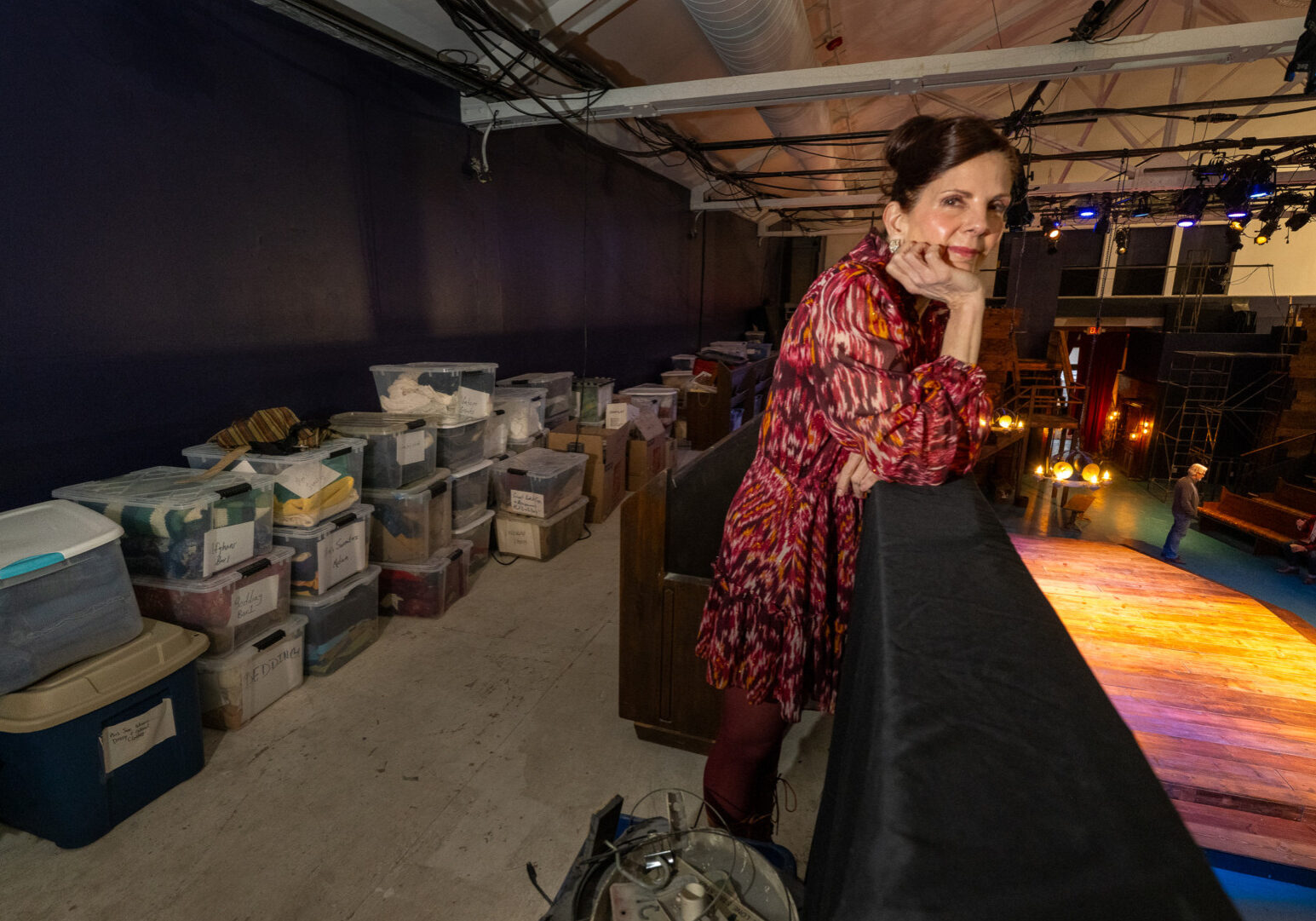
A large portion of the ensemble’s home, the Warwick Theatre, was ash, charred timbers and soot-saturated costumes and props — remnants from a recent massive fire.
The destruction was so great the insurance company stopped tallying repair costs because they were exceeding the likely policy payout. The damage dwarfed the ensemble’s annual budget nearly three times over.
Yet, theater leaders had declared the building would be repaired and the Metropolitan Ensemble Theatre (known as the MET) would return to its stage.
Cleary and his friend had big doubts.
Breaking News
“Our conclusion was, ‘How are they going to do this?’,” Cleary said. “As much as we loved it, there was an element of disbelief because the task seemed so huge.”
Fast forward to a blustery evening a few weeks ago. Cleary sits waiting to rehearse his role as King Henry VIII in the MET’s production of “A Man for All Seasons.”
Cleary will be stepping onto a stage he doubted would ever be.
“I am ashamed to say that when the fire happened my first thought was ‘That’s the end’,” Cleary said. “I thought ‘I don’t know how we are going to recover’.
“This would kill most theater companies.”
But not the MET.

Theater is rich with rituals, superstitions and history.
People say “break a leg” not “good luck.” No one quotes “Macbeth” inside a theater. A “ghost light” is left on.
And there is the ever-present threat of fire.
“It used to happen all the time so it is always something you are afraid of,” said Karen Paisley, the MET’s founding artistic director. “You take a lot of precautions. And we always did take them.”
That includes precautions everyone thought had been taken when work concluded inside the Warwick on the evening of Feb. 6, 2024.
“They cleaned up carefully,” Paisley said. “They did not realize stain rags will self-combust if you put them in a closed space. They put the last of the rags in a garbage can in the basement staircase.”
Paisley’s phone lit up the next day at 4:56 a.m.
“I knew something was terribly wrong,” she said.
The scene that morning at the Warwick was so horrifying that Paisley’s voice shakes when recalling it now.
“I could see the firefighters running into the building — then they turned and began to run out of the building. I felt terrified because it looked like they were abandoning the building,” she said.
The firefighters explained the fire was so hot they feared the steel could buckle and the building could collapse.
Firefighters finally extinguished the blaze hours later with the help of a massive column of water poured from above by crane-like equipment, and it was safe enough for Paisley to walk into a place she had labored for years into becoming a forever home for the MET.
She cofounded the theatre in 2003.

There’s no missing the Warwick in the 3900 block of Main Street in midtown Kansas City.
At night, its marquee with large red letters stands out among the theater’s neighbors — small businesses mingled with occasional darkened storefronts. The new streetcar extension rumbles by.
The marquee is a sort of tribute to the building’s origins.
The Warwick was a silent film theater built in 1912 by William Andlauer, a Kansas City entrepreneur and filmmaker. Andlauer did more than screen movies from Paramount Pictures at the Warwick. His Andlauer Film Co. made promotional films for government agencies, churches and businesses.
Andlauer’s first feature film, “As the World Rolls On,” holds a spot in Kansas City history.
Made in 1921, the movie included scenes from throughout Kansas City and starred the famous boxer Jack Johnson as part of its all-Black cast.
The Warwick suffered its first catastrophic fire in 1927. It was shuttered for two years for repairs.

The theater closed permanently in 1953 after Andlauer’s death.
After that, the building housed a thrift store, a furniture store, and a design company’s studio.
The Warwick has also sat vacant, as it was when Paisley walked into the space while searching for a new home for the MET. The ensemble purchased the building in 2016 and had its first production in April 2018.
The midtown location was ideal for the MET’s audiences. But there was something else that struck Paisley: A 29-foot ceiling.
“Part of what makes the Warwick experience so extraordinary is that height. There is the sense of the infinite,” she said.
“The way the lines of the building is built kind of carries you,” Paisley said. “Going east-west there is this really long line of the building, and then you have some vertical height that is really impressive.”
Yet that distinctive feature could have also led to the the Warwick’s demise.
Sliver of Hope
When firefighters finally deemed it safe to enter the theater, Paisley waded through water and darkness into a surreal scene.
“It looked like an Armageddon nuclear winter because there was so much ash,” she said.
It was heartbreaking to walk through the portion of the theater where the fire started — the staircase, the men’s costumes, the restrooms.
“I thought there would be twisted metal from the racks, or buttons, or something,” Paisley said. “There was nothing there. The fire had been so hot that it simply incinerated everything.”

She walked uneasily toward the performance stage area — the spot with that enticing high ceiling.
“I was afraid,” Paisley recalled. “Then we got there and realized the fire had never reached the actual theater. If it had, there was so much air I think it would have been a loss.”
Instead, the Warwick had a chance to be saved.
The damage estimate had reached $1.6 million by the time the insurance stopped counting. In the end, the insurance company paid just over $1 million.
There was, however, no shortfall in the support from MET’s community.
“I live within walking distance so I saw the fire,” said Valerie Andruss, a MET donor and season ticket holder. “I sent a check the same day because I knew they needed it.”
Actors like Cleary volunteered their time and muscle.
“Everyone I talked to said we should pitch in because this place means a lot to us,” he said.
And there was a lot of work to be done. While the fire didn’t spread throughout the building, everything in it had to be evaluated and, if salvageable, cleaned.

The MET found office space — and the needed folding tables and chairs — to continue day-to-day operations. It also found spots to rehearse and perform.
“There were moments of feeling very overwhelmed, but I don’t remember them lasting very long,” Paisley said. “We have been renovating the building for years. Why would we destroy everything we had done?”
Volunteers provided manpower and advice after professionals finished repairs and completed other tasks.
Evidence of the community’s support for the Warwick’s comeback is recognized in the MET’s program this season. There are 129 lines of names under “Our Fire Recovery Friends.”
“Donations from all sources and for all reasons totaled about $447,000,” Paisley said.
The MET opened again in the Warwick in September.
Patricia Miller, longtime MET supporter and Kansas City arts advocate, said the Warwick needed to be saved no matter how long it took, no matter what it took.
“I thought Karen was so brave to bring it back to life,” Miller said. “It’s one of my favorite theaters. I love her actors. I love her choices. I love the place.
“It would have been a devastating loss.”
Anchor Institution
Losing the Warwick would have had consequences beyond the Kansas City arts scene.
The building is located in the Southmoreland Neighborhood, which boasts such arts heavyweights as the Nelson-Atkins Museum of Art, the Kemper Museum of Contemporary Art, and the annual Heart of America Shakespeare festival.
The neighborhood also includes the Southmoreland Historic District, which is listed on the National Register of Historic Places.

“It is a priority for our neighborhood to retain as many historic structures as we can,” said Sarah Davis, chair of neighborhood preservation and culture for the Southmoreland Neighborhood Association.That is, Davis added, as long as a building is safe.
Davis does not oppose development, but she said it’s important to retain the character of the place.
“It’s understanding what that neighborhood was before,” she said.
Andruss said preserving buildings like the Warwick is important.
“I am really fond of historic buildings,” Andruss said. “I get very unhappy when the older buildings come down.”
For actor Kenan Meadows, the Warwick is more than the place where he landed his first professional theater gig. He also was involved in the production of “Joe Turner’s Come and Gone,” the show that was being rehearsed at the time of the fire.
“The fire was terrible, but something beautiful came out of it,” Meadows said.
“There are more people coming to it. They heard about the fire, and they want to come and check it out. It adds to the history of it.
“It’s important to the history of Kansas City but especially Midtown. The Warwick has been around for a long time — as long as my great-grandmother. I’m Black, and there was a time when we weren’t allowed in there. I think of those things, too. It’s a very important part of this community. It has to keep going. It has to.”
Flatland contributor Debra Skodack is a Kansas City-area freelance writer.

Reading these stories is free, but telling them is not. Start your monthly gift now to support Flatland’s community-focused reporting.
Related Stories
Nick’s Picks | Roads, Bathrooms, Costco and More …
New Toll Road Opens Kansas City’s first toll road opens this week. Starting Saturday, you’ll pay up to $3.50 to travel the new express lanes on U.S. Highway 69 from 103rd to 151st streets in Overland Park. There are no toll booths — cameras scan your license plate, and a bill arrives by mail. KTAG…
Nick’s Picks | Baseball, Drones, Romance and More …
Royals Reveal Next week, the Kansas City Royals head to Arizona for Spring Training. And that’s the mayor’s self-imposed deadline to lock in a stadium deal. So, is this finally the week owner John Sherman steps to the plate and unveils where the Royals will build their next home? At last week’s council meeting, Mayor…
History of Persecution Binds Black, Jewish Communities
Kansas City icon Alvin Brooks knows more about the Civil Rights Movement here than almost anyone alive. And Brooks, former Kansas City mayor pro tempore, insists that progress for Blacks here would have been much more difficult without the consistent and persistent help of Jewish residents and leaders. “Jews in this community and across the…