
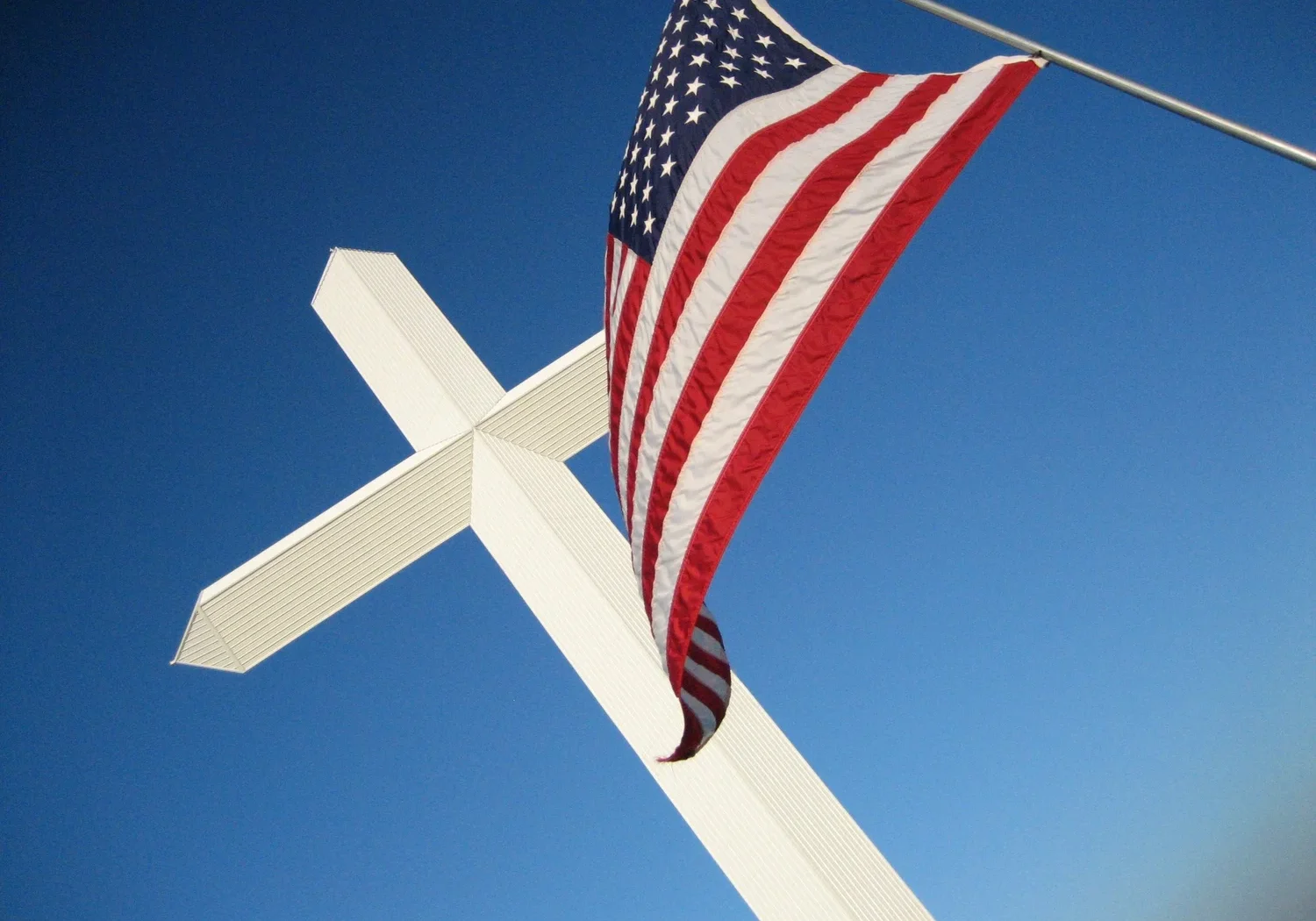
In recent decades, Christian Nationalism’s warped ideas have begun to attract the attention of scholars and teachers at universities and seminaries here in the Heartland.
They’re trying to understand both its appeal and its dangers and to give students the tools necessary to make their own judgments about whether it’s good old basic Americanism or, rather, a threat to the ideas found in the nation’s aspirational founding documents.
Why a threat?
Because, at its base, Christian Nationalism embraces the idea that God has uniquely blessed the United States and that the U.S. should be governed by Christians using Christian values. Those ideas conflict with the guarantees of religious freedom and separation of church and state that underpin the country’s history and constitutional values.
As part of the relatively new attention being paid here to Christian Nationalism, last fall the St. Paul School of Theology, a United Methodist seminary here, offered a series of lectures on “Faith and Politics” that was open to staff, students and the public.

As part of that series, seminary President Jay Simmons presented on the elements of Christian Nationalism that are not congruent with the history of the U.S. and the values of its founders.
“We also have been involved with a couple of the programs that the Mainstream Coalition sponsors,” Simmons said.
“As a United Methodist institution,” he added, “the social principles of the U.M.C. are very clear about advocating for religious pluralism, the First Amendment, maintenance of the free exercise clause as well as the establishment clause of the Constitution.”
Similarly, David Congdon, who lives in Lee’s Summit and teaches at the University of Kansas, leads a popular K.U. class on religion in the U.S. in which students explore Christian Nationalism.
The course, he says, covers it “from the Protestant Reformation to today.”
And he quickly discovered that his “students are across the board very critical of Christian Nationalism. People flocked to the course because they were so appalled and concerned about Christian Nationalism.”
Congdon grew up an evangelical Christian but eventually walked away from that branch of the faith.
“It wasn’t just evangelicalism but a larger concern regarding the attempt to demarcate who is in and who is out, who’s saved and who isn’t, rejected and damned,” he said. “Evangelicalism is one version of that, and I think Christian Nationalism takes that same us-vs.-them binary and applies it to the nation.
“So the nation has to be purified within of people who don’t belong to us — the immigrants, the outsiders, the liberal, the woke. Effectively, Christian Nationalism is an evangelical purity politics applied not just to the church but to the nation as a whole.”
Similarly, at Rockhurst University in Kansas City, Craig R. Prentiss, professor of religious studies, teaches a class in which Christian Nationalism is considered at least indirectly.

“We talk about in-group, out-group formation,” he says, “which is essentially the idea that it takes almost nothing to allow you to imagine yourself as part of a group and then begin to develop usually negative ideas about whatever constitutes the out-group. These patterns develop over and over,” including among those who either favor or oppose Christian Nationalism.
And while this subject is gaining increasing attention on college and seminary campuses in this area, not everyone has joined in.
For instance, David F. Freeman, an associate professor of history and religious studies at the University of Missouri-Kansas City, told me by email that he “made a conscious decision several years ago, as Christianity became increasingly politicized in this country, to step away from any academic interest in modern or contemporary forms of Christianity. My new guideline is anything after the 16th century is current events!”
He also noted that teaching or researching Christian Nationalism “would be a tricky topic for a professor at a public university in a red state.”
Beyond that, my efforts to get someone from the Southern Baptist pastor training school here, Midwestern Baptist Theological Seminary, to talk with me about this subject turned up no one.
Still, the subject continues to attract students and the faculty interested in helping them understand this movement so they can figure out, for instance, what Vice President JD Vance means when he calls the U.S. a “Christian nation.”
Even people in area congregations are seeking to understand Christian Nationalism.
Last fall, for instance, when Kansas City Star editorial page Editor Yvette Walker and I gave a series of talks to area churches about threats to our democracy, audience questions about Christian Nationalism were plentiful.
But area teachers caution that there’s not one simplistic definition of what this kind of nationalism means.

For instance, Congdon said that the term “is an umbrella concept. It’s a fairly new term that has become more or less the dominant term, but it’s only arisen in the last eight to 10 years. Christian Nationalism is a very large, all-encompassing umbrella for any position that joins together political nationalism and Christianity into a hybrid mix.”
Even so, Simmons insisted that this nationalist idea shows a “willful disregard” for the First Amendment.
“We’re seeing it enacted in an agenda that very much favors the free exercise clause of the First Amendment at the expense of the establishment clause,” he said, meaning that Christian Nationalism is in many ways supportive of the idea that every American should be a Christian or at least governed by Christians.
“The concern that I have,” Simmons said, “is that the positions that they argue would suggest an understanding of Christianity and the history of the United States that overlooks a very important element in both traditions.”
He said the argument that the U.S. was founded as a Christian nation neglects the Virginia Statute of Religious Freedom and Thomas Jefferson’s writings in support of that statute, and also overlooks Jefferson’s letter to the Danbury Baptist Association in 1802, where he talked about the wall of separation and the intent of the First Amendment to maintain and fortify the wall of separation.
“Christian Nationalism seems not to appreciate that these elements in our history are real and determinative in what the Founders believed would be secular republic that promoted the free exercise of religion for all of us,” Simmons said.
As Christian nationalist ideas spread, it’s important that scholars and teachers know what that threat means to keeping the U.S. a free and religiously welcoming country, even if our history in that regard is quite mixed.
But blunting the spread of Christian Nationalism may well depend on area educational institutions becoming more active in grasping its goals and communicating them to a wider audience.
Bill Tammeus, an award-winning columnist formerly with The Kansas City Star, writes the “Faith Matters” blog (https://substack.com/@billtammeus429970) for The Star’s website. His latest book is Love, Loss and Endurance: A 9/11 Story of Resilience and Hope in an Age of Anxiety. Email him at wtammeus@gmail.com.

Reading these stories is free, but telling them is not. Start your monthly gift now to support Flatland’s community-focused reporting.

Related Stories

Nick’s Picks | Roads, Bathrooms, Costco and More …
New Toll Road Opens Kansas City’s first toll road opens this week. Starting Saturday, you’ll pay up to $3.50 to travel the new express lanes on U.S. Highway 69 from 103rd to 151st streets in Overland Park. There are no toll booths — cameras scan your license plate, and a bill arrives by mail. KTAG…

Up From the Ashes: Warwick Theatre Revival Draws Applause
Two years ago, John Cleary met a fellow Kansas City actor for drinks. Their conversation centered on the fate of the Metropolitan Ensemble Theatre. A large portion of the ensemble’s home, the Warwick Theatre, was ash, charred timbers and soot-saturated costumes and props — remnants from a recent massive fire. The destruction was so great…

Nick’s Picks | Baseball, Drones, Romance and More …
Royals Reveal Next week, the Kansas City Royals head to Arizona for Spring Training. And that’s the mayor’s self-imposed deadline to lock in a stadium deal. So, is this finally the week owner John Sherman steps to the plate and unveils where the Royals will build their next home? At last week’s council meeting, Mayor…