
Cultivating History Pt. 3: Business Success Breeds Resentment
February 20, 2025 | Brian Burnes | 4 min read
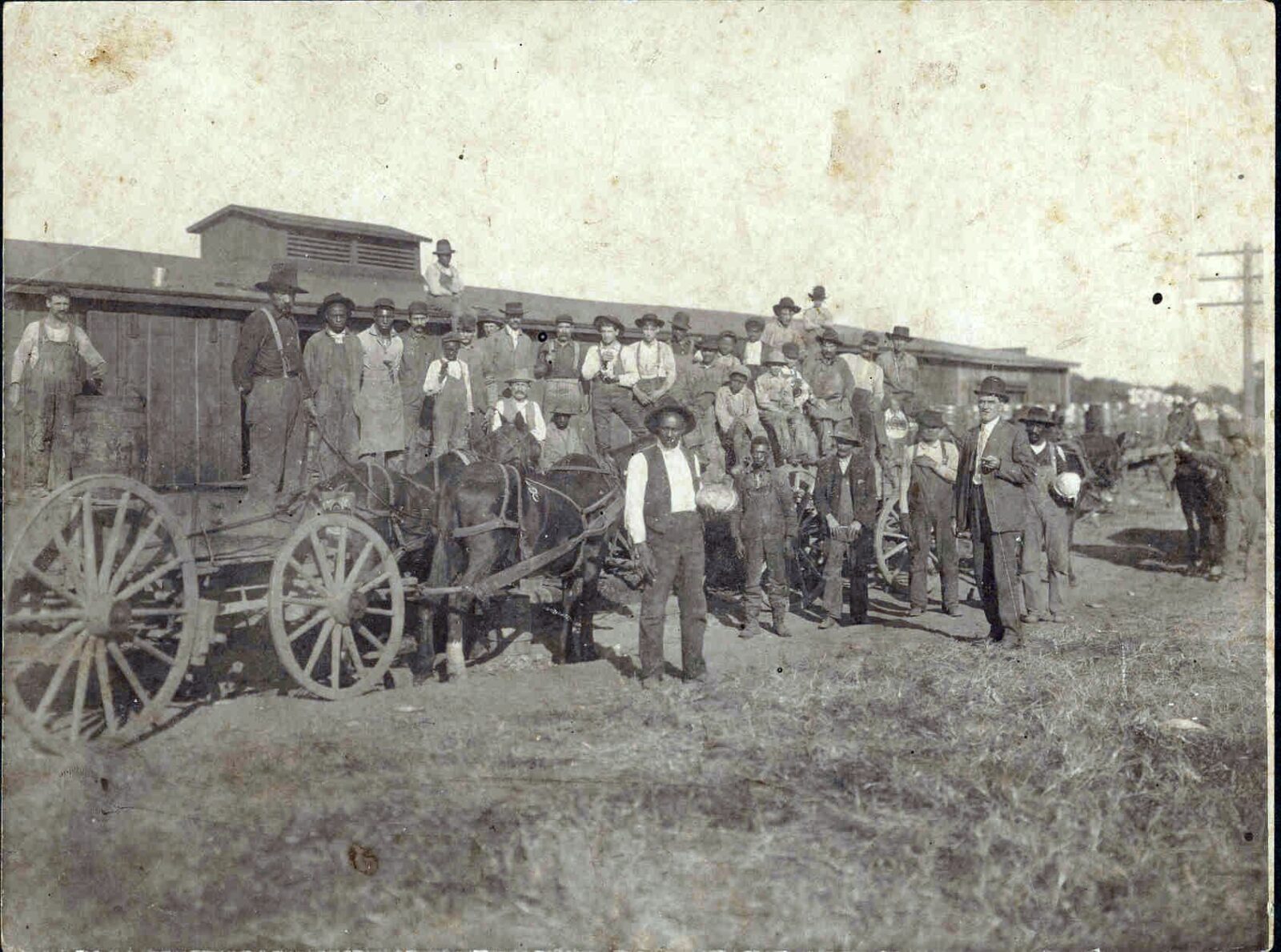
Junius Groves had built a potato empire by 1907, when educator Booker T. Washington showcased his success in his book, “The Negro in Business.”
Groves then was shipping potatoes across North America while also importing what Washington called “fancy seed potatoes” from distant states.
“He would get seed potatoes from Idaho and other places, and he would experiment by cross-breeding those seed potatoes with other potatoes,” said David Meditz, chair of the Landmarks Commission in the Unified Government of Wyandotte County and Kansas City, Kansas.
Junius and his wife, Matilda, also grew cabbage, apples, peaches, and pears.
They maintained a vineyard.
They held a majority interest in a casket and embalming company and invested in banking and mining ventures.
They ran a general store.
“Groves diversified,” said Mike B. Rollen, the Kansas City, Missouri, urban farmer who hosts the “Potato King” documentary that premiers tonight on Kansas City PBS.
“He was recession-proof.”
Previous Installments
At the approximate spot where Groves’ extended family members last year dedicated a new street sign bearing his name, he established Groves Center, where African American farmers could acquire small parcels of land. He also opened a golf course and, with Matilda, established a Baptist church.
Then there was their quality of life.
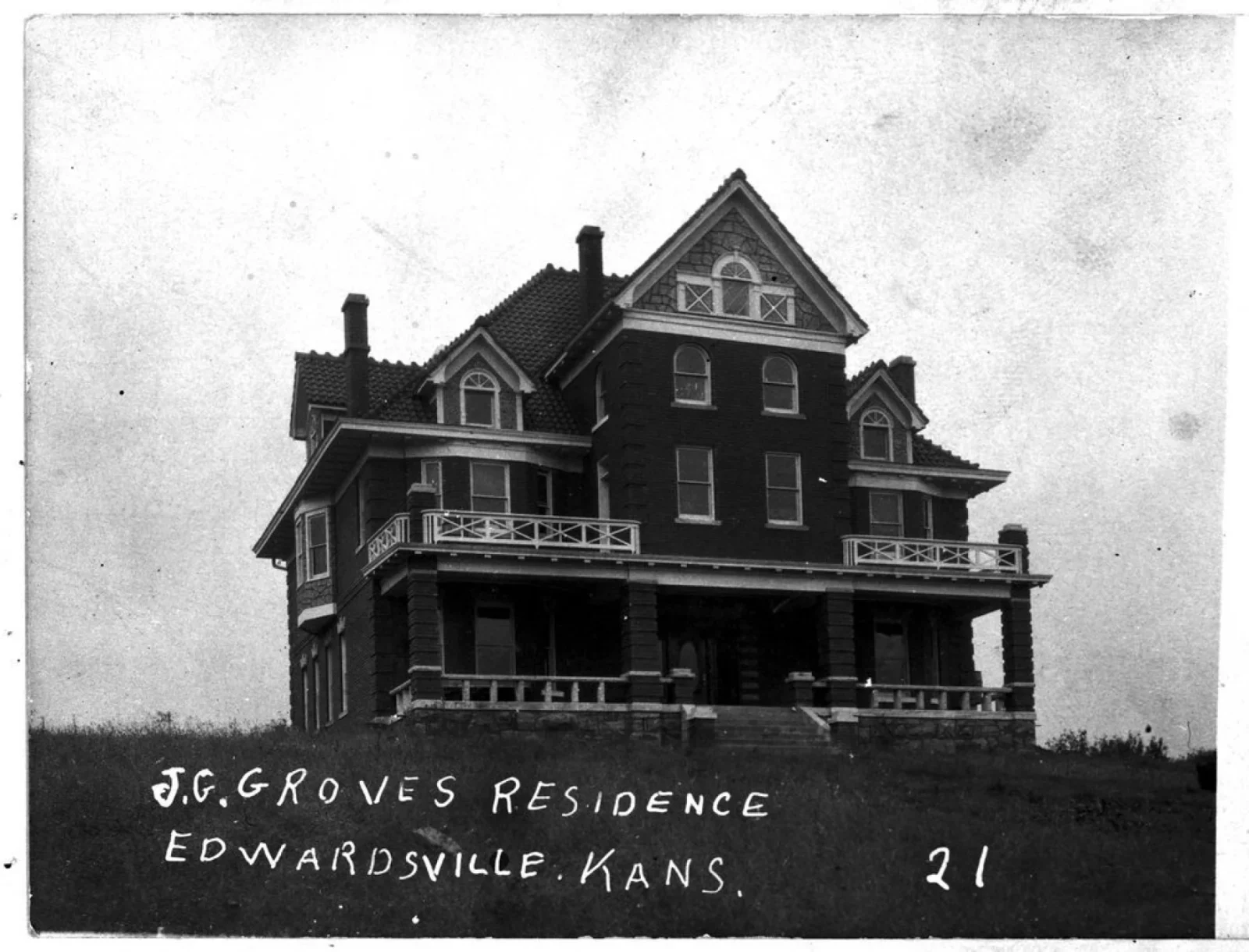
They had 12 children. The family lived in a mansion which The Country Gentleman, a national agricultural journal, described as a “22-room palace.”
The home, built on a hill, would have been visible to those who admired Groves as well as those who, perhaps, resented him.
The first two homes Groves built for his family burned down, said great-grandaughter Joyce Groves Holland.
Significantly, the third house, the “palace,” was built of red brick, she added.
Unmarked Grave
Groves died in 1925 and today the location of his grave is unclear.
“I don’t know if Junius specifically requested no headstone be placed,” said Holland.
But there would be reason for that. Local Ku Klux Klan members had threatened to exhume Groves’ body, hang it on display, and desecrate it by fire, Holland added.

“He was so successful the Union Pacific Railroad ran a spur to his property,” Rollen added.
“I believe that, as a Black man, Junius Groves was too big for his time.”
But maybe not all of the enmity directed toward Groves was race-related, Rollen said.
“He had figured out a way to grow more potatoes per acre in the United States than anyone,” he said.
“When you think about it, he controlled a commodity. So there could have been some conflict there, because he was getting so big.”
Hard Times
Groves’ will valued his estate at more than $100,000, with more than 400 acres of Kaw Valley land plus still more acreage in western Kansas.
Groves’ will directed his holdings be left intact within the family.
But the Depression hit the family hard.
On August 12, 1930, the Knights of Pythias of Missouri, a fraternal organization, acquired the Groves farm at auction on the Wyandotte County Courthouse steps for $61,000.
The buyers insisted they had no other option, as no payments had been made on a $50,000 loan extended to the Groves family.
The seven sons and one daughter then operating the farm blamed weather conditions and the state of the potato market.
“I have letters from food merchants saying they were not going to buy at the price the family wanted,” Holland said.
Matilda died on August 28, 1930.
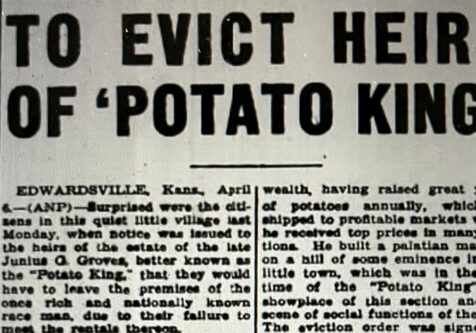
Lawyers delivered an eviction notice in 1933.
The family mansion, then vacant, burned in 1964.
Mystery Loan
“There is still mystery about this,” said Holland, who long has researched her great-grandfather’s story.
An uncle described to her an “under the table” loan from the fraternal organization of $3,000 to some of Groves’ sons after Groves’ death. Even decades after the dodgy transaction her uncle remained upset by it, Holland said.
But her great grandfather’s legacy, now being revived, represents a triumph over long-ago adversity, she added.
“Junius Groves is finally getting his recognition,” she said.
Today Rollen, with Wyandotte County farmer Bob Ford, works 30 acres of Kaw Valley land under lease, including some once tended by Groves.
Groves’ story remains relevant, Rollen said, as he works to encourage urban residents to grow more educated about food and how to grow it in any spot of land accessible to them.
“Groves was a brilliant man and we are learning more about him now, during this renaissance of urban agriculture.”
Flatland contributor Brian Burnes is a Kansas City area writer and author.
Reading these stories is free, but telling them is not. Start your monthly gift now to support Flatland’s community-focused reporting.

Related Stories
Cultivating History Pt. 2: ‘Potato King’ Thrives Amid Racism
While Kansas would prove friendly to potato growers like Junius Groves, it would not be quite the “free state” envisioned by Exodusters, the African Americans who, following the end of Reconstruction, considered their prospects more promising in the North. “It was about the same time when the Exodusters arrived in Kansas that the state Legislature…
Cultivating History Pt. 1: ‘Potato King’ Earning New Renown
Junius G. Groves is having a moment. Community knowledge of the African American potato farmer, who died 100 years ago this August, is growing after largely having vanished from the collective memory of Kansas, where he arrived carrying 90 cents in 1879. A new documentary, “The Potato King,” directed by filmmaker Jacob Handy, premiers Thursday…

Environmental Justice: Wyandotte County Seeks Solutions
Advocates in Wyandotte County are seeking environmental justice for communities paying the health care price for decades of industrial pollution.