

Fountain City Frequency |Getting Real About A Complex Diagnosis
March 14, 2016 | Matthew Hodapp | 4 min read
Kevin Bryce is a filmmaker from Kansas City, Missouri. His 2012 documentary “We Are Superman” (produced by Re:Dream‘s Christopher Cook) explored the after-effects of hyper-segregation on Troost, and a movement trying to transform it from a dividing line into a gathering place.
Bryce’s newest documentary “All These Flowers” investigates bipolar disorder through the stories of six people who been diagnosed with the illness.
“Everyone that I know who’s been diagnosed is extremely secret about it,” says Bryce, “and I wanted to know why. Why can’t people talk about it.”
Originally, Bryce set out to define bipolar disorder with the documentary, but he found that a straightforward definition of the illness was nearly impossible to find. As the film progressed, it became more focused on documenting the experiences of people with the disorder. That process became an incredibly personal study for Bryce as he began reflecting on his own life experiences.
“The day I finished principle editing was the same day I was diagnosed by a doctor with bipolar II disorder,” says Bryce.
[FLEX-CONTENT]
Toward the middle of the film, Timothy Taylor, one of the subjects diagnosed as bipolar, attempts to describe the disorder through a mathematical equation. He asks the viewer to visualize that two plus three equals seven.
“Imagine that though you looked over and over again at the equation it didn’t seem right that two plus three equals five,” says Taylor, “and somehow you know deep down inside that it really equals seven and that this is all a lie.”
Bryce says that his “seven” is a feeling that he is a total failure, a feeling that drove him to suicidal thoughts occasionally during his early twenties.
Similar to most bipolar patients, Bryce was prescribed medication to deal with the disorder. But his Canadian citizenship and complications from the rollout of the Affordable Care Act caused him to lose his health insurance.
“I’m not extreme,” says Bryce. “I’m more, if there’s a spectrum, I’m like somewhere past the middle. So I’ve been able to manage without the medications.”
Dr. Ellen Frank, a professor of Psychiatry and Psychology at the University of Pittsburgh School of Medicine is featured prominently in the film. She says that the view of bipolar disorder as a spectrum is accurate, and that it may be more precise to say there are multiple bipolar disorders.
“That runs from very seriously impairing disorder that includes periods of psychosis during mania, through — maybe it’s not even fair to say milder conditions but — different conditions,” says Frank.
[FLEX-CONTENT]
Support networks are incredibly important to those working through their illness. Bryce says he sees these support networks like concentric circles, or ripples, each connecting to the other. The people closest to the diagnosed also have a support network, and so on.
As people leave the theaters, Bryce hopes they walk out with a better understanding of bipolar disorder, and that they won’t be so quick to judge people with the illness.
“Not thinking that someone with the disorder is the disorder,” says Bryce “They are bipolar. It’s like saying they are asthma, they are cancer. No, they’re not cancer. They have it and they struggle with it, and they’ll hopefully survive.”
The documentary has been screened at multiple film festivals across the country, and was selected for the 2016 Kansas City Film Fest.
Flatland is teaming up this month with Fountain City Frequency for a series featuring narrative-driven stories from the KC region. Fountain City Frequency is a KC-based independent podcasting group supported in part by the Charlotte Street Foundation. Look for a new audio story on Flatland each Monday in March.
Reading these stories is free, but telling them is not. Start your monthly gift now to support Flatland’s community-focused reporting.

Related Stories

Healing Hate: How to Build a More Resilient Kansas City
A decade after an antisemitic hate crime at the Jewish Community Center in Overland Park, communities are embracing the science behind helping children recover.
Seeking Help for Children Traumatized Mass Shooting in Kansas City? Experts Stress Routines
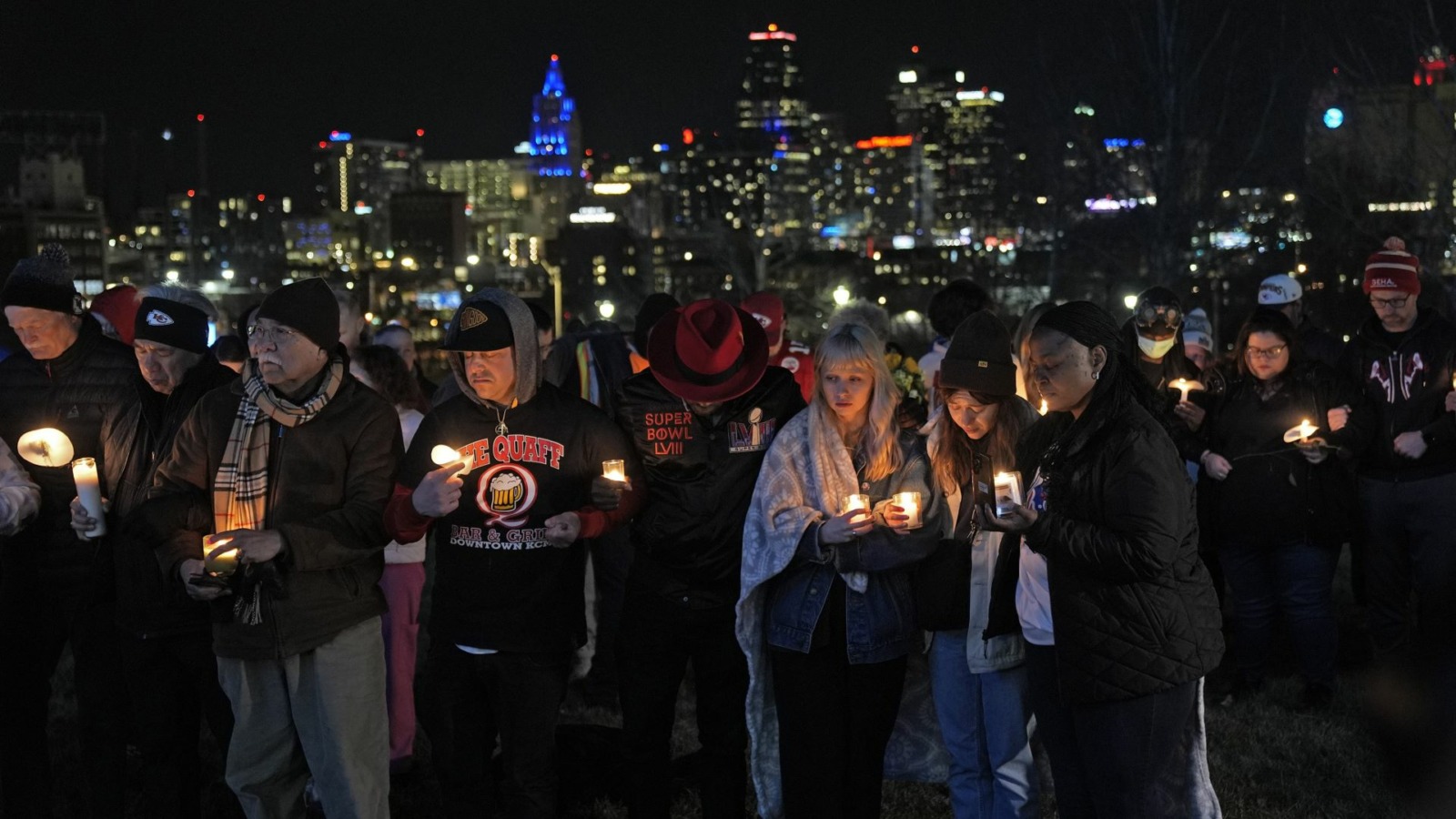
Experts say returning to routine activities is important for children traumatized by the mass shooting at the Kansas City Chiefs Super Bowl parade.

AgrAbility Helps Folks of All Abilities to Farm
After a life-altering car crash, Carey Portell's persistence, willingness to adapt and support from Missouri AgrAbility helped her succeed as a cattle farmer.