
Patients Prescribe Best Practices for KC Health Care Providers
February 13, 2013 | | 4 min read
Before nationally renowned public health and health literacy researcher Ruth M. Parker, M.D. began her keynote presentation at the Health Literacy Conference, co-hosted by the Health Care Foundation of Greater Kansas City, Health Literacy Missouri and the Center for Health Policy at the University of Missouri, on Feb. 12, 2013, she thanked the “expert” panel that preceded her.
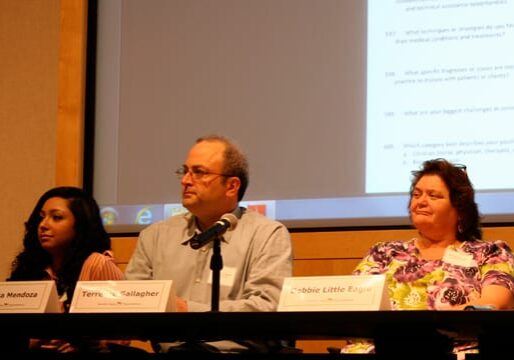
These experts were five Kansas Citians, who have spent a lot of time navigating the health care system because of complex medical situations. From a father advocating for his 13 year-old daughter, who is unable to speak because of a rare genetic disorder, to a woman trying to juggle treatment for herself as well as care for her husband and aging father, the panel featured a diverse range of experiences.
The panel, moderated by KCPT’s Nick Haines, shared what has and hasn’t worked, when it comes to engaging with health care providers and becoming more health literate.
“I think it was excellent having the perspective initially of the panel of patients and clients to see and to hear from their perspective exactly what they think is needed to make things more understandable for them,” said Teresa Tunstill, a nurse and health educator at Clay County Public Health Center. “Most clients want to be engaged in their health care. If not, they wouldn’t come and seek health care. They made it easy to understand that we’re not engaging them in the correct ways.”
Health literacy, or how well a patient can receive and understand basic health information and services, has become a central focus for many health care providers after the passage of the Affordable Care Act.
“The ACA stresses the importance of patient engagement and in some instances requires providers to document how they educate and equip patients for better self-management of their conditions,” said Rhonda Holman, Vice President of HCFGKC. “New penalties for excessive hospital readmissions are an example of the way that the new law demands better outcomes from our health care system. Getting better results will require providers to do a better job of actively engaging us in our health care, which in some instances will mean making it easier for us to navigate the health care system and to understand what we’re to do for ourselves once we leave the doctor’s office or hospital.”
Essentially, a patient who doesn’t understand his medical condition or treatment has higher health care costs and higher health risks. According to Health Literacy Missouri’s website, “Almost 9 in 10 adults struggle to understand and use health information.”
A 2009 study from the Center for Health Policy at the University of Missouri, estimated the costs of poor health literacy in Missouri to be $3.3 billion to $7.5 billion each year.
“Most people in our country cannot understand the health information that they need in order to take care of their health,” Dr. Parker said during her keynote address.
But Parker doesn’t put the onus solely on patients to master the intricacies of the health care system.
“We all support making people’s skills and abilities better, support education and trying to help people understand and teach them,” Parker said. “But what can we do to make what it is you need to know, more understandable, more navigable, more doable, more health literate? The work now is more for those of us who work in health and medical care to say how health literate are we?”
According to the statistics and individual stories, Parker cited in her presentation the answer to that question seems to be: not very.
Parker, however, applauds the efforts toward health literacy that are being made in Kansas City.
“[The HCFGKC] is partnering with patient experts from the beginning and what looks like a broad and comprehensive coalition to figure out what they can do, where,” Parker said. “We all look forward to seeing where it goes.”
The Health Literacy Conference served as the launch of HCFGKC’s Health Literacy Initiative, which includes grant opportunities for health care providers.

Reading these stories is free, but telling them is not. Start your monthly gift now to support Flatland’s community-focused reporting.

Related Stories

Nick’s Picks | Roads, Bathrooms, Costco and More …
New Toll Road Opens Kansas City’s first toll road opens this week. Starting Saturday, you’ll pay up to $3.50 to travel the new express lanes on U.S. Highway 69 from 103rd to 151st streets in Overland Park. There are no toll booths — cameras scan your license plate, and a bill arrives by mail. KTAG…

Up From the Ashes: Warwick Theatre Revival Draws Applause
Two years ago, John Cleary met a fellow Kansas City actor for drinks. Their conversation centered on the fate of the Metropolitan Ensemble Theatre. A large portion of the ensemble’s home, the Warwick Theatre, was ash, charred timbers and soot-saturated costumes and props — remnants from a recent massive fire. The destruction was so great…

Nick’s Picks | Baseball, Drones, Romance and More …
Royals Reveal Next week, the Kansas City Royals head to Arizona for Spring Training. And that’s the mayor’s self-imposed deadline to lock in a stadium deal. So, is this finally the week owner John Sherman steps to the plate and unveils where the Royals will build their next home? At last week’s council meeting, Mayor…