
Sponsored Post: Booming Nashville Skyline Offers Lessons for Downtown Kansas City
July 22, 2019 | Kevin Collison | 6 min read
Editor’s note: In April, the Downtown Council invited CityScene KC to attend an Urban Land Institute Conference in Nashville, Tennessee with a leadership delegation from the Council.
They had heard downtown Nashville’s speculative office development market was robust, and wanted to learn the reasons why and determine if there were any lessons for Kansas City.
To that strategic end, we met with a range of local and national developers, city economic development and Chamber of Commerce leadership. The following post was commissioned and sponsored by the Downtown Council based on our visit.
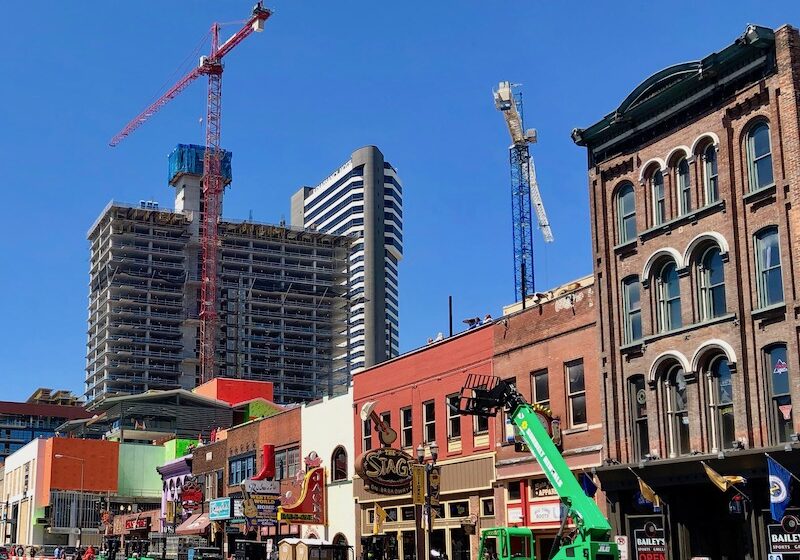
Downtown Nashville is strumming on all six strings these days with dozens of tower cranes across its skyline, a construction boom with lessons for Kansas City as civic leaders seek to add office space to our downtown mix.
It wasn’t always that harmonious in the Music City.
Nashville’s downtown was a sleepy and sometime seedy place in the late 1980s and early 1990s, left behind by the urban renaissance occurring in other Southern cities such as Atlanta and Charlotte.
There were no people living downtown–the city’s zoning laws at the time prevented it–and most office development was in Cool Springs, a big suburban office area similar to Corporate Woods in Overland Park.
Even the famed downtown honky-tonk live music district along Lower Broadway was tarnished with strip clubs and other unsavory businesses.
It was a 1989 Wall Street Journal article that omitted Nashville from the rising cities of the South that prompted leading local bankers to question downtown’s stagnation, according to Ralph Schultz, CEO of the Greater Nashville Chamber of Commerce.
Those bankers pushed the Chamber leadership to step up its economic development game, launching what has become a series of five-year plans that set specific goals and metrics to measure achievements.

Recent additions to the Nashville skyline are an impressive backdrop at a rooftop bar.
That civic initiative combined with the 1991 election of a dynamic mayor, Phil Bredesen, launched the city on the upward path that’s clearly visible today.
Bredesen sought to revive downtown Nashville with iconic amenity investments he called “civic furniture.”
“Mayor Bredesen focused on civic furniture and helping with incentives,” Schultz said. “The bankers brought focus on planning and economic development.”
It helped immensely that an earlier civic reform had dealt Bredesen a strong hand to run local government. In 1962, Nashville became the first city in the country to merge with its surrounding county, Davidson.
The merger created a Metro Nashville government that gave the mayor executive powers to run the city and veto power over the 40-member Council. The combined city-county had 627,000 residents in 2010, 39.2 percent of the greater metropolitan area’s population.
The city also is fortunate to be the state capital of Tennessee and home to major universities that draw thousands of talented, young people to Nashville including Vanderbilt, Middle Tennessee State and Belmont.
Bredesen’s emphasis was bringing major professional sports to Nashville. He championed the arena that became home to the NHL Predators, and helped the city land the NFL franchise that became the Tennessee Titans.
“The two pro teams put us on a list we weren’t before,” Schultz said. “Companies began thinking maybe this is a market we had not been aware of.”

The 1200 Broadway apartment tower is part of a boom in residential construction in downtown Nashville.
Both pro teams play in downtown venues that boost the entertainment district. Other big “civic furniture” investments that helped galvanize downtown were the new Music City Convention Center and the Country Music Hall of Fame.
Bredesen also cleaned up the honky-tonk strip while retaining the dozens of top quality country live music clubs that made it famous. The three-block district draws 14 million visitors annually.
“All our major amenities were built in the urban core,” Jay Turner of Market Street Enterprise told a recent national meeting of the Urban Land Institute in Nashville. “That was by design to attract people downtown.”
Currently, 12,000 people live downtown and 72,000 work there. The longterm goal is for 40,000 residents and downtown is expected to grow to 95,000 employees in six years, according to Tom Turner, president and CEO of the Nashville Downtown Partnership.
The downtown office market has 9.5 million square feet of premier space with a 7.3 percent vacancy. Another 2.4 million square feet of office projects and 4,000 new apartments are in the pipeline.
Employers want to be downtown, absorbing 1 million square feet of office space annually, according to stats from CBRE, a national real estate firm.

The $500 million Fifth and Broadway mixed use development will include office, apartments, retail and a new home for the National Museum of African-American Music.
By comparison, downtown Kansas City has a five-year annual absorption rate of 361,000 square feet.
Nashville’s higher demand has boosted rents significantly higher than downtown Kansas City for office and residential space.
Rents for premium downtown office space in Nashville go for $32- to $33 per square foot vs $21 in downtown Kansas City. Rents in new apartment buildings are up to $3.25 per square foot vs $2.50 here.
And every day, an estimated 60- to 70 people move to Music City, many of them pursuing a dream in the creative field.
“We’re now getting great national press about Nashville,” Schultz said.
“The ‘It’ city has a nice ring to it, but truth is the mayor who brought the stadium and arena, and worked on downtown furniture had the greatest influence.”
Attorney Jerry Riffel, chairman of the Downtown Council board, said Nashville’s impressive downtown revival offers lessons for Kansas City.
“Nashville is an impressive example of urban recovery and growth,” he said. “Kansas City has done as good of job, maybe better, investing in the civic furniture.
“The table is set, our urban environment is exciting and we now need to focus on jobs, Class A office space and a better job or replacing and expanding our affordable housing supply.
“We have a new mayor and City Council and the time is ripe to establish a new exciting path of progress.”
Next Monday: When Amazon Came Calling, Downtown Nashville was Ready

Reading these stories is free, but telling them is not. Start your monthly gift now to support Flatland’s community-focused reporting.
Related Stories
Nick’s Picks | Roads, Bathrooms, Costco and More …
New Toll Road Opens Kansas City’s first toll road opens this week. Starting Saturday, you’ll pay up to $3.50 to travel the new express lanes on U.S. Highway 69 from 103rd to 151st streets in Overland Park. There are no toll booths — cameras scan your license plate, and a bill arrives by mail. KTAG…
Up From the Ashes: Warwick Theatre Revival Draws Applause
Two years ago, John Cleary met a fellow Kansas City actor for drinks. Their conversation centered on the fate of the Metropolitan Ensemble Theatre. A large portion of the ensemble’s home, the Warwick Theatre, was ash, charred timbers and soot-saturated costumes and props — remnants from a recent massive fire. The destruction was so great…
Nick’s Picks | Baseball, Drones, Romance and More …
Royals Reveal Next week, the Kansas City Royals head to Arizona for Spring Training. And that’s the mayor’s self-imposed deadline to lock in a stadium deal. So, is this finally the week owner John Sherman steps to the plate and unveils where the Royals will build their next home? At last week’s council meeting, Mayor…