
Beliefs Ease Strain of Rime Buddhist Center Financial Struggles
March 31, 2019 | Bill Tammeus | 5 min read
In early March, the winter-brown grass on the vacant lot at the northwest corner of 30th Street and Highland in Kansas City reflected the harsh winter weather that pummeled the city for several months.
It looked beaten, exhausted, almost breathless.
But this land is where the Rime (pronounced REE-may) Buddhist Center has placed its long-term hopes. This is where, one day — maybe in 10, 15 or even 20 years — Lama Matthew Rice and Rime members imagine having their very own space.
It’s just that the road from here to there has financial potholes and potential detours. And yet Rice and his group, committed to practicing Tibetan Buddhism, are using Buddhist ideas to help them travel this bumpy journey. Which means they are recognizing life’s transience and remembering that the idea of attachment is far from a core Buddhist value. They are approaching all this, in other words, with a sense of calm, of equanimity, of peace.
“The Rime Center as an organization,” says Rice, “will continue in some form. It’s not the building, it’s the people.”
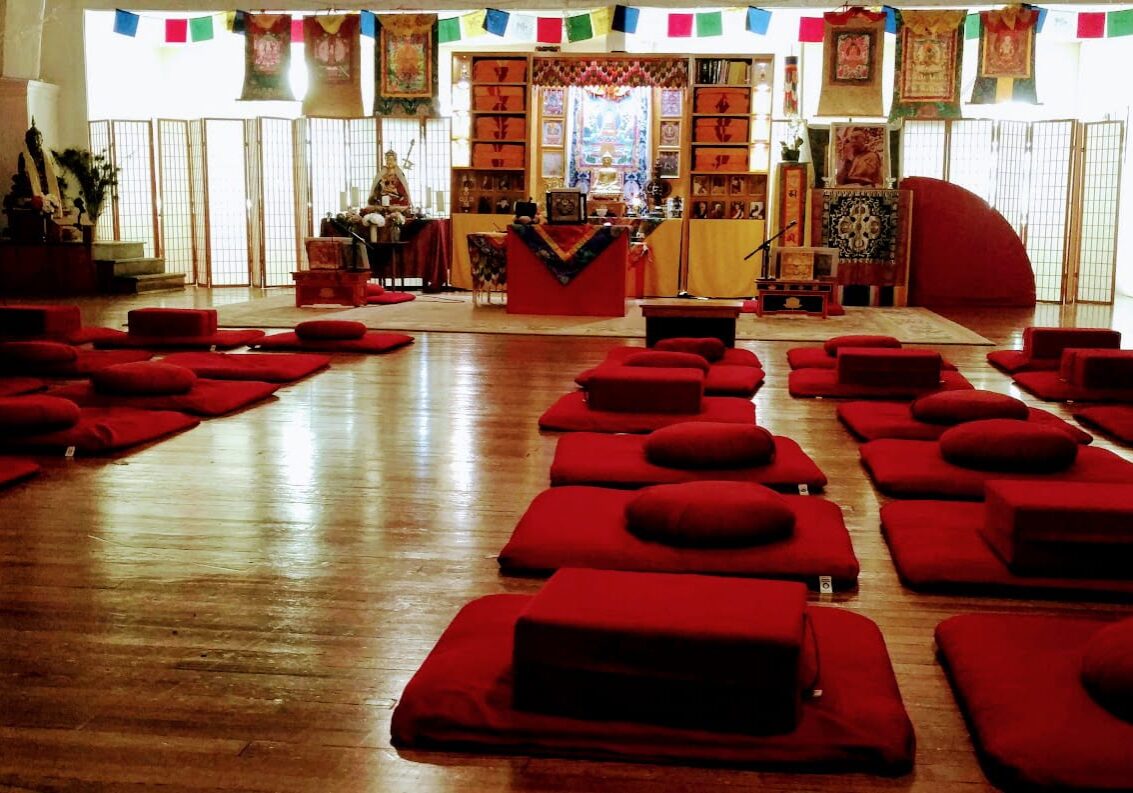
The center’s current building, at 700 W. Pennway St. on the western edge of downtown Kansas City, Missouri, costs the center thousands of dollars each month in rent and upkeep — and that total is more than has been coming in from members, gift shop sales, and fees for classes the center offers.
In fact, the center has been running a deficit for years, even though Rice receives no salary as its spiritual director. Rice supports himself by working for a company called Mosaic, a Lutheran non-profit that works with adults with intellectual disabilities. His job is to train people how to use computers.
A recent effort to get members to pledge more in monthly donations has brought the center closer to financial stability, but probably not close enough, Rice acknowledges. So he and other center leaders are weighing options, which include buying a vacant church in Kansas City, Kansas, or finding less-expensive rental property somewhere. And it’s a decision that needs to be made soon, before lease-renewal time comes in late summer.
No matter what choice is made, it means putting off the dream of building a new center on the recently acquired land at 30th and Highland. But the terms under which the Rime Center acquired that land last year from the Land Bank of Kansas City means it cannot sit idle more than a year.
So Rice and the Rime Center plan to construct a meditation garden there this spring. The idea is that it can be used by anyone and will be one way to beautify the neighborhood while the dream of building a new center there is deferred.
“Our attendance is in a lull right now,” Rice says. He thinks it has less to do with the Rime Center itself than with the fairly widespread societal trend of people not engaging as much in spiritual communities.
“We have a core group of active membership of about 135 or so,” he says. “For weekly attendance on Sundays, out of that 135, we probably have fortyish people who come regularly.”
Such numbers disappoint Rice a little and, as he told me recently while giving me a tour of the current center, it makes him a little sad that a move may be necessary. But his Buddhist spiritual training, he says, teaches him how to handle such troubles without getting unnecessarily worried.
As he says, he’s trained to remember the idea of “impermanence,” and that eases some of the stress from this project. Thinking of the Rime Center in its current location really brings up the notion of impermanence. “When we think about that, the attachment we have to some notion of what the Rime Center is, well, there’s a bit of freedom from that.”
Buddhism is a non-theistic tradition, meaning that it doesn’t propose a belief in God. Rather, it’s a spiritual practice based on the “Four Noble Truths” taught by Gautama Buddha, who lived about 2,600 years ago. Those truths teach people how to recognize and relieve suffering.
That clear-eyed approach to misery can help create an ability to focus not on desires but on the acceptance of reality. “Also,” Rice adds, “you plant the seeds and hope that they arise in a beneficial way. The other thing is not being attached to results and just being open, open-hearted.”
All of which means that Rice believes there will continue to be a Rime Buddhist Center, but how or where is uncertain. And that doesn’t stress him out. At least not in a debilitating way.
Bill Tammeus, a Presbyterian elder and former award-winning Faith columnist for The Kansas City Star, writes the daily “Faith Matters” blog for The Star’s website and columns for The Presbyterian Outlook and The National Catholic Reporter. His latest book is The Value of Doubt: Why Unanswered Questions, Not Unquestioned Answers, Build Faith. Email him at wtammeus@gmail.com.
Reading these stories is free, but telling them is not. Start your monthly gift now to support Flatland’s community-focused reporting.
Related Stories

Tackling the Scourge of Christian Nationalism
In recent decades, Christian Nationalism’s warped ideas have begun to attract the attention of scholars and teachers at universities and seminaries here in the Heartland. They’re trying to understand both its appeal and its dangers and to give students the tools necessary to make their own judgments about whether it’s good old basic Americanism or,…
Downtown KC Renaissance Seeds Congregations
As civic, commercial and residential life has blossomed in Kansas City’s Downtown in recent years, religious life has grown there, too. But that doesn’t mean it’s been easy for newly planted Downtown faith communities to flourish. “It’s been tougher in one sense than we thought it would be,” says the Rev. Troy Campbell, pastor of…
Taking ‘Bold Political Stances’ To Fight Injustices
It didn’t take long for the new Greater Kansas City Pastors Association to spring into action. As The Kansas City Star reported in early September, just one “day after thousands of people descended on the Missouri Capitol to demonstrate their outrage over congressional maps aimed at minimizing Kansas City’s voting power,” the new pastors’ group…