
Missouri Amendment 4: What to Know About the Kansas City Police Funding Ballot Question
July 8, 2024 | Celisa Calacal, KCUR 89.3 | 6 min read
When you look at your Aug. 6 Missouri ballot and see the same question about funding for the Kansas City Police Department as two years ago, that’s not a mistake. In April, the Missouri Supreme Court ordered the state to run the vote again.
Kansas City Mayor Quinton Lucas’s lawsuit challenging the police funding question prompted the court to throw out the results from November 2022 and order a new election for Aug. 6.
Here’s everything you need to know about the ballot measure:
Wait, why did the Missouri Supreme Court order a new election?
The court ruled that the fiscal note summary — the last paragraph people read before casting their vote — was so inaccurate and misleading to voters that it warrants a do-over.
The summary, prepared by the Missouri Auditor, stated that “state and local governmental entities estimate no additional costs or savings related to this proposal.”
But according to the court’s ruling, Kansas City officials told the auditor that the ballot item, which appeared as Amendment 4, would cost about $38.7 million per year, resulting in a “negative fiscal impact.”
Missourians did not see any of that information when they voted on Amendment 4 in 2022.
Following the court’s ruling, Missouri Gov. Mike Parson and Secretary of State Jay Ashcroft, both Republicans, ordered the new election for August. The court then affirmed that decision, despite Lucas asking the court to schedule the measure for November.
What does Amendment 4 say?
The ballot language reads:
“Shall the Missouri Constitution be amended to authorize laws, passed before December 31st, 2026, that increase minimum funding for a police force established by a state board of police commissioners to ensure such police force has additional resources to serve its communities?
This would authorize a law passed in 2022 increasing required funding by the City of Kansas City for police department requests from 20% of general revenue to 25%, an increase of $38,743,646, though the City previously provided that level of funding voluntarily. No other state or local governmental entities estimate costs or savings.”
The Missouri legislature passed a bill in 2022, which Parson then signed into law, that required Kansas City to increase its minimum funding of the KCPD from 20% to 25% of its general revenue.
But that law violated Missouri’s “Hancock Amendment,” which prohibits the state from mandating local actions without providing funding — which forced lawmakers to put the issue to voters first.
What happened when Amendment 4 was put on the ballot in 2022?
Voters approved the ballot measure 63% to 37%. Voters in the Kansas City portion of Jackson County rejected Amendment 4 by 61%.
The following year, Kansas City allocated $284.5 million to the KCPD, meeting that threshold. This year, the department received $320.8 million for the 2024-2025 fiscal year.
Why vote for Amendment 4?
Those in favor of Amendment 4 say the department needs a larger budget to perform its duties. Missouri Republican state Sen. Tony Luetkemeyer introduced the bill that led to Amendment 4. He said the previous mandate of 20% was not enough for the police department.
“The rising tide of crime in Kansas City is a bad thing for our city,” said Luetkemeyer, whose district includes Buchanan and Platte counties. “We need to make sure that we have a well-funded police force that has the resources it needs to keep our citizens safe.”
Why vote against Amendment 4?
Opponents say it’s unfair that the state of Missouri has a say in local policing decisions in Kansas City.
“To me, Amendment 4 is another side of trying to take that authority away from Kansas Citians,” Lucas said. “It is taking creative solutions away from Kansas Citians, one dollar at a time.”
Melesa Johnson, director of public safety with the mayor’s office, said the financial implications of Amendment 4 — about $38.7 million per year — would mean less money for other city services like fire, public works and health.
“It negatively impacts every single other city resource, city programs, city department, and city benefit that we provide to the citizens of Kansas City,” Johnson said.
Johnson said Kansas City should have a say in how the police department spends city money instead of signing a blank check. She said the city has never tried to defund the KCPD, and pointed out that this year, city officials went above the 25% mandate to give the department about 31% of general revenues.
“We decided to go above and beyond the call of duty, because we want our officers to have pay increases, we want them to be able to recruit and retain more officers,” she said. “But with this measure, it completely discredits our ability to have a greater say in not only how much the police department gets, but also how it’s spent.”
If Amendment 4 only applies to Kansas City, why is the whole state voting on it?
It’s because Kansas City is the only city in Missouri — and the only major city in the U.S. — that does not have local control of its police department.
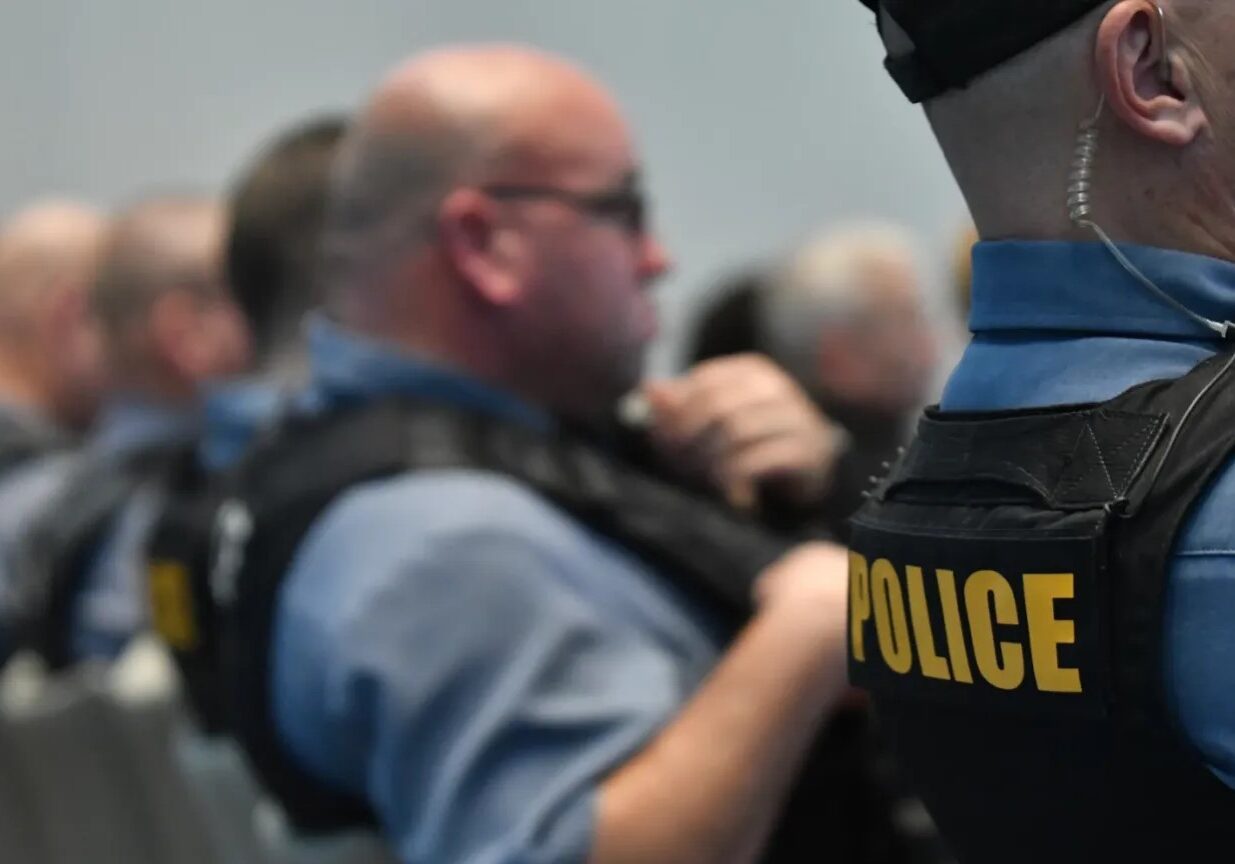
The KCPD is controlled by a Board of Police Commissioners. Four members are appointed by the Missouri governor, and the fifth member is the mayor of Kansas City.
State control has its roots in Missouri’s pro-slavery Civil War days. It means Kansas City’s elected officials cannot set department policy or discipline officers, and can only rubber stamp the department’s annual budget — often the largest of any city agency.
“What Amendment Four did was to suggest that we should not have the same rights that people in Reno have, the same rights that people in Oklahoma City have,” Lucas said. ”What I think is at stake in this election is really local control.”
St. Louis police were also under state control until 2012, when Missouri voted to return control to the city.
What else should I know?
The last day to register to vote in time for the August elections is July 10. You can check your voter registration here.
Celisa Calacal covers Missouri politics and government for KCUR 89.3, where this story first appeared. KCUR is a member of the KC Media Collective.

Reading these stories is free, but telling them is not. Start your monthly gift now to support Flatland’s community-focused reporting.
Related Stories

On the Ballot | Ranked-Choice Voting
Introduction On Tuesday voters will decide whether to change Missouri law to prohibit ranked-choice voting and change the language in the Missouri Constitution to say that “only” U.S. Citizens can vote rather than “all”. Ranked-choice voting allows voters to rank all the candidates in order of preference. The way it works: Transcript Nick Haines [Host,…
On the Ballot | Missouri Abortion Rights
Introduction Amendment 3 presents Missouri voters with the decision to overturn the state’s abortion ban and enshrine the right to an abortion in the state constitution. Its inclusion in Missouri’s November ballot is a direct result of a citizen-led campaign that gathered more than 380,000 signatures. If passed, Amendment 3 would overturn Missouri’s abortion ban,…
On the Ballot | Missouri’s Minimum Wage
Introduction Proposition A will appear on Missouri’s November ballot, asking voters to decide on raising the state’s minimum wage and implementing paid sick leave. If approved, the minimum wage would increase to $13.75 in 2025 and $15 in 2026, with annual adjustments based on inflation. The law would also require businesses to provide paid sick…