
KU Faculty, Students Go on Offense at Allen Fieldhouse Against Administration’s Budget Strategy
February 3, 2021 | Tim Carpenter, Kansas Reflector | 7 min read
LAWRENCE, Kan. — Faculty and students at the University of Kansas stood in shadows of Allen Fieldhouse to blow the whistle Tuesday night on the administration’s plan to deal with massive budget problems by shedding tenured professors from the payroll, undervaluing work of graduate teaching assistants and jettisoning degree programs.
Focus of the protest prior to the basketball showdown between the Kansas Jayhawks and Kansas State Wildcats was the personnel policy unanimously adopted in January by the Kansas Board of Regents. The higher education board granted six public universities in Kansas the option of relying on a temporary process to speed suspension or termination of employees, including tenured professors.
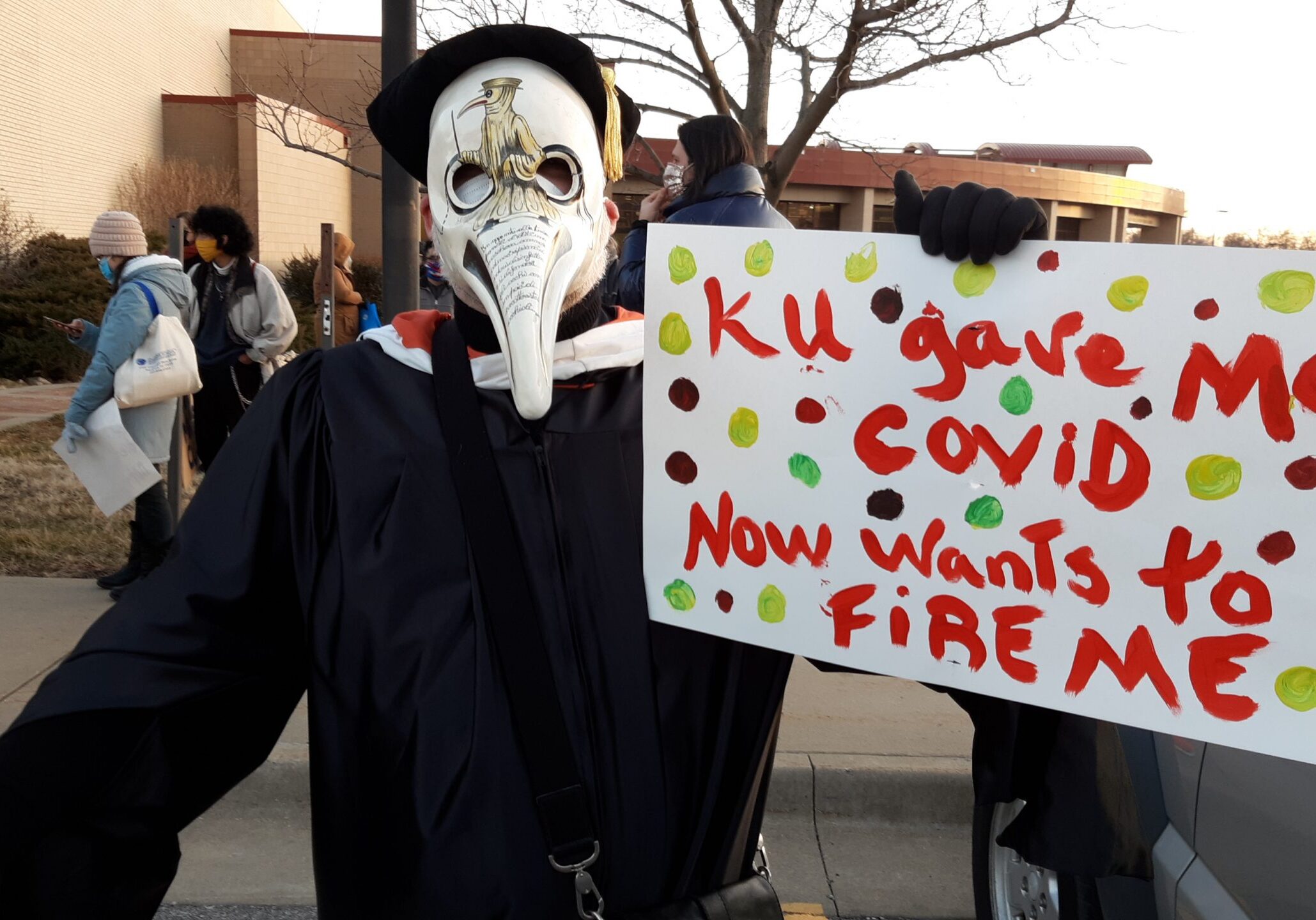
Gregory Cushman, an associate professor of environmental studies, joined the march and protest with a colorful sign: “KU gave me COVID, now wants to fire me.” It reflected his personal sacrifice as an educator during the pandemic as well as his opinion about the new personnel policy. He fears the result will be dismissal of faculty without respect to the knowledge and expertise those people bring to teaching and research at the university. He’s been at KU for 17 years and believes staffing reductions, if necessary, ought to be handled with longstanding policies.
“I got seriously ill with COVID teaching a class last semester,” said Cushman, who happened to be teaching a course on history of disease at the time. “I was sick for four months.”
The policy was inspired by recognition the state universities suffered revenue shortfalls during the COVID-19 pandemic and Gov. Laura Kelly recommended the 2021 Legislature slash expenditures on higher education. It’s unlikely the Republican-led House and Senate would reverse the Democratic governor by plowing more cash into KU, Kansas State and the other universities.

The faculty group OneKU demanded rejection of the “reckless and unprecedented” policy approved by the Board of Regents. It gives administrators too much of a free hand to terminate employees without regard for tenure or full due process protections, the organization said. Under previous rules, the university would have to demonstrate a financial exigency to engage in a downsizing blitz.
Elizabeth Esch, associate professor of American studies, and Araceli Masterson-Alga, associate professor of Spanish and Portuguese, said the objective of the protest while basketball fans waited in line outside the fieldhouse was to unite researchers, teachers and students opposed to the policy. They rallied under the slogan: “Let’s defend KU, not defund KU.”
“The crisis at KU was not created by students and their families, the faculty, the graduate students or the researchers who make this university, and it did not start with COVID-19,” the professors said in a joint statement. “We hope that the events this week will serve as a reminder to ourselves that we are a ‘whole,’ and that our communities are worth defending.”
KU chancellor Doug Girod and KU provost Barbara Bichelmeyer have said they wouldn’t rule out reliance during the next two years on the extraordinary Board of Regents policy and would develop the formal framework to accommodate the procedure. Their statements were viewed by some as insufficiently forceful compared to comments by administrators at other universities indicating there were no plans — at the moment — to deploy this alternative method for reducing staff.
Girod said budget challenges at KU were unprecedented and not unique to the Lawrence campus. He said the governor recommended a 5.3% cut to KU’s base state appropriation, which would equate to a $7.6 million in Lawrence and a $6 million at KU Medical Center. It would be the largest percentage clawback since 2010 and the biggest dollar retrenchment in university history, he said.

“KU faces a projected fiscal year 2022 shortfall of $74.6 million, which could worsen depending on state funding,” the chancellor said. “That will require us to eliminate programs and departments, reduce services, and implement furloughs and layoffs. While this will not be easy, it is unavoidable given the financial challenges facing KU and other universities across the country.”
Bichelmeyer said the staffing policy approved by the Board of Regents served to lay bare the severity of financial challenges confronting higher education. KU has offered piecemeal remedies to budget issues for more than a decade, she said. The pandemic added urgency to search for answers to declining student enrollments, shifting student expectations, rising operational costs, new instructional formats and demographic realities, the provost said.
She said the Board of Regents offered universities the policy tool because they were “concerned about our productivity, our relevance and even the value we provide. This is one way of challenging us to be as efficient and as effective as we can be in service to our state. I believe we are up to the challenge.”
“I want to be absolutely frank and honest with you all. As provost, I’m not yet inclined to say we will need the tool they provided, and I am ready to do the work necessary to avoid it, but I’m also not yet able to say we won’t need the tool,” Bichelmeyer said.
In a letter to employees, she said KU’s recent voluntary separation program for faculty and staff would save KU about $7 million dollars a year. A new travel system could save the university a few million dollars annually, she said. The reduction of course offerings and efficiencies in procurement will save KU significant money over time, she said.
A program officer with the American Association of University Professors responded to the Board of Regents’ creation of a new pathway to stripping faculty of tenure by concluding it could “eviscerate tenure at the institution and, along with it, the academic freedom and shared governance tenure is meant to protect.”
“While encouraged by news that five of the six state institutions do not plan to institute the regents’ policy, we are dismayed to hear that the administration of the University of Kansas does plan to do so,” said Mark Criley, the AAUP program officer.
Members of the Graduate Teaching Assistants Coalition, which is affiliated with American Federation of Teachers-Kansas Local 6403, stood in solidarity with the faculty. GTAC members also declared as insufficient the $17,500 annual wage for their part-time teaching jobs at KU.

Kelsey Carls, a doctoral student in women, gender and sexuality studies from San Diego, said negotiations on a new contract for teaching assistants wasn’t going well. The university’s negotiator proposed a two-year freeze on GTA compensation, she said.
“It’s untenable, unacceptable and insulting,” Carls said. “We teach something like 40% of the undergraduate courses here. KU works only because we do.”
Ellen Collier, a fourth-year doctoral student from Lawrence in the department of French, Francophone and Italian, placed a small image of the devious and wealthy Springfield Nuclear Power Plant owner Charles “Monty” Burns from “The Simpsons” on her poster with the line: “There is no greater disaster than greed.”
KU has chosen not to compensate graduate teaching assistants at the level commensurate with their status as essential workers at the university, she said.
“I want the university to prioritize us,” said Collier, who is treasuer of the GTA union. “We do so much for them. They need to appreciate us more.”
Tim Carpenter writes for the Kansas Reflector, a nonprofit news operation that covers Kansas state government and politics.
Reading these stories is free, but telling them is not. Start your monthly gift now to support Flatland’s community-focused reporting.
Related Stories

Meet the Kansas City Public Schools board candidates for the April 2025 election
This story was originally published by The Beacon, an online news outlet focused on local, in-depth journalism in the public interest. Meet the Kansas City Public Schools board candidates for the April 2025 election All seven candidates running for the Kansas City Public Schools board support the $474 million bond issue that’s also on the…
SCOTUS Justice Applauds KC Stage Adaption of Her Book
As the first Latina, and the third woman on the U.S. Supreme Court, Justice Sonia Sotomayor is noted for reasoned questioning and, at times, searing dissents. But legal opinions, despite obvious historical weight, aren’t the writings that Sotomayor referred to as her life’s work during her recent visit to Kansas City. The messaging within her…
Nick’s Picks: Election Day, College Hoops, COVID Battle and More …
Election Day or Election Week? It’s nearly time to say goodbye to all the political ads that have appeared during every commercial break for the past couple of months. Are you going to miss them? What about all the candidate robocalls blowing up your phone? Election Day is finally here on Tuesday. But if you’re…