
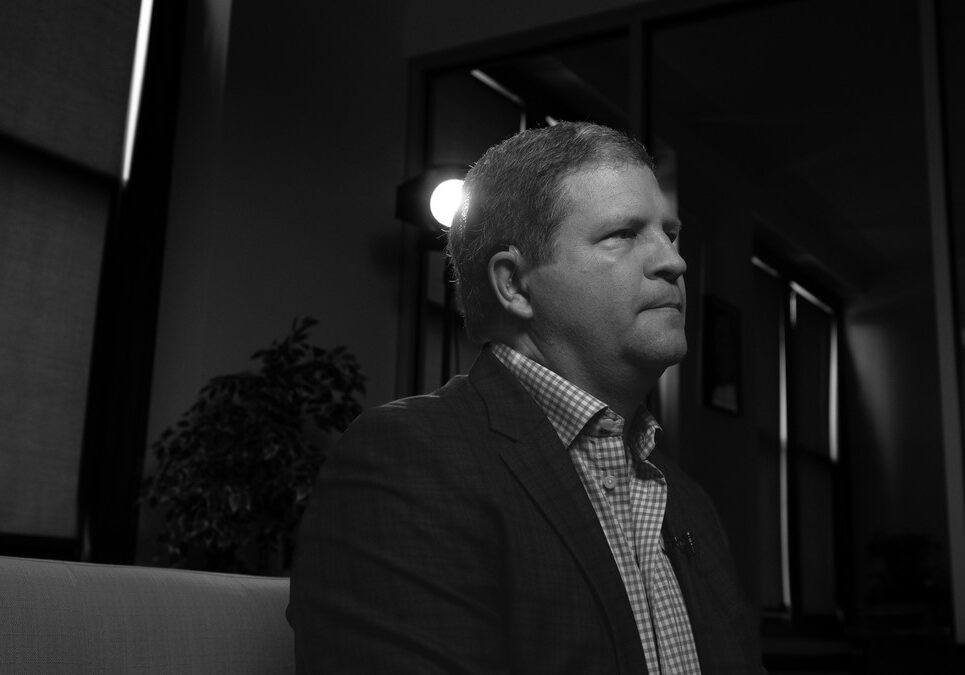
Hearing-Impaired Nonprofit Founder Aims to Remove Blinders from Corporate America
December 26, 2022 | Mike Sherry, John G. McGrath | 4 min read
A first-grade hearing test was an eye-opener for Jim Atwater.
He was already experiencing the progressive hearing loss that would lead to cochlear implants as an adult, but his teachers didn’t believe something was amiss.
“They thought I just wasn’t doing it,” said Atwater, 52. “So they made me sit there all day and test over and over again.”
That was Atwater’s first inkling that people with disabilities are treated differently, but he would experience far more consequential examples in early adulthood. Those snubs fueled the Leawood man’s passion for disrupting the established model for assisting underserved populations through his nonprofit, Aptly.
Changemakers: Jim Atwater
One affront involved a college Latin professor who refused to accommodate Atwater’s hearing difficulties. Atwater failed the class, and the stress of the experience led him to transfer schools.
Then, in his mid-20s, medical school admissions staff shattered his dream of becoming a doctor when they told him that older physicians would not repeat themselves for him during his training. That determination negated his prerequisite work at Johnson County Community College, his admission test performance, and his excellent admissions interview.
The medical school experience “is one of the biggest tiebacks to Aptly,” he said. “As a person, as a family, all my parents put into this education and all that I did … and all the people that spent time helping me — for nothing.”
For Atwater, his experience serves as just one example of how an entire field or industry can miss out on an entire workforce that can solve big problems, simply because executives have not taken the time to understand a particular population.
What Atwater is building through Aptly is a comprehensive database of individuals and families from any number of underserved populations, including people with disabilities and recently released prison inmates.
Aptly is designed to serve businesses, providing not only access to a vast labor pool, but also a direct connection to potential customers they might have missed otherwise. The Toronto-based data-insights firm, Return on Disability Group, estimates that the worldwide disability market has $1.9 trillion in disposable income.
Rather than working with a handful of nonprofit organizations to achieve social-benefit goals, Atwater said, Aptly makes all those nonprofit services and resources available to businesses in one place. More importantly, he said, Aptly includes individuals and families that might be missed because they are not part of an established nonprofit program.
Also, Atwater said, the information included in Aptly establishes the credentials of potential employees to guard against underemployment. Why place someone with autism in a menial role, Atwater asked, when their art skills make them perfectly qualified for a design position?
Earlier this year, the U.S. Bureau of Labor Statistics reported a 2021 employment rate of 19.1% for persons with disabilities compared with 63.7% for persons without disabilities.
In short, Aptly is all about giving a hand up, not a handout.
Atwater’s career took him to American Century Investments, where he built websites and worked across departments in process improvement. He left after 16 years to begin an entrepreneurial path that has led to Aptly and a sister for-profit company.
But the medical school rejection still stings, especially since his interests intersected with a high-priority need.
“I had just come back from spending a summer working on a ranch in Colorado, and I wanted to be a rural doctor, and I committed to that program during the application process,” Atwater said. “And so again, here is somebody right in front of them … and they just ignored it.”
Mike Sherry is a former editor and writer for Flatland. He is now a communications consultant for nonprofits and freelance writer. John McGrath is a video producer for Kansas City PBS.
Reading these stories is free, but telling them is not. Start your monthly gift now to support Flatland’s community-focused reporting.

Related Stories
Ferguson, Missouri, Experience Inspires Marketer to be ‘Incubator’ for Creatives
Daniel Gilmore plans to start a nonprofit marketing agency, Chosen Creative Concepts, to link people of color with a network of resources and opportunities.
Former Inmate Serves as ‘Voice on the Outside’ for Women Prisoners
Mary Taylor’s life took unexpected turns on the path that would lead her to be founder of the nonprofit 3 Quarters of the Way Done.
KCK Sports, Education Nonprofit Embodies Passion of its Co-Founder
Adrion Roberson has stopped coaching youth football after more than three decades. But even after leaving the sidelines, he remains driven to transform the lives of his players and their parents.