
Holding her daughter Ravaira close to her, Lajua Manning smiles as she looks out the window. A full-time student training to be a registered nurse, Manning, also a full-time mom, has worked full-time as a certified nursing assistant for five years. She says the juggle may be the hardest thing she has ever done.
But there’s light at the end of the tunnel. Manning graduates in May, and can expect a higher salary in future employment.
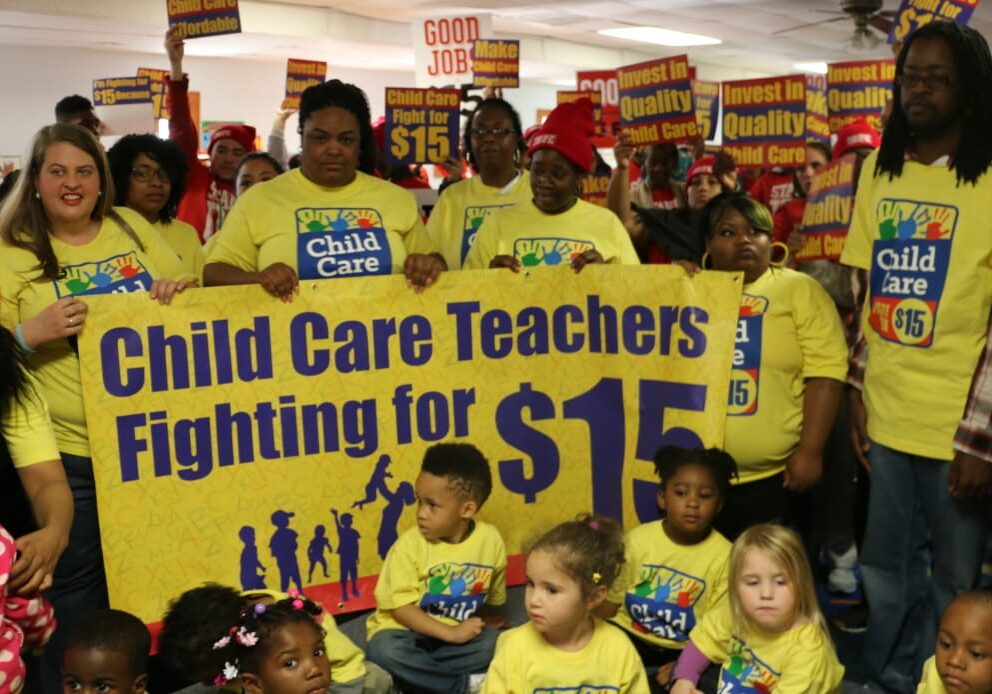
Still, Manning showed up this past Tuesday to deliver a passionate speech at Stand Up KC’s most recent Fight for 15 protest to a large group of supporters.
“Everyone who works hard deserves to be paid a livable wage, regardless,” Manning told the group at the Ubuntu Academy on Troost Avenue. “It’s important for me to be here, to stand together and be unified, because I know exactly what these people are going through.”
Home health care providers and child-care workers are the latest industry to join fast-food workers and hotel employees seeking $15 an hour, an amount they claim is a “livable wage.” Stand Up KC’s rally Tuesday was the first in a series of protests aimed at uniting the industry around the cause.
“Everyday we (home health-care providers) take care of people’s loved ones. We take care of the sick, we take care of the dying, we comfort the families of our patients. We work so hard, and we deserve to be paid enough to survive,” Manning says. “We can’t afford child care, we can’t afford health care, and we are the ones who are caring for others,” she said.
“Somedays, I go hungry just to make sure my daughter has enough to eat,” Manning told Flatland.
[FLEX-CONTENT]
That statement, as hard as it may be to grasp, comes on the heels of a new report from the Economic Policy Institute (EPI) entitled “Child Care Workers Aren’t Paid Enough To Make Ends Meet.” The report concludes that the chid-care industry is among the nation’s lowest paid, with an average of $10.31 per-hour. That’s 39.3 percent below the $17 median hourly wage of workers in other occupations.
Workers in the child-care industry rarely receive benefits, pensions or overtime pay.
But changes could be on the way.
On Monday, California made news as its Department of Social Services announced it will now pay over-time wages to home care workers, starting in February.
If this is a sign of changes to come for the industry, it’s been a long time coming. Since 1974, federal law has exempted home care workers hired via staffing companies from overtime and minimum-wage pay, according to the Associated Press.
Kimmy DeVries is a child-care worker who has spent the past three years in the industry. She’s a graduate of Calvin College in Grand Rapids, Michigan, and is $90,000 in debt from college loans. She described her struggles to the gathering on Tuesday, saying $15-an-hour wage would change her life.
[FLEX-CONTENT]
[FLEX-CONTENT]
Lisa Miller, who, when asked her age, laughs and says she is “older,” has worked in the fast-food, hotel, and home health-care industries for the past 30 years. Having spent decades in low-wage jobs, Miller says now she is looking to local government for support.
[FLEX-CONTENT]
[FLEX-CONTENT]
In July, Flatland producers visited Lajua Manning and her daughter at home, and they were featured in this video.
See more stories on disparity and “Getting By” from KCPT and the Hale Center for Journalism, at kcpt.org/gettingby.
Reading these stories is free, but telling them is not. Start your monthly gift now to support Flatland’s community-focused reporting.

Related Stories

Getting By In Retirement
Patricia Corry, 79 “Whatever is coming down the pike, is coming down the pike” [FLEX-CONTENT] Originally from Canada, Patricia lived in Texas before moving to Kansas City. A self-described “fatalist and eternal optimist,” Patricia tries to take retirement day by day. She spends part of her time working for Reconciliation Services. Hear Patricia’s story: …

Upside Down-Land: Bitter Harvest
As Cerner and other businesses use TIF to ensure their growth, Kansas and Missouri keep squeezing their poorest citizens.

Upside Down-Land: Cerner's TIF Transplant
Neal Patterson personifies 21st-century Kansas City entrepreneurialism. He is his generation’s Henry Bloch or Joyce Hall, the head of a company he started from nothing — Cerner Corporation — and made KC’s most prosperous business. Cerner, a health-information technology firm, makes more than $3 billion a year. The company’s market capitalization — the value of…