
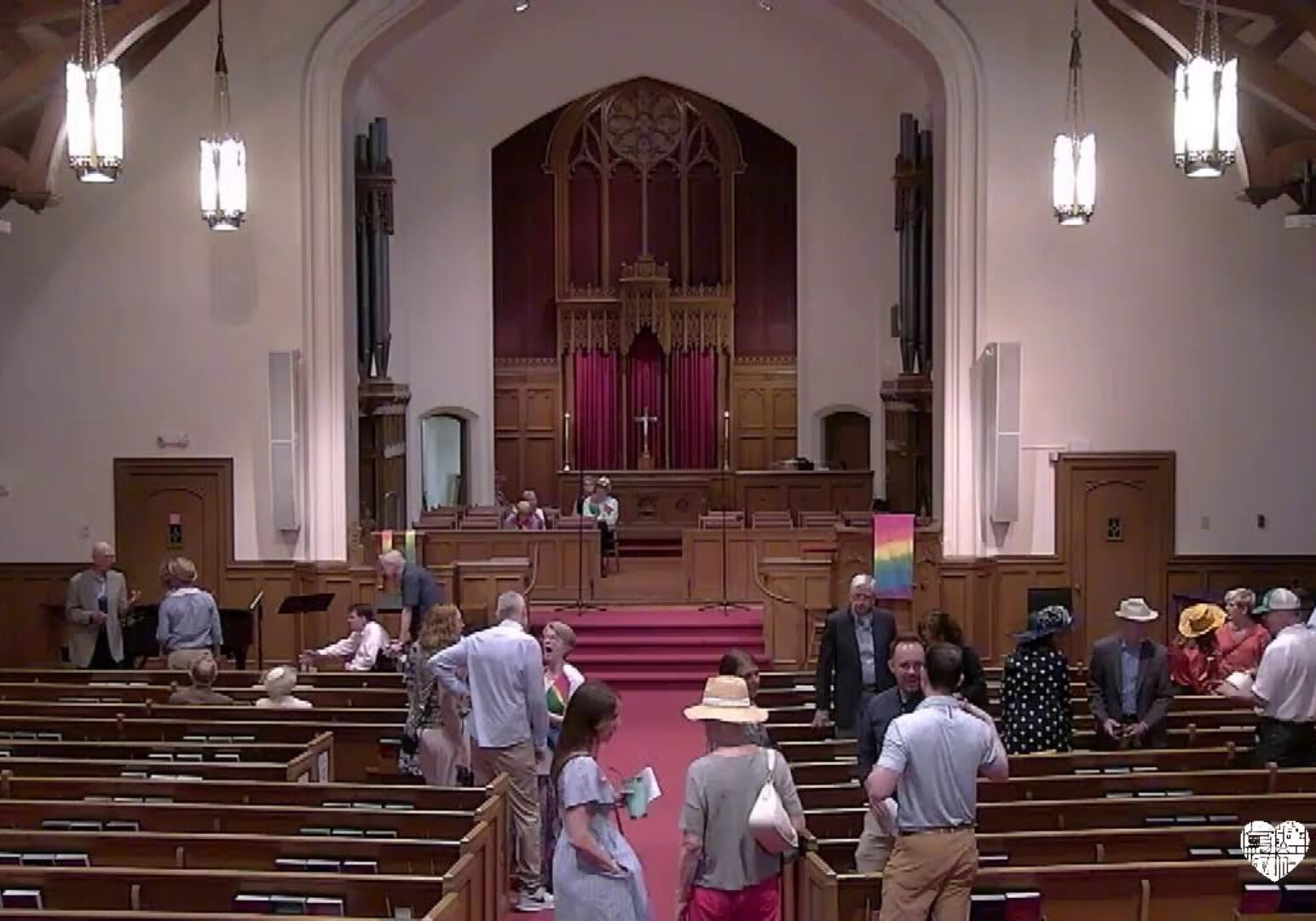
The new senior pastor whom my congregation, Second Presbyterian Church, will welcome to the pulpit this weekend brings with her a family legacy that may seem unusual.
The Rev. Sarah Are Speed is not simply the daughter of Carol and the Rev. Tom Are, former senior pastor at Village Presbyterian Church in Prairie Village, she’s part of the seventh generation of pastors from her family.

In fact, her parents were both preachers’ kids, and they met in seminary.
Seven generations of clergy in one family is a bit unusual but it turns out that a surprising number of ordained leaders come from families in which being in the professional ministry seems more like the family business.
Consider, for instance, the Rev. Brad Bryan, pastor of Keystone United Methodist Church in Kansas City:
“My brother and I are seventh-generation Methodist clergy,” he says, “making me the eighth in succession, on my father’s side. My great-grandfather was a Methodist pastor who married a preacher’s daughter and the line continues from there.
“My dad, Rev. Jim Bryan, was my pastor for 18 years in Osage Beach, Warsaw, Springfield, and Columbia (Missouri). My grandfather, Bishop Monk Bryan, retired as bishop of Nebraska the year I was born. His father, Rev. Gideon J. Bryan, served mostly in Texas.”
But even famous clergy—Martin Luther King Jr. and Sr., Billy Graham and his son Franklin, Emanuel Cleaver II and III, and Joel Osteen and his father John—have nothing on Bryan or Sarah Speed when it comes to family legacy.
“For our part,” says Bryan, “our father played the contrarian. He told us flat out not to become pastors — that if there was anything else we were remotely interested in, we should do that.
“Of course, now I understand that he was distancing himself from our own process of discernment, making sure that any perceived expectation of continuing some family legacy wasn’t coming from him. My mother, a physical therapist, played a critical and equal role in me finding this purpose and becoming who I am today.”
Rabbi Mark Levin, founding rabbi of Congregation Beth Torah, says that famed Rabbi Jakob Josef Petuchowski (1925-1991) “claimed that his family produced a rabbi every other generation,” and maybe more often, given that Petuchowski’s son Aaron also became a rabbi.
But does being part of a long line of clergy have benefits? Depends on whom you ask.
Rabbi Jacques Cukierkorn of Temple Israel of Greater Kansas City says, “I descend from a long line of rabbis in Poland as well as quite famous Hassidic rebbes. That and 99 cents buys you a Coke at McDonald’s.”
But Bryan has a different take:
“I think what this line of generational ministry has given me is an intimate, experiential understanding of clergy life. The schedule, the demands, the balance of work life and home life, living a little bit in the public eye, open and available for scrutiny and criticism. I knew all that stuff going in. I had lived it already, from the other side.

“Many clergy persons have to spend a good deal of time figuring out the way of life itself because it is a unique situation. I came in prepared for the imbalances and politics and landmines, and that has been advantageous.”
Speed, too, says she benefitted from a family full of pastors: When she was a child, she says, “the church was often the topic of dinner table conversation. . . Through these conversations I not only witnessed a deep faith and love for the church in my parents, aunts, uncles and grandparents but I also benefited from countless leadership lessons.”
When you think about how families get created, you might imagine that there wouldn’t be many, if any, examples of families with generations of Catholic clergy. And while that’s mostly true, there are examples in which being spiritual leaders tends to run in Catholic families.
For instance, the Rev. Paul Turner, pastor of the Cathedral of the Immaculate Conception in downtown Kansas City, tells me this: “In four generations of my family, I am one of 17 priests and nuns. Quite remarkable, especially when you consider that none of us is the parent of another in the group.”
For the last several years I’ve served on a national team that produces two adult Sunday school lessons each week based on news stories. It’s called The Wired Word, and the team is made up of both clergy and lay people.
When I asked clergy team members if they, too, were part of a family with generations of clergy, our Ohio-based team leader, the Rev. Stan Purdum, replied: “I am a fifth-generation pastor. My father and mother were officers (clergy) in the Salvation Army. Later they switched to the United Methodist Church. My paternal grandparents were S.A. officers as well and my great-grandparents were S.A. officers in Canada.” Beyond that, he said, “My great-great-grandfather was a lay pastor in the Primitive Methodist Church in England. His weekday job was as a shepherd.”
Team member Rev. Joanna Loucky-Ramsey of upstate New York reported this: “My mother was a missionary to children in the deep South and American Southwest and then in Czechoslovakia. She put her younger sister through Bible school, after which she served as a missionary-educator in India for three or four decades. Two of their brothers (my uncles) were pastors, one in the Christian and Missionary Alliance tradition and the other in the United Methodist Church.” Beyond that, Joanna’s husband Bill also is ordained to ministry, but he’s spent most of his career as a contractor.
Most clergy members I know would say that a family connection to the profession is not why they became ordained. Rather, they had to feel what some faith traditions describe as a “calling” (presumably by God) to ministry, regardless of family history.
Bryan says that calling is an “internal need, an emotional and spiritual experience that this is ‘what I am supposed to do.’ This was my experience. I was, probably, more susceptible to a call to ministry than someone without my experience. But I was still called. Eventually, I found that I could not not answer the call. I tried. It didn’t work.”
I’m looking forward to hearing more from Sarah Speed about her own sense of call to ministry. I just hope she’s not disappointed to find she’s not the only seventh-generation pastor in town.

Reading these stories is free, but telling them is not. Start your monthly gift now to support Flatland’s community-focused reporting.
Related Stories
Nick’s Picks | Roads, Bathrooms, Costco and More …
New Toll Road Opens Kansas City’s first toll road opens this week. Starting Saturday, you’ll pay up to $3.50 to travel the new express lanes on U.S. Highway 69 from 103rd to 151st streets in Overland Park. There are no toll booths — cameras scan your license plate, and a bill arrives by mail. KTAG…
Up From the Ashes: Warwick Theatre Revival Draws Applause
Two years ago, John Cleary met a fellow Kansas City actor for drinks. Their conversation centered on the fate of the Metropolitan Ensemble Theatre. A large portion of the ensemble’s home, the Warwick Theatre, was ash, charred timbers and soot-saturated costumes and props — remnants from a recent massive fire. The destruction was so great…
Nick’s Picks | Baseball, Drones, Romance and More …
Royals Reveal Next week, the Kansas City Royals head to Arizona for Spring Training. And that’s the mayor’s self-imposed deadline to lock in a stadium deal. So, is this finally the week owner John Sherman steps to the plate and unveils where the Royals will build their next home? At last week’s council meeting, Mayor…