
More Than Mail: A Brief History of Kansas City Post Offices
July 22, 2020 | | 5 min read
What makes a post office?
If you’ve ever sent mail in Kansas City, you might have noticed not all post offices in the area are created equal.
To figure out why some are so beautiful and others are purely functional requires digging through more than a century of history. The story of Kansas City’s post offices spans the City Beautiful Movement, World War II and some forgotten local architects.
Here is their story.
City Beautiful Movement
What does Chicago have to do with Kansas City’s largest post office? More than you might think.
In 1893, Chicago hosted the World’s Columbian Exposition to mark the 400th anniversary of Christopher Columbus’ voyage in 1492. A group of famous American architects gathered to create buildings for the fair, designed in a neoclassical style that would soon sweep across the nation.
Attendees of the fair were inspired by the beauty they saw at the exposition and decided to bring it to their own communities. Thus was born the City Beautiful Movement, which encouraged the use of grand European architecture and emphasized the need for beauty in urban planning.
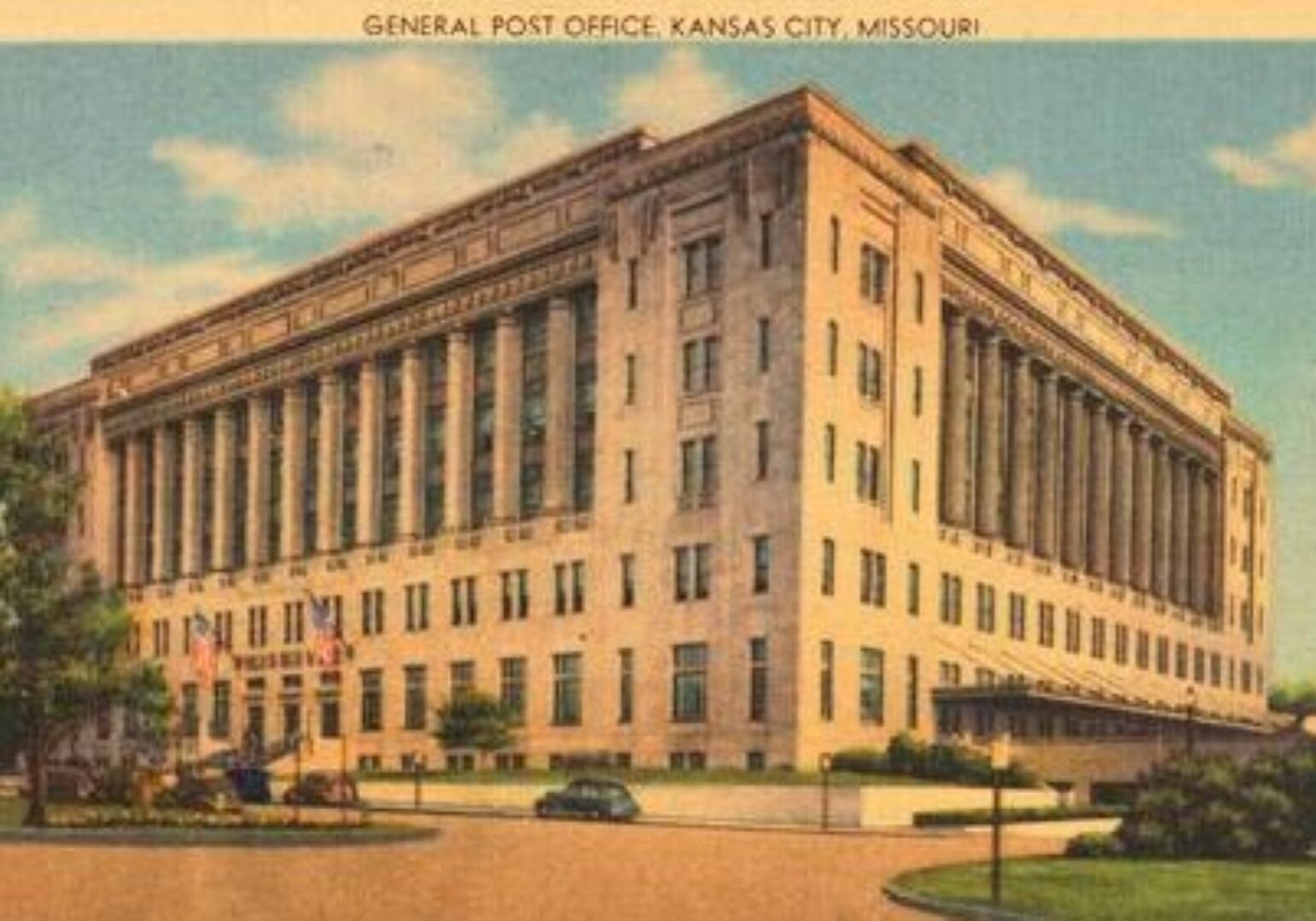
Now fast forward to Kansas City in 1930. After more than a decade of planning, construction of a new post office building was finally underway at 315 W. Pershing Road, across the street from Union Station. The $3 million project became a monument to the state of mail delivery. By 1936, according to a form seeking to register the office as a historic place, the facility was ranked as the third busiest in the country.
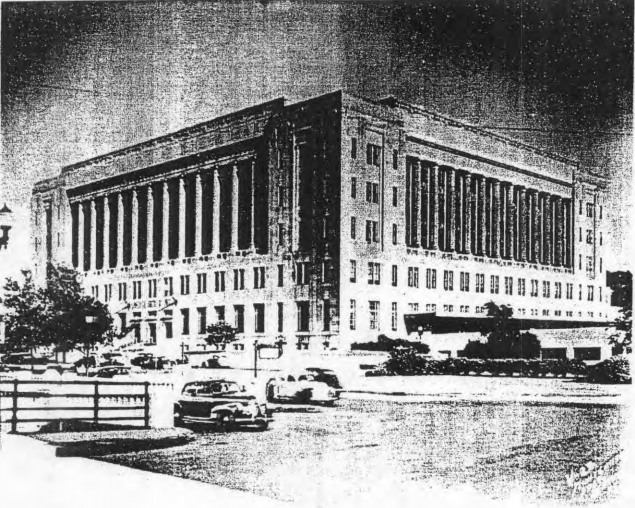
Built in line with neoclassical ideals, massive columns adorned both the front and back of the building, and rectangular windows decorated the exterior. It was designed to be just as impressive inside — a skylight spoke to the desire for a post office that’s much more than a merely utilitarian space.
Post-war architecture
By the end of World War II, architectural expectations changed. Reconstruction in the wake of the Great Depression and a long war was sorely needed, manufacturing jobs were booming, and the country needed more houses, fast.
This combination of factors prompted a new architectural style, said Brad Wolf, one that prioritized functionality over everything else. Wolf, Kansas City’s historic preservation planner, described a shift towards “international” architecture, which blurred the lines between different countries’ respective styles.
“The idea behind international design was that there were no boundaries,” Wolf said. “A pure geometric form.”

Gone were the dramatic columns featured at the Main Post Office on Pershing Road, and in their places were brick exteriors and flat roofs. Terrazzo floors dominated the scene, chosen for public buildings based on their durability.
Cynics said the new style was cheap. Wolf emphasized its advantages.
“The idea of the international style, and new methods of construction, allowed architects to play with design a little bit,” he said. “A lot of architects experimented with new materials.”
Remembering local architects
For a while, the city boasted one of the largest collections of post offices in the U.S. In a 2012 report drafted for the U.S. Postal Service, researchers found that Missouri had the fifth largest number of post offices in the country from 1940 to 1971.
Today, the buildings remain as markers of history. But who made that history?
Federal government buildings, like the post office on Pershing Road, were often designed by staff architects based on guidance from officials in Washington D.C. But after the war, Wolf said, there was a shift to single-use design contracts, most of which went to local architects.
There were still regulations that needed to be followed — architects had to make sure their plan fell in line with U.S. Postal Service regulations. Above all, according to the architect’s handbook, the buildings must be “safe, functional, and cost-effective.”
As part of the KCModern survey, the City Planning and Development Department gathered information on buildings built from 1945 to 1979, including who designed them.
The post office at 3952 Wyandotte St.? That’s Gerard Wolf. 1920 Main St.? Stephen Kenney. 1825 Vine St.? Manuel Morris.

Some, like Morris, have a storied history in the city. He designed King Louie West, now the Johnson County Museum and Heritage Center, as well as warehouses, synagogues and other buildings.
Others, like Gerard Wolf and Stephen Kenney, have fewer mentions in the history books, but evidence of their work lives on with every letter sent in the buildings they created.
Emily Wolf is a Dow Jones summer intern with Kansas City PBS.

Reading these stories is free, but telling them is not. Start your monthly gift now to support Flatland’s community-focused reporting.
Related Stories
Nick’s Picks | Roads, Bathrooms, Costco and More …
New Toll Road Opens Kansas City’s first toll road opens this week. Starting Saturday, you’ll pay up to $3.50 to travel the new express lanes on U.S. Highway 69 from 103rd to 151st streets in Overland Park. There are no toll booths — cameras scan your license plate, and a bill arrives by mail. KTAG…
Up From the Ashes: Warwick Theatre Revival Draws Applause
Two years ago, John Cleary met a fellow Kansas City actor for drinks. Their conversation centered on the fate of the Metropolitan Ensemble Theatre. A large portion of the ensemble’s home, the Warwick Theatre, was ash, charred timbers and soot-saturated costumes and props — remnants from a recent massive fire. The destruction was so great…
Nick’s Picks | Baseball, Drones, Romance and More …
Royals Reveal Next week, the Kansas City Royals head to Arizona for Spring Training. And that’s the mayor’s self-imposed deadline to lock in a stadium deal. So, is this finally the week owner John Sherman steps to the plate and unveils where the Royals will build their next home? At last week’s council meeting, Mayor…