
Many ‘Moving Parts’ Complicate Work of KC Reparations Panel
August 31, 2025 | | 8 min read
Kansas City’s history of racial division and injustice is painful and often appalling.
But the city now has an opportunity through the Mayor’s Commission on Reparations to show other cities — and maybe the nation itself — how to begin repairing the vast damage inflicted on Black citizens by discriminatory, foolish, destructive, and indefensible past actions taken under city auspices.
Our national, regional, and local histories are so soaked in the corrosive, dehumanizing concept of white supremacy that without a thoughtful, fair, and effective program of reparations, there’s little chance that Kansas City — 160 years after the Civil War — will ever create a cohesive interracial community committed to human respect and opportunity.
Any honest account of history acknowledges that racist actions in our region began well before the founding of either Kansas City or the United States itself.
Related Content
Those actions by white European invaders resulted, first, in the cultural and physical genocide of Indigenous people who had called this land home for thousands of years and, next, in the enslavement of Black people who had been stolen from their African homes and forced to work for the very people who stole this land from its original residents.
All this repugnant history left behind devastating economic, generational, political, religious, and social trauma that has yet to fully heal.
In what became Kansas City, the story played out in countless acts of forced racial separation and unjust policies and practices that created a racially divided community in which Blacks had few chances to fulfill their career dreams or build generational wealth through home ownership in stable neighborhoods.
The mayor’s commission, created in 2023, is working to identify specific actions the city took that contributed to this damage.

The goal is to begin undoing what never should have been done in the first place. After a funding delay, the commission recently hired researchers to help document how city policies and practices contributed to systemic racism over the past century or more so the commission can propose remedies.
(What federal, state or county governments did to make matters worse for Black people is not part of the commission’s mandate. And neither is the history of injustices against Indigenous people.)
But as Alvin Brooks, former mayor pro tem and long-time social-justice activist, told me recently, this job is terribly complex.
“You want something specific that they can zero in on,” he said. But “to come up with specifics” that can be attributed to city action “is very difficult to do . . . There are so many moving parts.”
Even the 1950s case of the city closing the Swope Park swimming pool to avoid admitting Blacks is not as simple as it might seem, Brooks said. He acknowledges that was a clearly racist act, but says it’s unclear more than 70 years later what reparations for that might look like.
The list of damaging actions city authorities may have taken might include ones that forced Black people to live in only certain neighborhoods. As that system began to crack, it led to destructive racial turnover throughout southeast Kansas City, and that hurt both current white homeowners and potential Black home buyers.
That home-buying system was also disastrously affected by the inclusion of restrictive covenants in property deeds, which prevented white homeowners from selling their homes to Blacks (and in some cases to Jews).
Country Club Plaza founder J.C. Nichols was a key player in creating that system (and, thus, in maintaining racially segregated neighborhoods for so long).
Related Content
Even today, countless Black families still struggle to use homeownership as a means of building wealth so their children and grandchildren can attend the nation’s best colleges. The question for the commission is whether — and how — city government was complicit in any of that and, if so, how the city should respond now.
Related to that was the longtime practice of redlining Black neighborhoods so potential homebuyers couldn’t get conventional mortgages and, thus, were unable to live where they desired.
The ripple effects from all that are everywhere today, as a recent exhibition by the Johnson County Museum showed.
Redlining is a story I covered in considerable detail for The Kansas City Star in the mid-1970s.
In one article, I revealed evidence that conventional mortgage lenders had redlined roughly 50 square miles of central Kansas City (Truman Road to 75th Street, Troost Avenue to Interstate 435). One result, as I described it in a follow-up article, was a system of private lending and eventually block-busting that led to troubling white flight.
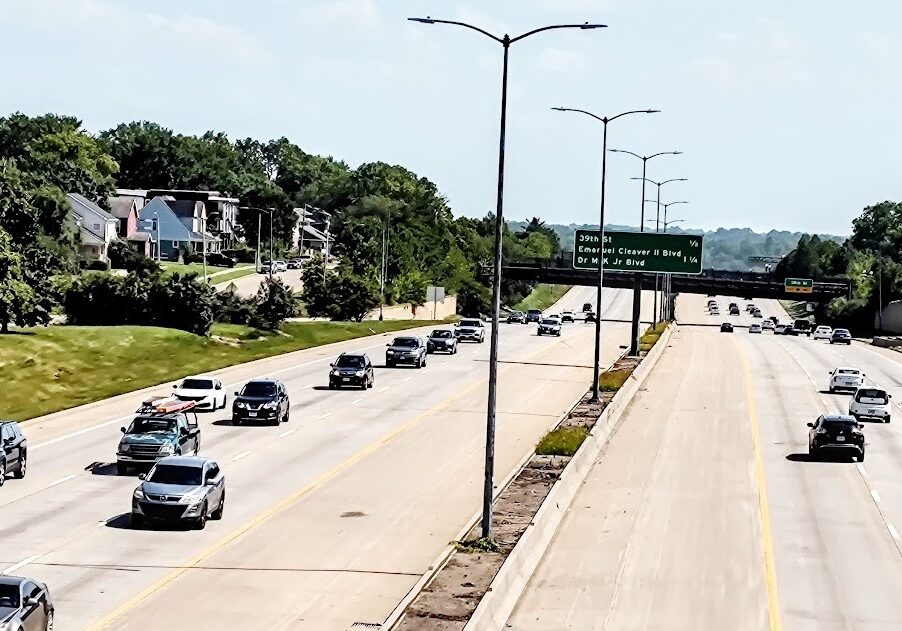
Something else on the repair list could be the long, heart-breaking process of destroying neighborhoods and forcing people to move so that, for instance, both the Bruce Watkins freeway and Interstate 70 could be built through predominantly Black neighborhoods.
The Kansas City Library tells the outrageous Watkins story in a current exhibit, “Detoured: The Making of Bruce Watkins Drive,” and in this recent “Signature Event.” (Building such highways hurt not just the Black community but also Kansas City’s heavily Hispanic West Side.)
Related Content
Beyond all that, public schools were segregated along the Troost divide (a divide the Kansas City School Board in effect ratified by the school attendance boundaries it created).
So Black families had to send their children to schools that received less funding and attention to quality education than schools attended by white students. Our city’s history is full of evidence of all that, including court records of desegregation lawsuits.
There also was segregation that limited where Blacks could work.
In employment, education and in such matters as mass incarceration, police violence, health care disparities, disproportional environmental burdens, and more, the commission must figure out what local government’s role was and what repair work to recommend.

As I noted in a previous Flatland column, there’s much resistance among white Kansas Citians to the idea of reparations and, as Brooks notes, it’s even “questionable to some degree by Blacks.” So, the commission must help educate everyone about why reparations will be good for everyone.
In his recent book, “Rebirth of a Nation: Reparations and Remaking America,” Joel Edward Goza shows that reparations for Blacks can uplift everyone. He points to nationwide research showing that “if racial gaps for Blacks had been closed 20 years ago, U.S. GDP (Gross Domestic Product) could have benefited by an estimated $16 trillion.”
Similarly, in their 2020 book, “From Here to Equality,” authors William A. Darity Jr. and A. Kirsten Mullen conclude that if America’s post-Civil War government had kept its reparations program, nicknamed “Forty Acres and a Mule,” instead of quickly abandoning it, “it is likely there would be no need for reparations to be under consideration now.”
Imagine that.
But none of that happened (unlike the reparations Germany continues to pay to Holocaust survivors and that the U.S. paid to Japanese-Americans, including my brother-in-law, incarcerated in camps in World War II).
So, it’s long past time to repent of this errant past. It’s time to start repairing the future.
(P.S.: The commission has put together this recommended reading list for citizens.)
Bill Tammeus, an award-winning columnist formerly with The Kansas City Star, writes the “Faith Matters” blog for The Star’s website, book reviews for The National Catholic Reporter and The Presbyterian Outlook. His latest book is Love, Loss and Endurance: A 9/11 Story of Resilience and Hope in an Age of Anxiety. Email him at wtammeus@gmail.com.

Reading these stories is free, but telling them is not. Start your monthly gift now to support Flatland’s community-focused reporting.
Related Stories
Nick’s Picks | Roads, Bathrooms, Costco and More …
New Toll Road Opens Kansas City’s first toll road opens this week. Starting Saturday, you’ll pay up to $3.50 to travel the new express lanes on U.S. Highway 69 from 103rd to 151st streets in Overland Park. There are no toll booths — cameras scan your license plate, and a bill arrives by mail. KTAG…
Up From the Ashes: Warwick Theatre Revival Draws Applause
Two years ago, John Cleary met a fellow Kansas City actor for drinks. Their conversation centered on the fate of the Metropolitan Ensemble Theatre. A large portion of the ensemble’s home, the Warwick Theatre, was ash, charred timbers and soot-saturated costumes and props — remnants from a recent massive fire. The destruction was so great…
Nick’s Picks | Baseball, Drones, Romance and More …
Royals Reveal Next week, the Kansas City Royals head to Arizona for Spring Training. And that’s the mayor’s self-imposed deadline to lock in a stadium deal. So, is this finally the week owner John Sherman steps to the plate and unveils where the Royals will build their next home? At last week’s council meeting, Mayor…