
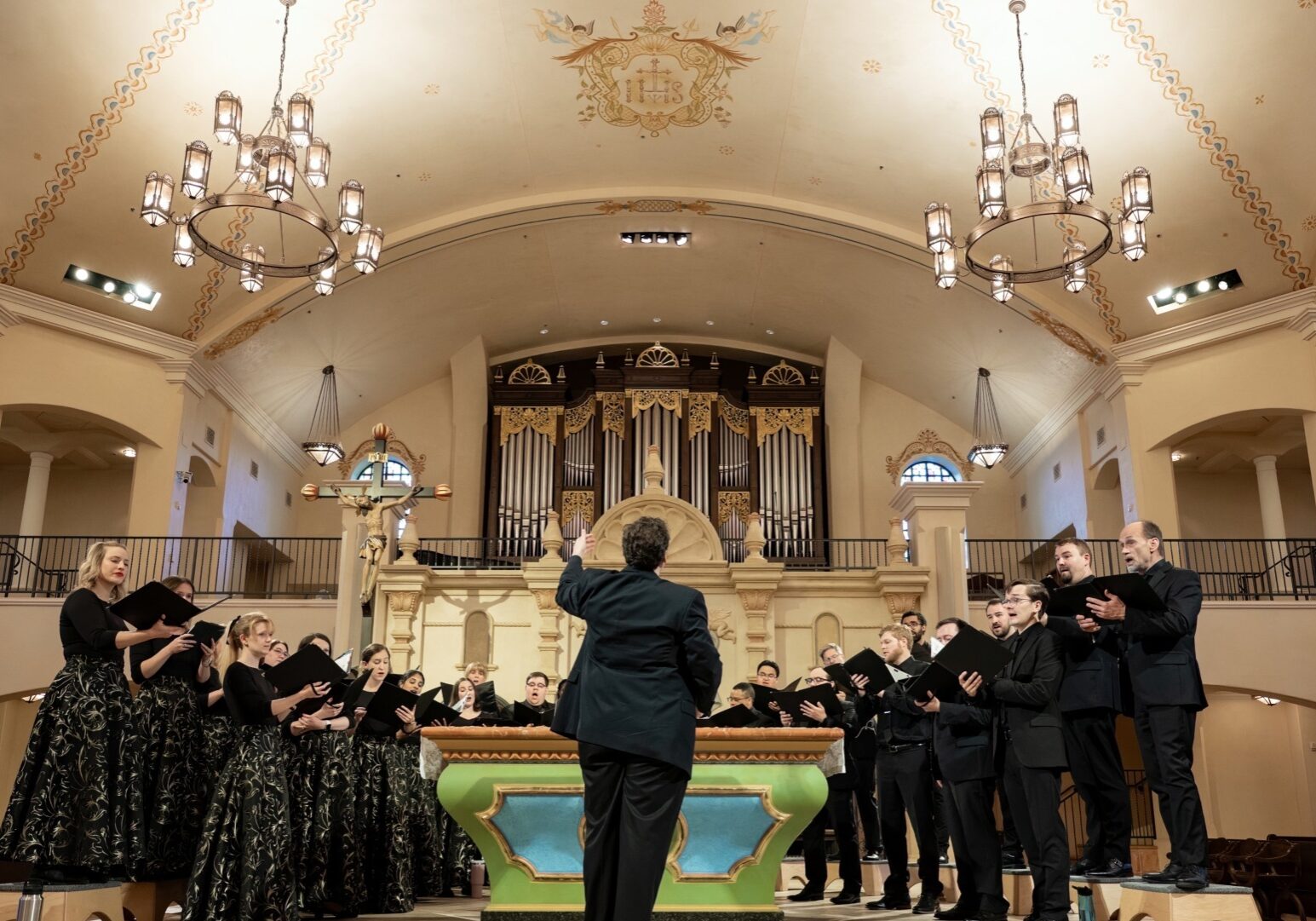
Rockhurst University music professor Timothy L. McDonald grew up near New York City where, he says, “we have a lot of sacred music, but it’s my perception that New York has not nearly as many professional and semi-professional sacred music groups as in Kansas City.
“It’s stunning to me how many such groups we have here.”
This is the case even as the decline in participation in institutional religion continues. But why?
Here’s an explanation from McDonald, who conducts the Rockhurst choral and orchestral group “Musica Sacra,” Latin for “Sacred Music.”
“This place (metro K.C.) is kind of an arts mecca and musical mecca on all kinds of levels.”
True enough. Besides that, Kansas City is located on the edge of the “Bible Belt,” and as McDonald notes, “I don’t think people’s hunger and need for that aspect in our lives is decreasing.”
So, the opportunities to hear and even study sacred music here seem almost endless.
Beyond Musica Sacra, an abbreviated list includes Te Deum; Musica Vocale; the Kansas City Chorale; at times, Friends of Chamber Music; and the Catholic Academy of Sacred Music (Kansas), which mostly offers music resources and recordings of music.

There’s more.
The Kansas City Symphony sometimes presents music with deep religious or spiritual roots, such as the performance earlier this spring of Francis Poulenc’s stunning “Gloria,” with a full orchestra conducted by Matthias Pintscher and accompanied by the 160-voice Kansas City Symphony Chorus, directed by Charles Bruffy.
And, of course, you can find sacred music performed by church choirs throughout the metro, including traditional Black gospel music. Cantors at Jewish services are also part of this, as are the rhythmic calls to prayer at Islamic mosques and the mesmerizing music that accompanies the area’s Sufi dancers.
But many churches have almost abandoned rich, historic sacred music, driving people to find it elsewhere. As Jay Carter, an artistic director and conductor for Musica Vocale, notes, “you don’t have to be a believer in the faith to experience the sense of transport and wonder and admiration” that sacred music offers.
Sometimes you can also find sacred music in performances offered here by such long-time sources as the Harriman-Jewell Series of concerts and 91.9 Classical KC, whose senior producer, Sam Wisman, notes that “we air seasonal holiday specials that are overtly sacred.”
Even the Lyric Opera here sometimes presents music that can be considered sacred or that at least has religious roots. An example: The opera’s 2022 presentation of “Amahl and the Night Visitors,” composed by Gian Carlo Menotti, who drew from a painting, “The Adoration of the Magi,” by Hieronymus Bosch.

But what, exactly, is sacred music?
Definitions vary widely and can include everything from 16th-century requiems to today’s rap, from compositions that begin with religious texts to modern Christian praise-band songs sometimes derided as “7/11 music,” meaning seven words repeated 11 times, all backed by relentless guitars and drums. Carter labels that as “what’s a little more trendy,” but adds that “when the church decides that it’s going to try to win the trendy battle, it’s fighting a losing battle.”
Indeed, McDonald is unsure of sacred music’s boundaries. “I don’t think you want to draw lines to say one type of music does it and another type doesn’t.”
Similarly, Carter says that “once you divorce it (sacred music) from dogma, there is something that is universal in a lot of it.” And, he says, “large chorale works are natural vehicles for communicating ideas, whether they be political ones or religious ones.”
In the same vein, Christine Getz, dean of the University of Missouri-Kansas City School of Graduate Studies and a professor in the Conservatory, says sacred music simply “expresses private or public devotion.”
But she then quickly adds this: “That box is really a difficult one to place it in because that definition doesn’t account for the large number of famous works that were written in a religious genre, like a Mass, for instance, or an oratorio or cantata or whatever. Maybe they had more of a commemorative purpose or were for a public concert performance.”
Matthew Shepard, artistic director of the choral group Te Deum, says that “almost anything can be considered sacred in the right context.” He also notes that the famous 20th-century theologian Paul Tillich believed that the word sacred means “that which deals with ultimate concern.” And that, Shepard says, is the music Te Deum seeks to present.


Bill Krusemark, a local church choir director who formerly taught music at the University of St. Mary in Leavenworth, says “sacred music starts with the text — whether it’s biblical or nonbiblical — and tradition. The music itself is not uniquely theological,” but, he adds, “the text has to envelope listeners and get to their hearts.”
Krusemark believes sacred music continues to be popular in part because chorale groups provide participants with “group identity, a shared sense of purpose and mental health. People form great friendships in choirs.” Krusemark, indeed, met his wife in a church choir decades ago.
Bruffy believes that “one of the most important elements about sacred music is its historic contribution. Our last recording (by the Kansas City Chorale) was a complete Mass, which was written in the 1500s. It’s a world premiere because the music was just found in the Vatican archives. So we had the piece reconstructed and then we subsequently recorded it. The other thing is, no matter what one’s beliefs are, sacred music has an inherent beauty and peace.”
And my sister Karin McPhail, who got her pipe organ degree at the Juilliard School, and who has spent her career playing sacred music in California’s Bay Area, says, simply, “sacred music is able to speak to the heart of all people.”
The Kansas City Symphony’s and Symphony Chorus’s recent performance of Poulenc’s “Gloria” certainly spoke to — and moved my own heart — as it moved the heart of the chorus director, Bruffy.
“The Symphony Chorus was so incredible,” he told me after the performance. “I was really thrilled. Some people mentioned that they had gone to church in that program.”
Sometimes in Kansas City you don’t even need to look for sacred music. Instead, it finds you.
Recently, for instance, I was at the Boost Mobile store at 55th Street and Troost Avenue and heard, in the background, what sounded like music that I had encountered when I spent part of my boyhood in India.
But when I asked the clerk about it, he said it was a recording of someone reciting the Qur’an. It also sounded almost like music to him, he said, though in Islam, the permissibility of music varies among interpreters and is a subject of debate among legal scholars. Still, he found the voice comforting, and I found it to be sacred music.
Maybe there’s just nowhere here that sacred music doesn’t exist.
Bill Tammeus, an award-winning columnist formerly with The Kansas City Star, writes the “Faith Matters” blog for The Star’s website, book reviews for The National Catholic Reporter and The Presbyterian Outlook. His latest book is Love, Loss and Endurance: A 9/11 Story of Resilience and Hope in an Age of Anxiety. Email him at wtammeus@gmail.com.

Reading these stories is free, but telling them is not. Start your monthly gift now to support Flatland’s community-focused reporting.

Related Stories

Nick’s Picks | Roads, Bathrooms, Costco and More …
New Toll Road Opens Kansas City’s first toll road opens this week. Starting Saturday, you’ll pay up to $3.50 to travel the new express lanes on U.S. Highway 69 from 103rd to 151st streets in Overland Park. There are no toll booths — cameras scan your license plate, and a bill arrives by mail. KTAG…
Up From the Ashes: Warwick Theatre Revival Draws Applause
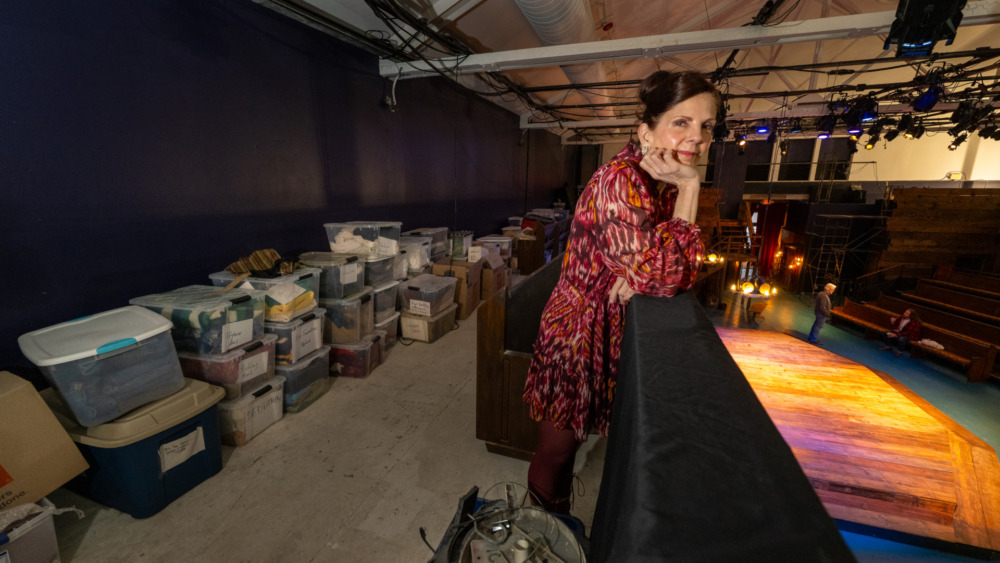
Two years ago, John Cleary met a fellow Kansas City actor for drinks. Their conversation centered on the fate of the Metropolitan Ensemble Theatre. A large portion of the ensemble’s home, the Warwick Theatre, was ash, charred timbers and soot-saturated costumes and props — remnants from a recent massive fire. The destruction was so great…
Nick’s Picks | Baseball, Drones, Romance and More …
Royals Reveal Next week, the Kansas City Royals head to Arizona for Spring Training. And that’s the mayor’s self-imposed deadline to lock in a stadium deal. So, is this finally the week owner John Sherman steps to the plate and unveils where the Royals will build their next home? At last week’s council meeting, Mayor…