
Editor’s note: This is the first installment of a three-part series on the restoration of the Big Blue Battlefield in Kansas City, Missouri.
It was cold for late October in Kansas City.
In 1864 Lt. Patrick Henry Minor, then leading an artillery battery against Confederate forces, would die the following March, from what likely had been pneumonia.
A graduate of Oberlin College in Ohio, he had been out of harm’s way just months before, teaching at his sister’s Leavenworth, Kansas, school for Black students when he received a request from the U.S. Army.
Minor previously quit the First Kansas Colored Infantry regiment when discrimination denied formal officer commissions to him and another Black commander.
But two years later, Chris Cotten, Kansas City Parks & Recreation director said recently, “attitudes had changed.”
In 1864 Minor re-entered the U.S. Army as an officer in the Independent Battery, U.S. Colored Light Artillery, sometimes known as Douglas’ Battery. During the Battle of Westport — contested across much of the Kansas City area — one section of that battery under Minor’s command moved forward and deployed against Confederate forces.

In leading those soldiers, Minor became the first regularly commissioned Black officer to command Black troops in combat.
“He didn’t have to be there,” Cotten said.
But when asked to return to the Army and accept an officer’s commission, Minor had agreed.
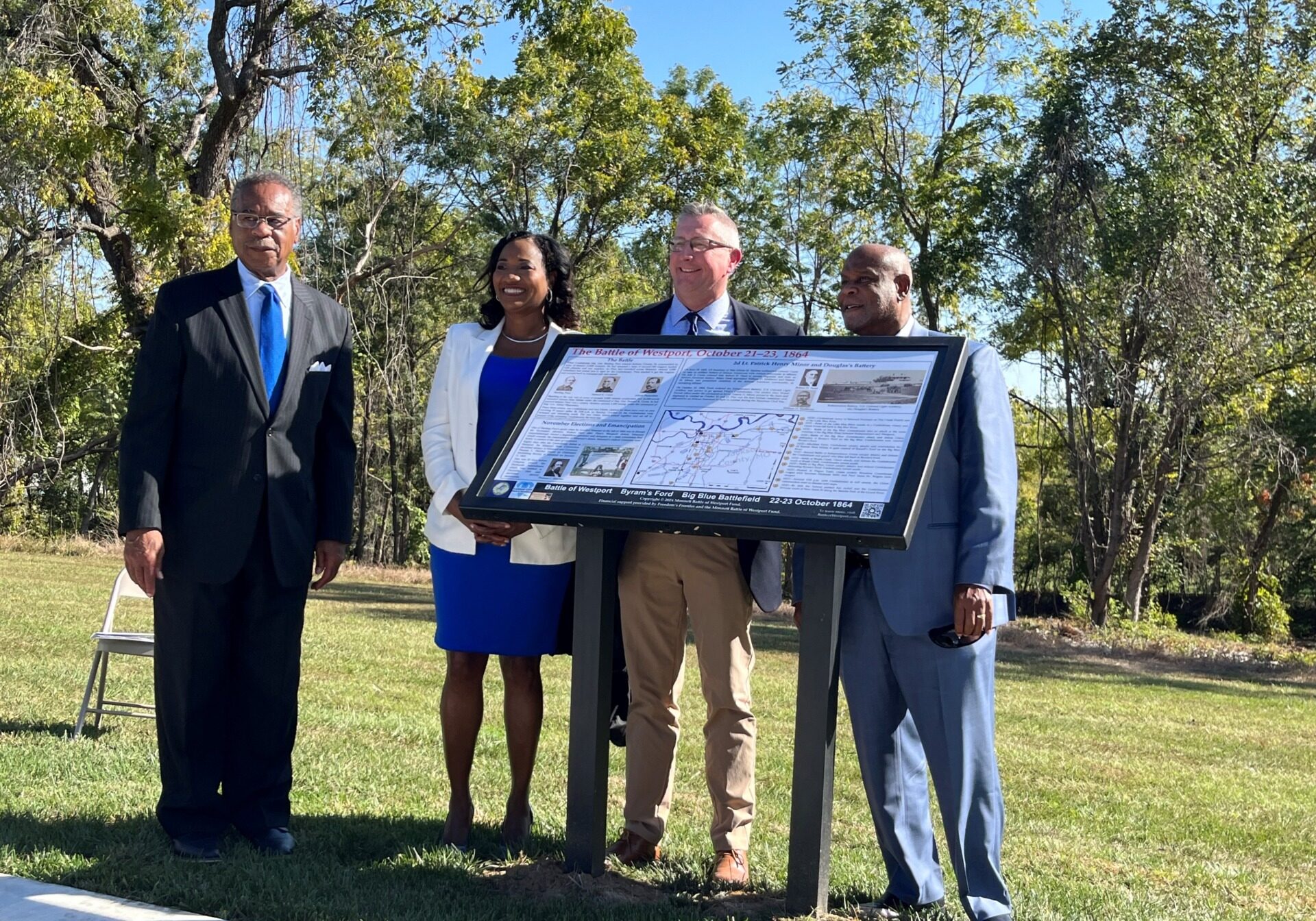
“Why did he leave the safety of the schoolhouse and return to combat operations?” Cotten asked an audience assembled for the Oct. 3 unveiling ceremony for new interpretative panels at the Big Blue Battlefield at 4800 E. 63rd St.
“We will never know the answer to that question. But we do know he could have avoided the carnage of the Battle of Westport and yet he did not. He stood for honor and courage, and I believe he served as a role model for those at the time who could not stand for themselves.”
Minor’s soldiers, Cotten added, “were in action on land now cared for by the parks department.”
Preservationists unveil improvements
On Oct. 19, Kansas City area Civil War scholars and preservationists led tours of the newly cleared and curated Big Blue Battlefield, just north of Swope Park, and the site of a critical moment in the larger Battle of Westport.
That 1864 engagement, contested from Oct. 21 through Oct. 23, is considered the largest Civil War battle west of the Mississippi River, stretching over 35 square miles and involving an estimated 29,000 troops.
Today the National Park Service lists the larger Battle of Westport site as a “Class A” battlefield, the same level of significance it accords to the locations at which the battles of Antietam, Shiloh, and Gettysburg took place.
Although scholars disagree about the number of casualties, there’s little debate regarding the clash’s significance. A Union victory, the battle effectively ended organized Confederate military operations in Missouri. Eighty days later, delegates to a state constitutional convention abolished slavery in Missouri; Gov. Thomas C. Fletcher issued the enabling ordinance on Jan. 11, 1865.
The ordinance preceded by almost three weeks congressional adoption of the Thirteenth Amendment in Washington, D.C.
The required 27 of the then-36 states had ratified the amendment by the following December, ending slavery across the country.
‘Not just something that happened way back’
“It warms my heart to think about what happened here on this ground and the impact it made for my life and my future grandkids,” Ryana Parks-Shaw, Kansas City Mayor Pro Tem and Fifth District City Council member, said on Oct. 3.
She considers it her duty, she added, to honor those who fought there “by understanding the lessons of history, lessons that remind us of the fragility of freedom and the importance of unity in the face of division.”
At the same ceremony, U.S. Rep. Emanuel Cleaver spoke — referencing recent “hideous” attempts to ban books — of the importance of defending not only the written history of the Battle of Westport but also preserving the actual acreage on which a crucial portion of it was contested, at Byram’s Ford, on the Blue River.
“We need to fight the cost of ignorance for our current young people,” Cleaver said.
“When we come and talk about the Battle of Westport, it’s not just something that happened way back.
“Our kids may happen to know that something happened. I mean, some might think that it was a battle of pizza parlors. You know — Westport pizza.
“We’ve got to make sure that history remains on the table for our children to partake.”
Coming next: A bloody battle at Byram’s Ford
Flatland contributor Brian Burnes is a Kansas City area writer and author.

Reading these stories is free, but telling them is not. Start your monthly gift now to support Flatland’s community-focused reporting.
Related Stories
Nick’s Picks | Roads, Bathrooms, Costco and More …
New Toll Road Opens Kansas City’s first toll road opens this week. Starting Saturday, you’ll pay up to $3.50 to travel the new express lanes on U.S. Highway 69 from 103rd to 151st streets in Overland Park. There are no toll booths — cameras scan your license plate, and a bill arrives by mail. KTAG…
Up From the Ashes: Warwick Theatre Revival Draws Applause
Two years ago, John Cleary met a fellow Kansas City actor for drinks. Their conversation centered on the fate of the Metropolitan Ensemble Theatre. A large portion of the ensemble’s home, the Warwick Theatre, was ash, charred timbers and soot-saturated costumes and props — remnants from a recent massive fire. The destruction was so great…
Nick’s Picks | Baseball, Drones, Romance and More …
Royals Reveal Next week, the Kansas City Royals head to Arizona for Spring Training. And that’s the mayor’s self-imposed deadline to lock in a stadium deal. So, is this finally the week owner John Sherman steps to the plate and unveils where the Royals will build their next home? At last week’s council meeting, Mayor…