
Winning the War: Recalling the ‘Instrument of Deliverance,’ Pondering the Future of Democracy
May 16, 2025 | | 14 min read
Second of two installments
About 16.4 million Americans served during World War II, according to the National World War II Museum in New Orleans.
Just 66,000 — fewer than one out of every 250 who served – were still alive in 2024. Among those, 1,321 lived in Missouri in 2024, while 352 lived in Kansas.
Seven Kansas City-area World War II veterans, in interviews with Kansas City PBS for the “Winning the War” documentary, offered vivid recollections of their war-time service and, especially — when it was over — their euphoric relief.
Of the six Kansas City-area American veterans interviewed, none of them saw Dwight Eisenhower personally.
“Some of the guys knew there was a General Eisenhower,” said William “Bill” Casassa of Shawnee, 80 years ago a member of a tank destroyer unit fighting its way through Germany.
Day One Story
Watch the Documentary
“Some of us didn’t know there was a General Eisenhower. We just knew there were plenty of generals somewhere and they were sending orders to us.”
But Sally Keithley-McCulley of Shawnee, 80 years ago a member of the British Royals Signal Corps, had seen Eisenhower.
“I was at the war office one day taking some tests,” she said.
“I was getting ready to leave and I looked down and there was this big limousine that had just pulled up. It had the British flag and the American flag on the car and I thought, ‘Oh, somebody important.’“
It was not just one but two important people — Eisenhower and British Army Field Marshal Bernard Montgomery.
“And I thought: ‘Oh no. If I go down I am going to have to salute them.’ I was the only one there.”
But, she added, “they were too busy talking. They were not going to stop and see a little old private.”
“Everybody loved Eisenhower,” recalled Keithley-McCulley, who married an American serviceman and moved to the Kansas City area. “They just liked him. They just knew he was running the show.”
On April 10, 1945, Casassa’s tank destroyer unit, after assisting in capturing Hanover in central Germany, had skirted the corner of what he later learned was the Ahlem concentration camp.
Casassa didn’t see the camp, but it left an unforgettable impression when the wind changed.
“It was the smell of pure evil,” he said. “My God it was awful.”
Two days later, Eisenhower visited another concentration camp, Ohrdruf, near the Buchenwald concentration camp. With fellow generals George Patton and Omar Bradley, Eisenhower toured the camp and ordered photographers to document his visit.
“He was brilliant,” Casassa said. “I don’t want to say he was a politician — he was a statesman.
“He immediately caught on to the fact that if he didn’t establish proof of what had happened that — sooner or later — this would be passed over as if it didn’t happen at all.
“And he was right.”

Germany surrendered on May 8, 1945.
A few months later U.S. Navy Ensign Edward Matheny Jr. of Kansas City reported to Raymond Spruance, commander of the U.S. Fifth Fleet and hero of the 1942 Battle of Midway.
Matheny first had been assigned to the staff of Admiral Chester Nimitz, commander-in-chief of the Pacific Fleet in Honolulu.
Some 10 months after taking the court as a starting forward for the University of Missouri men’s basketball team, Matheny was in a basement bunker at Pearl Harbor. He spent most of the war gently nudging aside senior officers to chart the location of American ships on a vast map of the Pacific.
“Are you looking for excitement?” Spruance asked Matheny in 1945.
It was a reasonable question.
The Fifth Fleet was expected to lead the amphibious assault on Kyushu, the most southerly of the Japanese main islands, as part of the planned invasion of Japan. Military advisors to President Harry Truman had estimated that a 90-day battle to take Kyushu could cost up to 175,000 battle casualties, with 38,000 killed in action.
Hence the dark humor from Spruance.
But Matheny had grown restless at Pearl Harbor and so had applied for a transfer to the Fifth Fleet.
“I simply told him that I had been interested in getting where the action was,“ Matheny said.
The invasion of Kyushu was scheduled for November 1945.
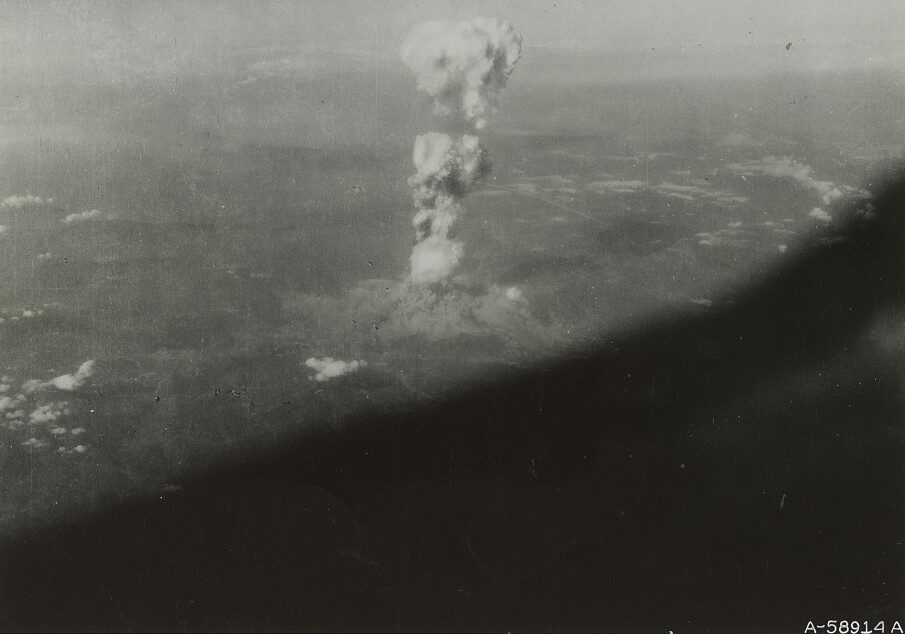
“But we were saved all that,” Matheny said, “by President Harry Truman dropping the atomic bomb.”
At about the same time, in early August 1945, Bob Sperry of Mission was on a troop transport ship in the Atlantic Ocean, headed to New York.
He and his fellow veterans had been told, not long after the German surrender, they would be trained for the expected invasion of the Japanese home islands.
But there had been an announcement. A new weapon of heretofore unknown power had been detonated over the Japanese city of Hiroshima.
“The ship just erupted — with glee, happiness, joy,” Sperry said.
“When we got to New York,” he said, “everybody in New York City seemed to be up there on the docks, cheering and waving flags, yelling and singing. We were just absolutely enthralled to know that we were not going to go to Japan.”
Truman first had learned of the successful New Mexico test of the atomic bomb on July 16, 1945, while attending the Potsdam Conference.
His grandfather never discussed his decision to deploy the atomic bomb with him or his brothers, Clifton Truman Daniel said, as they were too young at the time.
Years later Daniel began to investigate its complex legacy. In 2012, as a private citizen, he traveled to Japan, visiting Hiroshima Peace Memorial Park and meeting with about two dozen survivors.
While some Japanese journalists pressed him about whether he was there to apologize for his grandfather’s decision, Daniel replied that he was there not to apologize but to acknowledge the bombings and listen to the stories told by the survivors of both the Hiroshima and Nagasaki bombings.

Daniel’s voice had not been among the many who — on the bombings’ 50th anniversary in 1995 — had debated whether they had been necessary.
“A lot of the re-thinking of this happened afterwards, because of the result — the destruction, the death, the radiation,” Daniel said.
“And people began to back off …‘Well, no, I didn’t think there would be that many people killed’ or ‘‘I don’t think that weapon was necessary.’ People started to distance themselves from it.
“Grandpa never did. He once told Col. Paul Tibbetts, the pilot of the Enola Gay, ‘Has anybody been giving you trouble about using that weapon?’ And Tibbetts said, ‘No, sir.’ And Grandpa said, ‘Well, if they do, you tell them it was my decision, not yours. You were following orders.’
“He took and kept responsibility for that decision.”
For decades Daniel has accepted handshakes from hundreds of veterans who thank him, by proxy, for his grandfather’s decision.
Matheny, meanwhile, missed his opportunity to thank Truman directly.
After he graduated from Harvard Law School in 1949, Matheny joined a law firm with offices in the former Federal Reserve Bank building in downtown Kansas City. By the early 1950s, Truman had an office there, too.
“I remember seeing him in the elevator,” Matheny said. “He said, ‘I’m going to be late for lunch. Bess is going to give me hell.’‘’
“And I failed to tell him how much I owed him. I did not tell him that I was the beneficiary of his great statesman-like act, when he used the atomic bomb to bring the war to an end.
“I feel it was an instrument of deliverance.”
Casassa learned of the bomb from his mother, who woke him up with the news while he was home from Europe on a 30-day recuperation leave at his family’s Fitchburg, Massachusetts, home.
“When they dropped the bomb my life was granted back to me,” Casassa said.
“Because I knew I had survived in Europe 171 consecutive days of full engagement with the enemy. You run out of chances, you really do. Guys run out of chances.”
Further, he said, “we knew it was going to be a horror fighting the Japanese.” That’s why, he added, “I was so filled with joy I can’t explain it to you.”
His sentiments have not changed in the 80 years since.
“Well, I’m alive 80 years later, that’s how I feel about it,” he said.
“And so are a lot of other guys. And so are a lot of other Japanese guys… They wouldn’t have been surrendering.”
Another perspective of the war-time leadership of Eisenhower and Truman comes from Gail Harano Cunningham of Leawood.
Cunningham, a daughter of Satoru and Chieko Harano of Berkeley, California, was born May 3, 1944, at the Topaz War Relocation Center, a Japanese American internment camp in Utah.
Early in 1942, following the Japanese attack on Pearl Harbor, President Franklin Roosevelt signed Executive Order 9066. The decree prompted the forced relocation of Japanese Americans into internment camps. Over the ensuing six months, U.S. officers and soldiers organized and enforced the evacuation of an estimated 117,000 Japanese Americans up and down the country’s West Coast.
Cunningham’s parents and her six older siblings, as well as one of her grandmothers, and also two uncles, were relocated to the camp — or, as Cunningham calls it, a “concentration camp.”
Eisenhower believed, she said, that “war was certainly a bad thing in every way but he was very good at doing it.”
Truman’s conduct of the war, meanwhile, was “very pragmatic,” she added.
That includes, she said, his decision to use the atomic bomb against Japan.
“The bomb was there, and it was available and he — in my understanding — felt it was necessary to use it.
“This was a pragmatic decision that he felt he needed to make, and I think it was a terrible thing but I do not fault him for doing it. It was so complicated.”
The Future of Democracy
A 2021 poll of presidential historians conducted by C-SPAN, the cable and satellite television network, ranked Eisenhower as the country’s fifth most effective leader, with Truman sixth — rankings that were unchanged from the previous poll in 2017.
Yet both presidents for years struggled to get along with each other.
During Eisenhower’s 1961 visit to the Truman Library, Truman made a point of showing Eisenhower’s own portrait, prominently placed.
It was Truman’s reminder to Eisenhower, according to long-time friend Rufus Burrus, how Truman’s White House portrait had been removed from its prominent spot upon Eisenhower’s arrival.
Truman was, Burrus said, was “sort of rubbing his nose in it.”
Truman, according to The Kansas City Star, added levity to the occasion — when asked by Eisenhower if he should sign the library guest book — by agreeing.
“Then,” Truman said, “if anything is missing we’ll know who to blame.“
If the “feud” between Truman and Eisenhower lasted for years, it took only one day to end.
They reunited at the memorial services for President John F. Kennedy, who was assassinated on Nov. 22, 1963. At Eisenhower’s invitation, Truman accepted a ride to Arlington National Cemetery in Eisenhower’s car. Then, upon the invitation of Margaret Truman Daniel, Eisenhower and his wife Mamie came to Blair House, known as the presidential guest house, where Truman had been staying.
There, he and Eisenhower shared the coffee they had not shared on Inauguration Day 10 years earlier.
They would meet one last time, on June 6, 1966, when Eisenhower was in Kansas City to speak before a nonprofit group enlisting support for the United Nations. The two met for a private luncheon at the Muehlebach Hotel. When reporters and photographers were allowed brief access into the room, they outnumbered the guests at the luncheon.
“This is D-Day, you know,” Eisenhower told Truman.
“That’s right,” Truman replied.
Eisenhower died on March 28, 1969.
Truman died on Dec. 26, 1972.

Both men, during their presidential terms, had often invoked the transformative power of democracy and the imperative to maintain it.
“Democracy alone can supply the vitalizing force to stir the peoples of the world into triumphant action,” Truman said during his Jan. 20, 1949, inaugural address.
“We want democracy to survive for all generations to come, not to become the insolvent phantom of tomorrow,” Eisenhower said in his Jan. 17, 1961, farewell address.
“Democracy alone can supply the vitalizing force to stir the peoples of the world into triumphant action.”
president Harry Truman, inaugural address, jan. 20, 1949
Matheny feels confident the American people in 2025 can live up to what democracy can demand.
“I’m aware of the kind of people that we have and the strength of our citizenry and their ability to cope with any serious problems that arise,” he said. “I’m confident that is true today and will always continue to be true.”
Others are less confident.
“I don’t want to voice my political opinion but I think we have a danger, and I don’t want to see us get into like a dictatorship, and that scares me a little,” said Bob South of Olathe, a former naval aviator.
“We want democracy to survive for all generations to come, not to become the insolvent phantom of tomorrow.”
President Dwight Eisenhower, Farewell address, Jan. 17, 1961
The current moment, said Cunningham, reminds her of an Old Testament passage from the Book of Samuel.
Today, she said, she believes some Americans wish to simply defer to the decisions of a strong leader, as opposed to doing the hard work of achieving consensus through dialogue.
“The people of Israel said, ‘Give us a king,’“ she said.
“‘We don’t want to figure out what to do as we go along. We want a king…a strong person, a strong leader to follow, to lead us to war, to defeat our enemies.’
“I hate that. I think what we want to do is make our enemies understand that we can be friends.”
On June 6, 2024, Casassa, with close to a dozen veterans of either D-Day or the Allied campaign though Europe, received the French Legion d‘Honneur, France’s highest order of merit, from President Emmanuel Macron during ceremonies near Omaha Beach.
Although Casassa had not been among the estimated 160,000 Allied soldiers who took part in the Normandy Invasion, he helped complete the task that those had begun.
During a subsequent parade Casassa exchanged an unknowable number of fist bumps with French citizens who lined the streets, praising him for his role in delivering their country from fascism.
In contrast, he said, he’s troubled seeing contemporary Americans enjoying “an incredible level of luxury, and health and wealth, and lovely living conditions and education” while seemingly unaware of what it took to secure the freedoms they now enjoy.
Many contemporary American citizens, he said, “don’t really know or care to know how it came to be.”
Although Keithley-McCulley remains a British citizen, she disapproves of what she considers the corrosive nature of today’s political discourse.
“Patriotism is a lovely thing,” she said.
“And I think a lot of the people over here are missing out on something because they are too busy running other people down instead of building them up and helping them. It hurts.”
Vaughnie Tinsley, who worked at the North American Aviation plant during the war, also admitted to having personal doubts about the future of democracy.
“No, I don’t feel very positive. I hope I live long enough to change my mind.”
Tinsley died on Nov. 17, 2024, at the age of 99.
Flatland contributor Brian Burnes is a Kansas City area writer and author.

Reading these stories is free, but telling them is not. Start your monthly gift now to support Flatland’s community-focused reporting.
Related Stories
Nick’s Picks | Roads, Bathrooms, Costco and More …
New Toll Road Opens Kansas City’s first toll road opens this week. Starting Saturday, you’ll pay up to $3.50 to travel the new express lanes on U.S. Highway 69 from 103rd to 151st streets in Overland Park. There are no toll booths — cameras scan your license plate, and a bill arrives by mail. KTAG…
Up From the Ashes: Warwick Theatre Revival Draws Applause
Two years ago, John Cleary met a fellow Kansas City actor for drinks. Their conversation centered on the fate of the Metropolitan Ensemble Theatre. A large portion of the ensemble’s home, the Warwick Theatre, was ash, charred timbers and soot-saturated costumes and props — remnants from a recent massive fire. The destruction was so great…
Nick’s Picks | Baseball, Drones, Romance and More …
Royals Reveal Next week, the Kansas City Royals head to Arizona for Spring Training. And that’s the mayor’s self-imposed deadline to lock in a stadium deal. So, is this finally the week owner John Sherman steps to the plate and unveils where the Royals will build their next home? At last week’s council meeting, Mayor…