
Down Economy Has Many Midwest Farmers Looking For Agronomists’ Advice
November 26, 2016 | | 5 min read
As another harvest season wraps up, Midwest farmers are once again facing low commodity prices amid enormous supplies. And when they recover from the long days bringing in the grain, they will eventually sit down with their books and try to figure out how best to farm again next year.
Many will turn to an agronomist for advice. Field agronomists, experts in soils, plants, insects, diseases and more, have long been the first point of contact for farmers searching for help. Today, as farmers rely as much on data and research as on tractors and combines, agronomists and their network of experts are as important as ever to many Midwest farmers.
How does the connection between research and practice work in farm country? To understand the job better, I tagged along with Angie Rieck-Hinz, an Iowa State University Extension field agronomist in north-central Iowa.
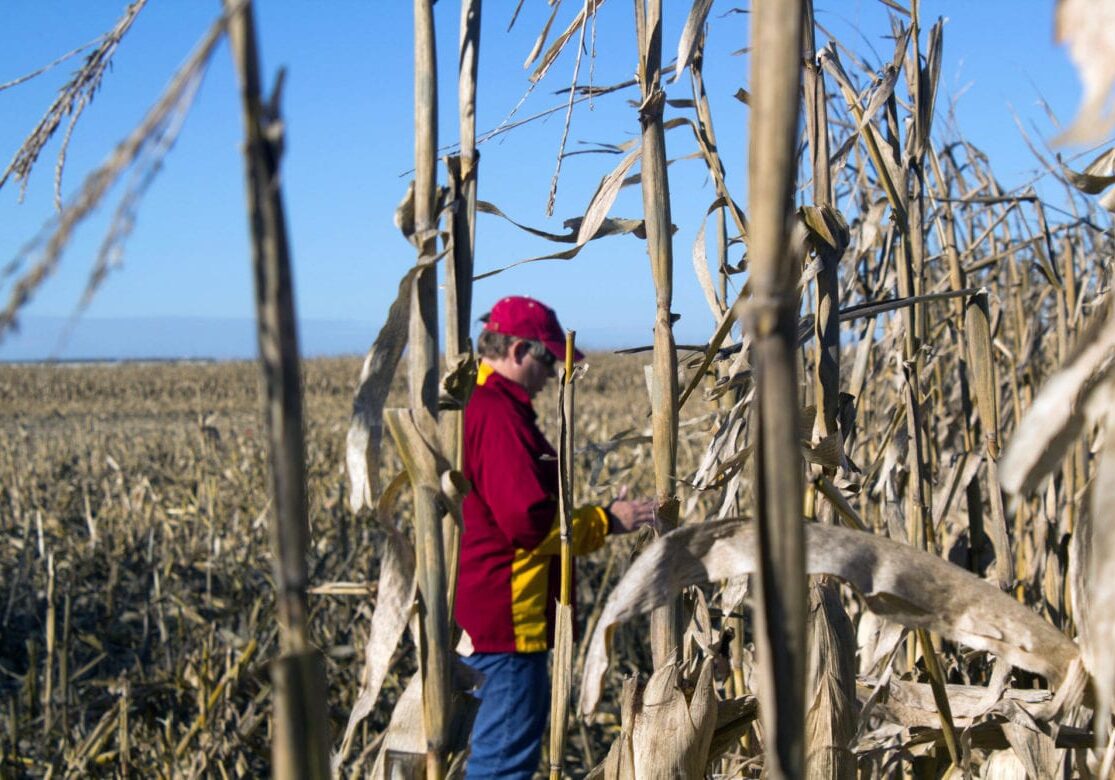
On my first trip with Rieck-Hinz, we follow a father-son farmer team from their home farm along two-lane county roads until we come to a stop along a stand of tall, green corn. They offer Rieck-Hinz her choice of two fields for placement of sticky traps — yellow, cardboard grids slathered with an adhesive. Rieck-Hinz pushes aside leaves and tromps between corn plants taller than she is, sweating in the footsteps of a century of agronomists before her.
After counting rows and assessing her position, she stops to attach the first trap.
“So, all we have to do is hang this above that ear,” she says, affixing the card to the plant. “There!”
“My job is to help you troubleshoot, if needed,” she says, “and come at it from an educational point of view.”
It’s a job that’s different every day. With corn and soybean prices stubbornly low this season, many farmers ask her about the wisdom of spending money on certain inputs. Should they, for example, risk the cost of applying a fungicide in the hope they will recoup that expense with higher yields at harvest? She asks them how many insects they’ve seen, or tells them how much a particular disease has been seen in nearby fields, and helps them sort through their options. Ultimately, it’s their decision whether the expense is worth it, and she knows it’s often not an easy one.
John Lawrence, Iowa State’s director of extension agriculture and natural resources, says in this economy, farmers are eager for informed suggestions.
“They’re trying to sharpen their pencils, cut costs where it makes sense without cutting into net profits,” Lawrence says.
Farmers are always looking for efficiencies, but when times are brighter, farmers may be open to new or different ideas. Right now, Lawrence says, it’s back to basics.
“Advice, maybe a little bit of hand-holding, now and then,” he says.
Farm management and finance specialists, Lawrence says, may have what farmers really need when margins are tight, but the agronomist is often the first point of contact between the farmer and the rest of the extension experts. And Lawrence says that means agronomists often are on the front-line to help with other problems. A call about adding nitrogen, phosphorus or potassium to a field may lead the agronomist down an unexpected additional path.
“They may find it’s a mental health problem,” Lawrence says. “That yes, this person has a soil fertility challenge, but they’re really under a lot of stress. And where are some resources we can [offer to] help that person look holistically, not just, do they need more pounds of N, P and K.”
Lawrence says extension agronomists are in the people business, and that is evident in the rapport Rieck-Hinz has with the farmers she sees.
Several months after the outing to set sticky traps, I catch up with Rieck-Hinz again. This time, Edwin Johnson, another farmer who volunteered some acres for research, is harvesting corn from a test plot. Johnson had offered up 20 acres in all to three different research projects this year.
“I’ve been doing quite a bit this year for them, and for myself, too,” Johnson says.
When he finishes harvesting and climbs down from the combine, he and Rieck-Hinz talk about the questions raised in one of the trials: whether adding sulfur fertilizer might increase yield. Johnson is hopeful and is considering using sulfur next season.
“You better save us a field (to study,)” Rieck-Hinz tells him playfully. “Don’t put sulfur on everything, we may need it for next year.”
As research results from the lab become available, Rieck-Hinz and other field agronomists bring the findings to farmers. Rieck-Hinz will host winter meetings and give presentations, answer questions about what to plant next year and whether to take a risk on something different.
“Taking all that stuff and boiling it down and giving a one hour talk in the winter time can be overwhelming,” Rieck-Hinz says. “But it’s exciting to have some new things to talk about once in a while, too.”
— Harvest Public Media, based at KCUR 89.3, reports on farm and food issues in collaboration with public media stations across the Midwest. For more information, visit www.harvestpublicmedia.org.

Reading these stories is free, but telling them is not. Start your monthly gift now to support Flatland’s community-focused reporting.
Related Stories
Nick’s Picks | Roads, Bathrooms, Costco and More …
New Toll Road Opens Kansas City’s first toll road opens this week. Starting Saturday, you’ll pay up to $3.50 to travel the new express lanes on U.S. Highway 69 from 103rd to 151st streets in Overland Park. There are no toll booths — cameras scan your license plate, and a bill arrives by mail. KTAG…
Up From the Ashes: Warwick Theatre Revival Draws Applause
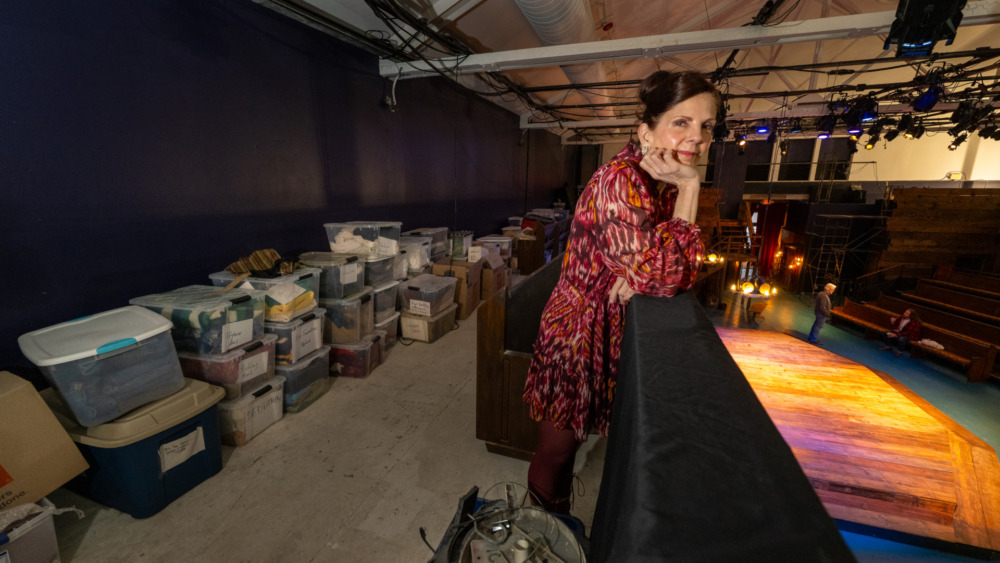
Two years ago, John Cleary met a fellow Kansas City actor for drinks. Their conversation centered on the fate of the Metropolitan Ensemble Theatre. A large portion of the ensemble’s home, the Warwick Theatre, was ash, charred timbers and soot-saturated costumes and props — remnants from a recent massive fire. The destruction was so great…
Nick’s Picks | Baseball, Drones, Romance and More …
Royals Reveal Next week, the Kansas City Royals head to Arizona for Spring Training. And that’s the mayor’s self-imposed deadline to lock in a stadium deal. So, is this finally the week owner John Sherman steps to the plate and unveils where the Royals will build their next home? At last week’s council meeting, Mayor…