
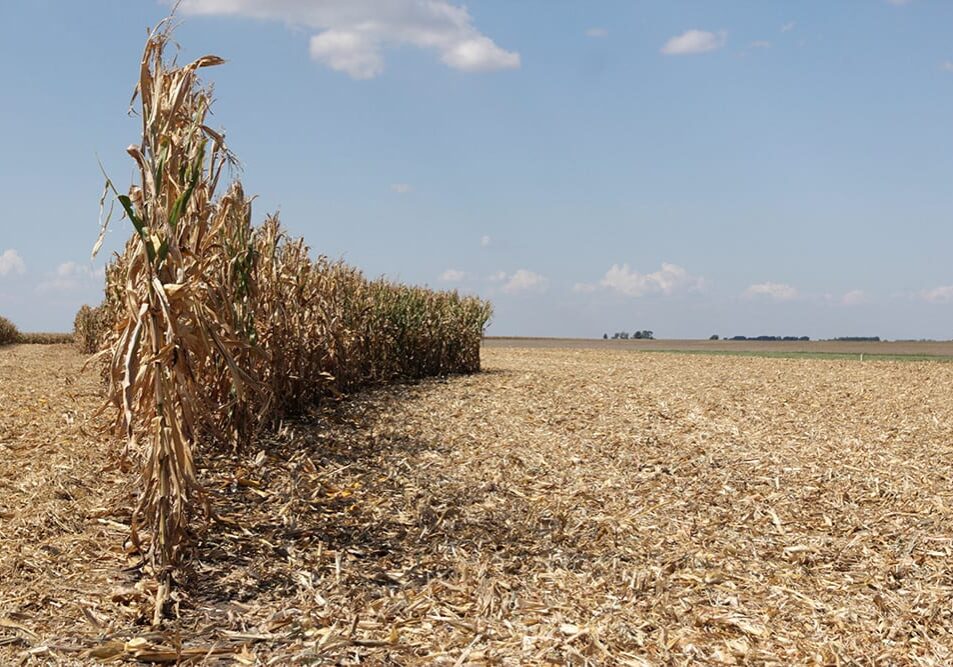
Scientists have noticed a change in the atmosphere. Plants are taking in more carbon dioxide during the growing season and giving off more carbon in the fall and winter. Recent research shows the massive corn crop in the Corn Belt may be contributing to that deeper breath.
It comes down to the Carbon Cycle. Over the winter when corn fields lay dormant, corn stalks and roots break down, sending CO2 into the air. Then in the summer when a new crop is growing, it takes up carbon from the atmosphere.
“So that’s like you’re breathing in,” said Andy Suyker, a micro-meteorologist from the University of Nebraska Lincoln. “There’s this constant breathing in, taking up carbon dioxide, and breathing out, releasing carbon dioxide.”
That’s the carbon cycle, and also how it’s different than fossil fuel emissions. It’s a give and take, with CO2 constantly shifting between plants and the air.
About 20 years ago, scientists realized the peaks and valleys of the carbon cycle are reaching higher – and lower – levels.
“The depth of that breath has gotten bigger,” said Joshua Gray, who studies the carbon cycle at Boston University. “So the CO2 concentrations go down a little bit more in summer than they used to, and they go up a little bit more in the winter than they used to.”
In fact, the concentrations are up to 50 percent higher in the northern hemisphere.
Most of the increase is due to a longer growing season brought on by a warming climate. But in a recent article in the journal Nature, Gray and his colleagues uncovered another human impact on the carbon cycle: farming.
Gray says scientists overlooked farming before. It only covers 6 percent of the land in the area he studied. But he found it accounts for a quarter of the increase to the carbon cycle.
“It’s surprising and not surprising all at the same time,” Gray said. “Surprising to get the result, and then you say, ‘Well of course, we have three times as much corn as we did 50 years ago. Of course this is going on.’”
Farming yields have made huge strides in northern China and the U.S. Corn Belt. Farmers use better equipment and plant more productive crop hybrids. They have more effective chemicals to control weeds and support their crops with more irrigation and fertilizer.
The fact that farming feeds the carbon cycle does not mean it’s making climate change worse. But, when it comes to reversing climate change, Gray says growing wheat or corn does less to sequester carbon in the ground than growing a forest or grassland.
“We’re not gaining more long-term carbon in the soil or anything like that by growing more corn, like we might with growing more oak trees,” Gray said.
But what if carbon-hungry corn plants did store CO2 underground? The U.S. Department of Agriculture and conservation groups has been trying to develop methods of carbon farming. They want to use agriculture to remove carbon pollution from the air. Australia has created an Emissions Reduction Fund that could end up paying farmers who can show they are storing carbon on their land.
It’s challenging. Scientists disagree on how to measure the impact of different farming techniques. Plus, Gray says crops weren’t designed for storing carbon.
“Crop breeding has tried to say, ‘If you take a kilogram of carbon out of the air I want as much of that kilogram to go into the thing I want to eat as possible.’” Gray said. “Now, this is at odds with sequestering carbon in the soil where you’d want to put as much carbon as possible in the roots.”
Still, there is great potential. UNL’s Suyker explains that corn, the region’s top crop, is a world-class carbon consumer.
“In fact a corn crop, when it’s taking up [its] peak amount of carbon dioxide, it will take up as much CO2 as an Amazon forest,” Suyker said
As research continues, scientists want to find a way to leverage that skill and take more carbon from the atmosphere and put it under the Corn Belt.

Reading these stories is free, but telling them is not. Start your monthly gift now to support Flatland’s community-focused reporting.
Related Stories
Nick’s Picks | Roads, Bathrooms, Costco and More …
New Toll Road Opens Kansas City’s first toll road opens this week. Starting Saturday, you’ll pay up to $3.50 to travel the new express lanes on U.S. Highway 69 from 103rd to 151st streets in Overland Park. There are no toll booths — cameras scan your license plate, and a bill arrives by mail. KTAG…

Up From the Ashes: Warwick Theatre Revival Draws Applause
Two years ago, John Cleary met a fellow Kansas City actor for drinks. Their conversation centered on the fate of the Metropolitan Ensemble Theatre. A large portion of the ensemble’s home, the Warwick Theatre, was ash, charred timbers and soot-saturated costumes and props — remnants from a recent massive fire. The destruction was so great…

Nick’s Picks | Baseball, Drones, Romance and More …
Royals Reveal Next week, the Kansas City Royals head to Arizona for Spring Training. And that’s the mayor’s self-imposed deadline to lock in a stadium deal. So, is this finally the week owner John Sherman steps to the plate and unveils where the Royals will build their next home? At last week’s council meeting, Mayor…