
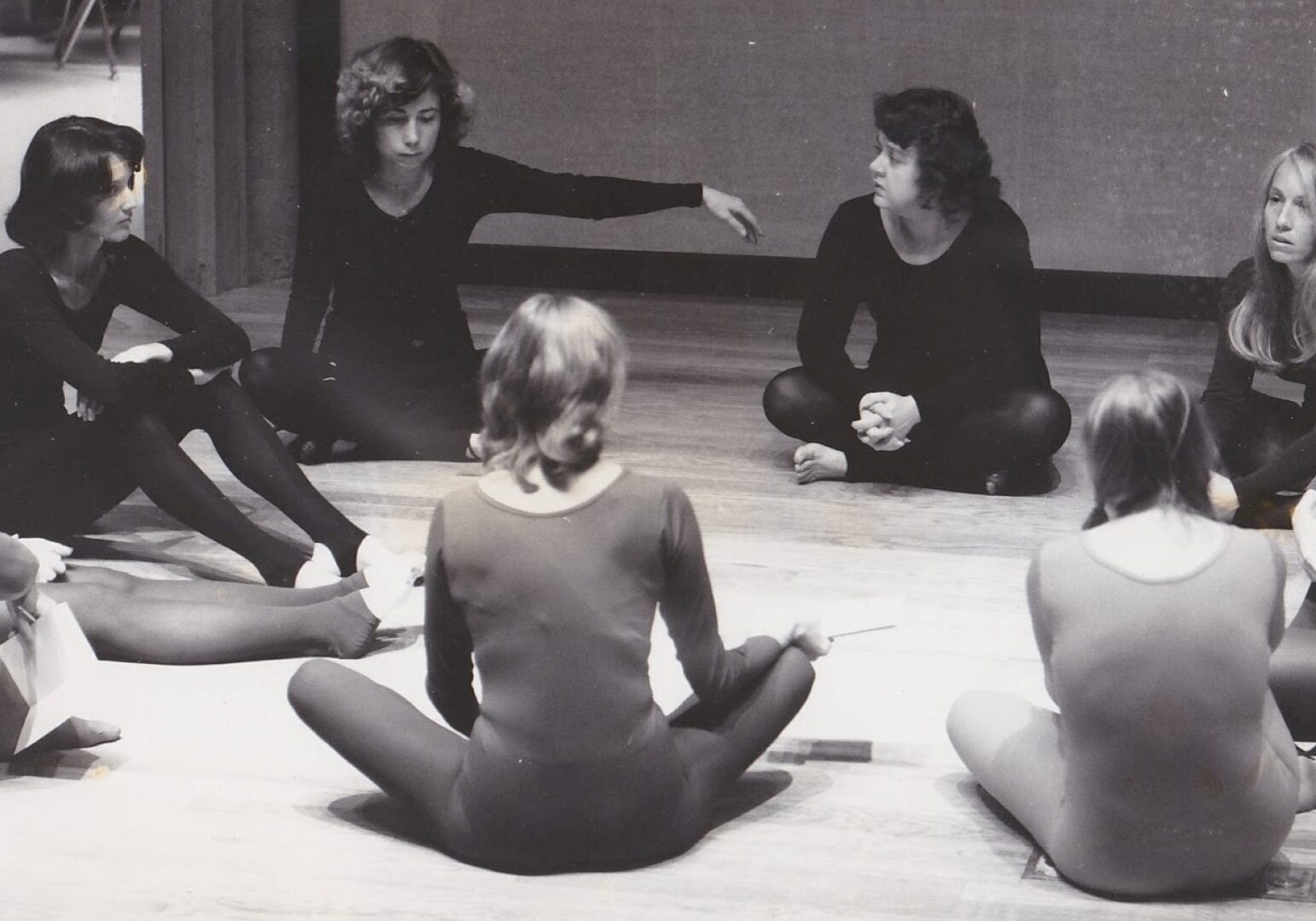
The 1970s — shag carpet, shaggier hair, and a whole lot of female empowerment.
Charity Gourley asked curiousKC to find out what happened to the women’s improvisational dance group The Emergents that performed on KCPT in the late ‘70s.
In the 1960s and ‘70s, Gourley spent several years living abroad with her family. When they returned to the United States they were greeted by a women’s liberation movement in full swing.
“I really began to leave my family behind as I moved forward in my thinking about women and our role in the world,” Gourley said. “I wanted to be someone other than my husband’s wife.”
She is thankful that she stayed with her family, but she refused to compromise her progressive thinking towards independence and equality for women. She found a group of women like her who were yearning for more, and they “met weekly to move to music while growing (their) consciousness of being women.”
Contact improvisation is a type of dance that was created in the U.S. in the ‘70s, and is still practiced today. It is an experimental and social form of dance that involves spontaneous movements, changes in balance, and transferring energy between dancers. “Jams” were invented in the mid-1970s to allow various dancers who didn’t know each other to gather and improv together.
While contact improvisation wasn’t a gender-specific movement, women would sometimes break off and host their own jams to focus on conveying the female experience, and to avoid men who used the art form to cross physical boundaries.
Enter from stage left: The Emergents.
The Emergents were founded in Kansas City in 1973 and traveled around the Midwest performing “dance statements” in which they expressed their experiences as women through movement.
“My friends and family thought I was just an oddball,” said Linda Williams, Kansas Citian and former member of The Emergents.
Williams recalled the stupor of being told for the first time that she was allowed to have her own identity separate from men.
“That was kind of heresy,” Williams said.

In 1958, Williams worked at a store in Kansas City on 95th Street and Troost Avenue. When she became pregnant, she was told that she could no longer work there because they “couldn’t have” a large woman being seen on the floor. The list of transgressions goes on, and they outline the boundaries that these women wanted to be freed from.
A 1974 article in The Kansas City Times catalogs “Woman: Challenges and Choices III,” a yearly conference where women from across the metropolitan area gathered to discuss important topics such as rape, sexism in politics and financial independence.
“On Saturday and Sunday evenings ‘The Emergents,’ a women’s modern dance group, performed an interpretive statement on women’s sexuality,” the article recounted. “The program ended with a dance to the song ‘I Am Woman’ by Helen Reddy, and the dancers received a standing ovation from the audience.”
“We collaborated ahead of time, but it was all improvisation on stage,” Gourley said.
According to another article from The Kansas City Star, The Emergents’ performance at the same conference the year prior caused many audience members to weep at the portrayal of their trials as women expressed through dance.
“It was empowering,” Williams said. “I remember standing on the stage at UMKC. It made us feel that we could do anything.”
The Star’s article detailed an Emergents workshop (it’s hard to call it a rehearsal when it’s improvisational) led by the group’s founder Suzy Shelton.
The Emergents typically met in spaces above churches to jam together. They didn’t just dance — they had open and vulnerable conversations with each other as well.
“I’ve built up such a level of trust in this group,” one woman in the article said, “that I no longer feel threatened by other women. I feel as if every one of us here has worth, and that we are truly beautiful.”
The group disbanded after its members, including Shelton, moved away from Kansas City. Over the years some of the women stayed in touch, some connections fell off, and some have died. Nevertheless, The Emergents leave us with a reminder of these words from Helen Reddy’s “I Am Woman”:
If I have to, I can do anything
I am strong
I am invincible
I am woman
Catherine Hoffman reports for Kansas City PBS in cooperation with Report for America.
curiousKC is supported by

Reading these stories is free, but telling them is not. Start your monthly gift now to support Flatland’s community-focused reporting.

Related Stories
A Better Big Blue Battlefield in Kansas City | Part II
Editor’s note: This is the second installment of a three-part series on the restoration of the Big Blue Battlefield in Kansas City, Missouri. In the mid-19th century, overland trail teamsters driving wagons west sometimes followed a branch of the Santa Fe Trail out of Independence, using the shortcut to reach fields where the animals used…
A Better Big Blue Battlefield | Part I
Editor’s note: This is the first installment of a three-part series on the restoration of the Big Blue Battlefield in Kansas City, Missouri. It was cold for late October in Kansas City. In 1864 Lt. Patrick Henry Minor, then leading an artillery battery against Confederate forces, would die the following March, from what likely had…
Historic Earthquakes Accounts Guide Modern First Responders
On December 16, 1811, a U.S. Army officer stationed in the soon-to-be-established Missouri Territory woke just after 2 a.m. reacting to what he described as a “great agitation”, an earthquake. Several of the officer’s guards, he soon wrote to a friend, “could scarcely keep their feet” during the shaking, which he said lasted about eight…