
curiousKC | A Quick History Lesson on the TV Tower Near 31st and Main Street
July 11, 2022 | Vicky Diaz-Camacho | 4 min read
Driving down Main Street or along Interstate 70, it’s hard to miss the 1,042-foot tall cherry-red tower looming over the Union Hill neighborhood.

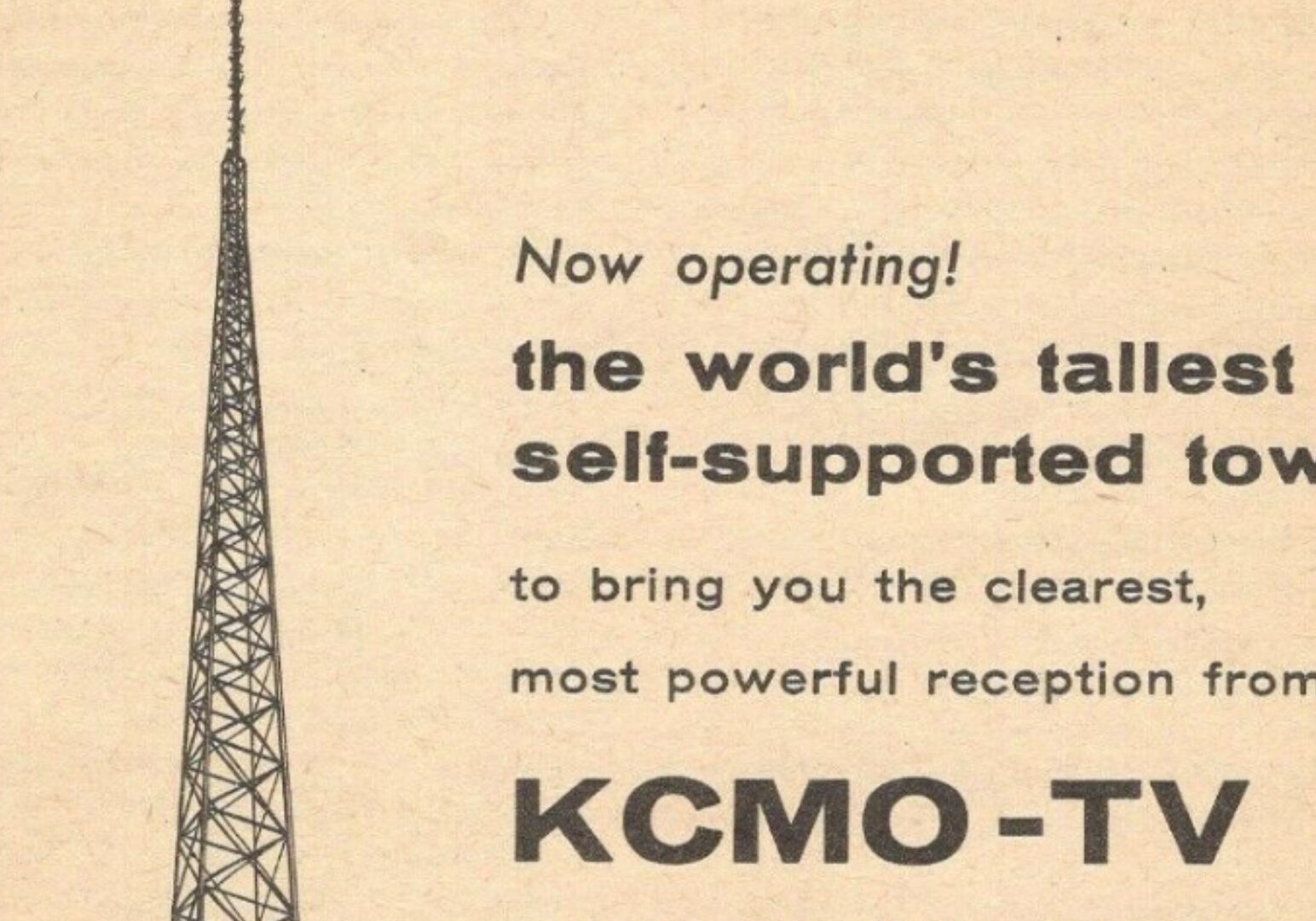
That’s what piqued the interest of a Kansas Citian Mike Bruenn. He wondered: “What is the history of the TV tower at 31st and Main? My father told me it used to be the tallest self-supporting tower in the world. Is that true?”
Bruenn shared the story of his childhood in the early 1960s, cementing that landmark in his memory. As a boy, his father would take his brother Mark, sister Michelle and him to watch airplanes land at the Downtown Airport. Then afterward, they’d drive through the city to see the lights and storefronts. That’s when his father said the tower was the world’s tallest tower at the time.
“Dad would exaggerate occasionally but we believed him in this case,” he said.
“You see, we lived in western Wyandotte County, which was the country back then, so being in downtown KCMO was a thrill. As we passed the TV tower on 31st street and looked up, it was the tallest thing we had ever seen.”
A search of Kansas City’s archives, old news clippings, sketches and articles reveals the story of how an area landmark was built.
So, where to begin?
The steel tower began to take shape in the late 1940s.
It was first owned by ABC, which transmitted Kansas City’s very first television station, WDAF, in 1949. A few years later it was sold to Iowa-based media conglomerate Meredith Corp.
KCMO-TV became a CBS affiliate as part of the deal, according to a news clipping from January 1955. At that time, CBS was expanding its TV and radio operations to Omaha, Kansas City and Syracuse.
“The tower was said to be modeled after the Eiffel Tower in Paris, but its nickname became ‘Eyeful’ tower, an allusion to the eye logo for CBS, of which the TV station is an affiliate,” according to a Kansas City Public Library blog entry.
By definition, it is a skyscraper.
Here is an image of the tower being built in 1955. It would be completed and begin operations one year later.

The tower not only powered several different local stations in the metropolitan area but also served as a weather beacon.
Between 1970 and 2001, engineers teed up flashing lights to alert the community of inclement weather, patterns denoting a different climate alert.
“When the tower’s lights flashed upward, the next day was predicted to be warmer, and when the lights flashed downward, a cooler day was ahead,” according to Kansas City PBS “Tower Trivia.” It even had a specific light alert for tornados.
However, this towering treasure is also a well-known danger zone during ice storms. In cold weather, ice collects on the steel structure and, when the weather warms up, tends to fall off in chunks along 31st Street.
So, here’s a life hack. Steer clear of the area in the winter.
Today, it serves KCTV-5, a CBS affiliate, and is a marker of sorts for Kansas City PBS, which occupies the buildings at the base of the tower.
As far as its height goes, the TV tower is twice as tall as the Washington Monument, according to the Missouri Valley Special Collections archives.
So, the answer to Mike’s last true-or-false question is yes. It was at one time the world’s tallest self-supporting tower.

Another question that’s cropped up is: What’s next for the tower on 31st Street and Main?
Throughout the years, community artists and advocates have sought to light the tower and make it a symbol of unity. The Tower Project, Inc., founded by Jasper Mullarney and supported by artist Jose Faus, in 2019 outlined six goals, one of which was to “establish a signal of equity as the shared civic identity and icon for the city.” Neither responded to a request for comment for this article.
Though its future as a public art project is still unknown, the tower has withstood the test of time. For more than 60 years it has been a staple in the metro’s skyscape and soon it will stand over a revamped Kansas City PBS headquarters.
Vicky Diaz-Camacho covers community affairs for Kansas City PBS.
Reading these stories is free, but telling them is not. Start your monthly gift now to support Flatland’s community-focused reporting.
Related Stories
A Better Big Blue Battlefield in Kansas City | Part III
Editor’s note: This is the final installment of a three-part series on the restoration of the Big Blue Battlefield in Kansas City, Missouri. The engagement on the Big Blue Battlefield was pivotal in the larger Battle of Westport, an October 1864 clash that effectively ended organized Confederate military operations in Missouri. As the years receded,…
A Better Big Blue Battlefield in Kansas City | Part II
Editor’s note: This is the second installment of a three-part series on the restoration of the Big Blue Battlefield in Kansas City, Missouri. In the mid-19th century, overland trail teamsters driving wagons west sometimes followed a branch of the Santa Fe Trail out of Independence, using the shortcut to reach fields where the animals used…
A Better Big Blue Battlefield | Part I
Editor’s note: This is the first installment of a three-part series on the restoration of the Big Blue Battlefield in Kansas City, Missouri. It was cold for late October in Kansas City. In 1864 Lt. Patrick Henry Minor, then leading an artillery battery against Confederate forces, would die the following March, from what likely had…