
However Colorado votes, GMO labeling debate far from over
October 29, 2014 | | 6 min read
Voters in Colorado Tuesday will decide whether or not they want the state to require labels on foods containing genetically modified ingredients, or GMOs. The 2014 ballot measure highlights a much larger national conversation about the safety and prevalence of genetically modified foods.
If passed, food companies and farmers would need to affix to food a label that reads, “Produced with genetic engineering” if the product contains certain genetically modified crops and their derived oils and sugars that end up in processed foods.
Those in favor of the proposal, Proposition 105, claim consumers have a right to the information. Those opposed say it amounts to a fear campaign.
At a Denver, Colo., grocery store, shopper Ben Hamilton says he puts a lot of weight on food package labels.
“I am a label reader,” said Hamilton, a human resources consultant. “I think a lot of people read labels and are curious.”
Hamilton gravitates toward organic options and scans nutritional facts. But he says he wants more information: specifically, whether or not the food he’s about to buy includes a genetically modified ingredient.
Before the current run-up to the election, Hamilton and 19 other voters in Colorado sat on a citizen review panel tasked with hearing from both sides. At the end of three days of debate, the group wrote up their conclusions and took a straw vote. The panel voted 11 to 9 in favor of labels. Hamilton’s “yes” vote is right in line with consumer groups that say GMOs come with too many unanswered questions.
“I think this boils down to a consumer’s right to know,” Hamilton said. “So it’s not to debate whether GMOs are safe or they’re good for you or bad for you. But it is about a right to know what’s in our food supply.”
Efforts to pass labeling laws through ballot initiatives in other states have been unsuccessful. Similar measures failed in California and Washington state. Vermont is being sued for the labeling law it enacted earlier in 2014.
Oregon voters will also be voting on GMO labeling in this election. Like Colorado, there was a similar citizen review panel. Ernest Estes, a Portland lawyer who sat on that panel, has his doubts.
“I’m not convinced we need it at this point,” Estes said. “And I’m not sure it does much for Oregonians.”
Estes wasn’t alone in that sentiment. The citizen panel in Oregon also voted 11 to 9, but in the opposite direction as the Colorado panel. They voted against enacting the labeling proposal.
“If there is little to no risk to the public,” Estes said. “I’m not sure the government should be in the role of requiring things like this.”
Current scientific consensus hasn’t found adverse health effects from humans eating genetically modified foods, according to the American Association for the Advancement of Science and the World Health Organization. Many scientists, including the board of directors of the AAAS, say labeling initiatives are being driven by misconceptions about genetically modified crops being unnatural or untested.
As it’s written, the Colorado labeling proposal includes a bevy of exemptions. The meat from a cow that’s fed GMO corn and hay won’t be labeled. Neither will dairy products, chewing gum, alcohol and pet food. Colorado Right To Know leader Larry Cooper, who spearheaded the signature gathering campaign to get the issue on the ballot, says the proposal had to be narrowly written.
“We had to be very careful what subjects we put in the ballot,” Cooper said. “Yes, we’ve eliminated some specific areas, but certainly they can be added later.”
Lawsuits are likely inevitable if the ballot measure passes, even with narrower language. Legal experts say to expect even more legal wrangling over labeling as more states look to add to the national patchwork of GMO laws.
“When you’re compelling a business to say something or a producer to say something, there has to be some governmental interest. There has to be a substantial government interest,” said Justin Marceau, a constitutional law professor at the University of Denver.
The proposals in Oregon and Colorado bring up thorny constitutional issues about free speech and commerce, Marceau says. If a GMO labeling law makes it all the way to the Supreme Court and opponents are unable to prove genetically modified food is harmful, Marceau says the law would be in jeopardy for violations of the First Amendment and the U.S. Constitution’s Commerce Clause.
“Why do we need this information? If it’s idle curiosity that we’re all just really curious about what’s in our food, that might not be good enough. If it is GMOs are harmful, then that’s a different matter,” Marceau said.
GMO labeling would undoubtedly have economic implications for farmers and consumers. Opponents of the measure say implementation of the new labels could raise the average family’s food bill by several hundred dollars per year. Labeling proponents say those figures are blown out of proportion. Both sides tout studies that back up their positions.
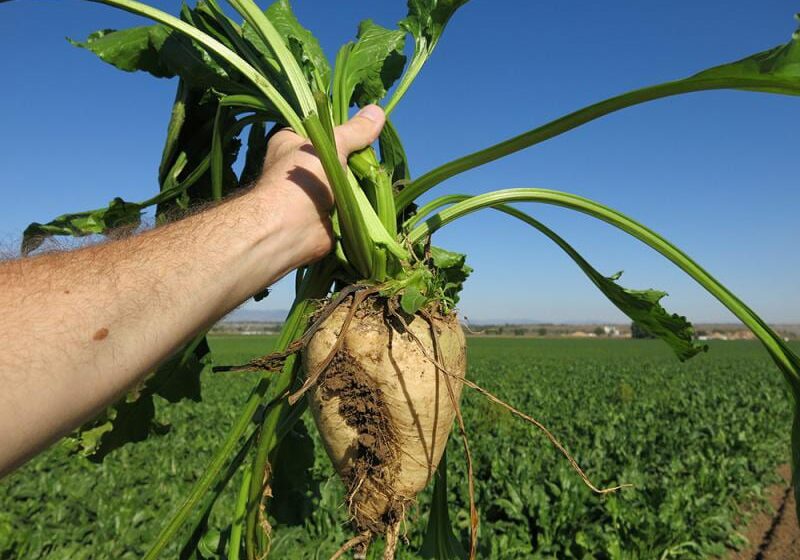
Colorado farmer Paul Schlagel says he’s sympathetic to curious consumers who want to know how their food is grown, but labeling genetically engineered, or GE, ingredients is too minute. He grows genetically engineered sugar beets outside Longmont, Colo. The sweet tasting beets are turned into granulated sugar at a nearby plant.
“When you process the sugar beets, there’s no GE material in the sugar,” Schlagel said. “The sugar is identical to conventionally grown sugar, sugar cane, even organic sugar.”
Schlagel’s beets are Roundup Ready, meaning the plant’s DNA has been altered to withstand applications of the herbicide glyphosate, though the particular gene that allows for the resistance isn’t present after the fleshy beet root is processed into sugar. If Proposition 105 passes, though, the sugar that’s grown on his farm will bear a label saying it was genetically engineered.
“It’s just misinformation. It’s misleading,” Schlagel says. “Prop. 105 is a mistake and I hope the consumers can figure that out.”
Both Colorado and Oregon consumers will have a chance to make their voices heard at the ballot box in November. And with more states taking up proposals, the national debate about GMO labeling is far from over.

Reading these stories is free, but telling them is not. Start your monthly gift now to support Flatland’s community-focused reporting.

Related Stories

Nick’s Picks | Roads, Bathrooms, Costco and More …
New Toll Road Opens Kansas City’s first toll road opens this week. Starting Saturday, you’ll pay up to $3.50 to travel the new express lanes on U.S. Highway 69 from 103rd to 151st streets in Overland Park. There are no toll booths — cameras scan your license plate, and a bill arrives by mail. KTAG…
Up From the Ashes: Warwick Theatre Revival Draws Applause
Two years ago, John Cleary met a fellow Kansas City actor for drinks. Their conversation centered on the fate of the Metropolitan Ensemble Theatre. A large portion of the ensemble’s home, the Warwick Theatre, was ash, charred timbers and soot-saturated costumes and props — remnants from a recent massive fire. The destruction was so great…

Nick’s Picks | Baseball, Drones, Romance and More …
Royals Reveal Next week, the Kansas City Royals head to Arizona for Spring Training. And that’s the mayor’s self-imposed deadline to lock in a stadium deal. So, is this finally the week owner John Sherman steps to the plate and unveils where the Royals will build their next home? At last week’s council meeting, Mayor…