
Caregiving Squeezes Households Between Young and Old
June 19, 2025 | | 11 min read
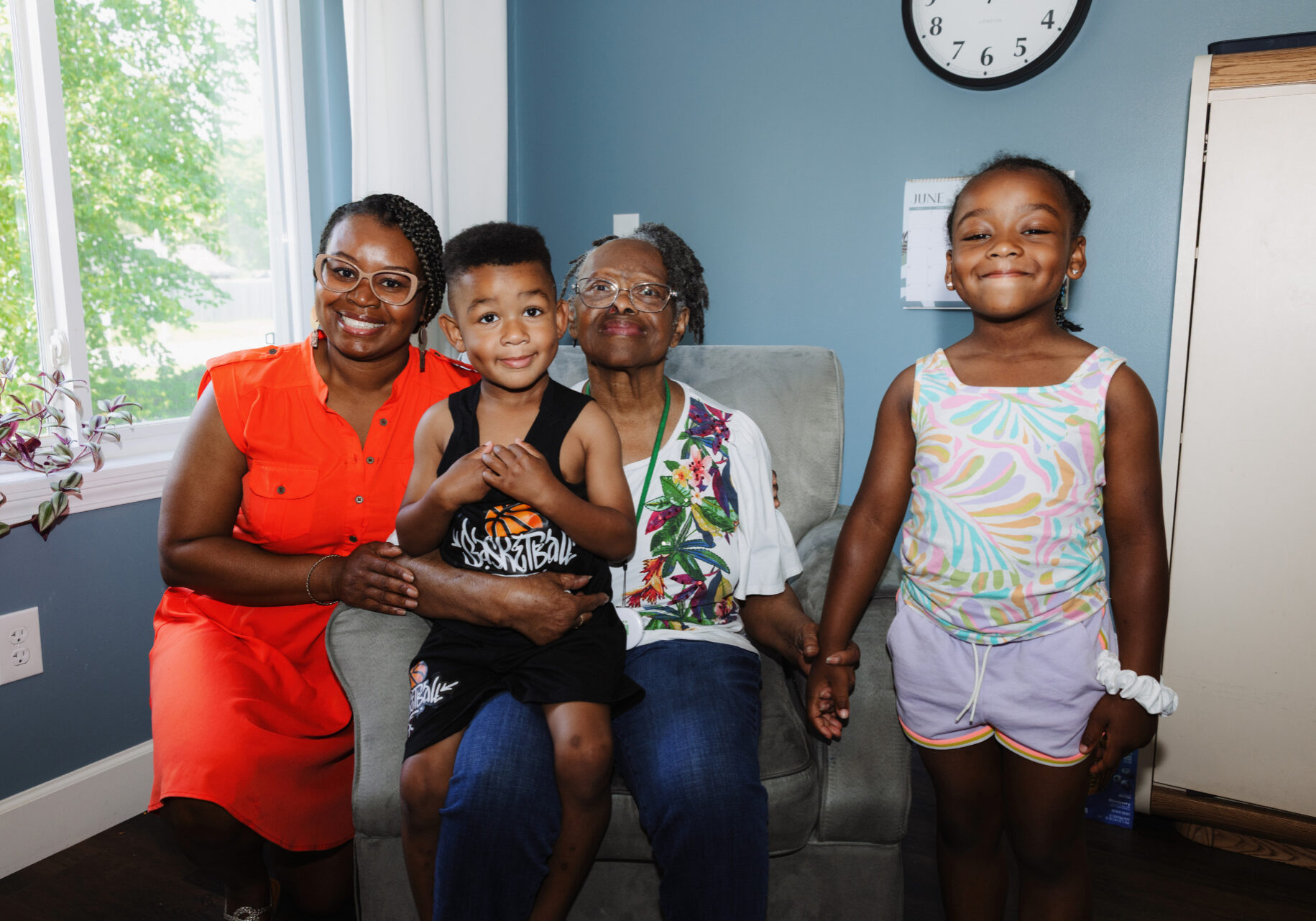
Melissa Johnson knows her life is hardly unique.
The Oak Grove, Missouri, woman cares for her infirm 72-year-old mother, who lives in her own home nearby.
She calls her mother daily. She brings dinner to her several times a week.
Johnson, who coordinates care with her aunt, a team of therapists, and a nurse, is also a mother of a 17-year-old daughter.
“At some point, you will be a caregiver,” Johnson said. “I think it’s inevitable for everyone.”
It is for Christina Hill, of Lee’s Summit, Missouri, who cares for her grandmother and her two young children. Her grandmother once lived with Hill and depended on daily needs like bathing and dressing.
Hill’s grandmother is now living with vascular dementia, and it is safer for her to be in an assisted living center. Hill visits her grandmother often and continues to supervise her care.

It’s a relationship that, at times, can feel overwhelming.
“A lot of times I shed tears,” Hill said. “No one can prepare you for when you are in the trenches like that.
“We are all the same people trying to do something extraordinary.”
Johnson and Hill are examples of what observers have termed the “sandwich generation,” adults caring for their aging parents while raising kids.
About a quarter of U.S. adults (23%) are part of the “sandwich generation,” according to a Pew Research Center survey conducted in October 2021.
Pew defined its cohort as adults who have a parent age 65 or older and are either raising at least one child younger than 18 or providing financial support to an adult child.
The straightforward description comes with myriad challenges and issues. It’s a generation that is often misread and undervalued.
“I believe there are probably more caregivers in the sandwich generation in Kansas City than people realize,” said Tim Wholf, director of Johnson County’s Department of Aging and Human Services.
“There are so many people doing it who don’t consider what they are doing caregiving. They just think this is what I am supposed to do. Kansas City right now is the kind of place where people are taking care of people and not thinking about having the caregiver title.”
That fuzziness makes it difficult to know the size of Kansas City’s sandwich generation.
“We all know it’s not very cut and dry when we become caregivers,” said Rachel Hiles, founder of Sandwiched KC, a support group. “Normally, it starts little by little, helping here and there.”
And it’s a generation that is only expected to grow because of societal and economic factors like skyrocketing housing costs, where increasing property taxes and maintenance bills threaten the ability of seniors to remain in their homes.
“Things have definitely changed,” said Janet Baker, executive director of KC Shepherd’s Center, a nonprofit that supports older adults. “People are living longer.”
She said it is estimated that at the beginning of the 20th century, 4% to 7% of people in their 60s had at least one living parent.
“Today, that figure is nearly 50%,” Baker said. “So people age, and that is coupled with the fact that unpaid caregivers – primarily family members – provide 85% of all long-term services. That’s the sandwich right there.”
Census data shows that life expectancy has risen steadily in the U.S. since the 1960s, with projections that life expectancy for the total population will increase from 79.7 to 85.6 between 2017 and 2060.
But there’s more.
Baker said there’s now something called the “club sandwich generation” to include families that have young children, are caring for aging parents, and have adult children living at home. Unaffordable housing is also one reason have failed to move out.
Hiles said there can be many ways to define the sandwich generation.

“No disrespect to those caring for children and caring for older parents, but anybody who is caring for a loved one is sandwiched,” she said. “It truly doesn’t matter what is on either side of the sandwich. We can all relate to the feeling of being pressured from all sides.
“Whether it’s a career, a grandma or children and mom and dad. We all have pressures that are smooshing us into the middle.”
A feeling of obligation is one of the biggest challenges facing the sandwich generation.
Their parents cared for them, so they should be able to care for their parents in return, no matter what else is going on in their lives.
“People say, ‘I got it. I’ll reach out if I need to.’ But then the reaching out never happens,” Wholf said.
“I am supposed to take care of my parents when they get sick. I am supposed to make sure my kids survive until adulthood. I am supposed to go to every game, but at the same time, my parents are beginning to have health issues, and I need to take care of them.”
Add to that scenario the responsibility of a job and career.

Wholf said it is estimated that 65% of sandwich generation caregivers have a full-time job. That statistic, he said, prompts a central question: “How do I keep my job and not struggle at the same time taking care of my children and parents?”
Caregiving, itself, is an undervalued job.
“There is no money in the system to make that a valued profession,” Baker said. “It’s squeezing the bubble. That’s among many things America has not gotten right.
“People are living longer and have outlived their resources,” she added. “And our support to caregivers has not kept pace. We can do better.”
Kids, parents, and a career leave little room for anything else for the sandwich generation caregiver.
“You can’t leave home unless there is someone there to take care of your person,” Baker said.
“You can’t leave to go to a caregiver’s support group. You just can’t leave.”
A growing concern of the sandwich generation is who is taking care of the caregiver.
That is what prompted Hiles, of Independence, Missouri, to start Sandwiched KC in 2018.
Hiles, who once had a full-time marketing job, found herself taking care of her grandmother while being a legal guardian of an adult with developmental disabilities.
“I was looking for support as a caregiver,” she said, “and I couldn’t find any organization that would meet me where I was at.
“Being a millennial, it didn’t really appeal to me to get in my car, drive across town, meet a bunch of strangers, and talk to them about all this going on in my life that is very personal. Having to navigate all that sounded traumatic. Even if I wanted to do that there is no way I had the energy or the wherewithal. I was absolutely tapped out.”
Hiles started with a virtual caregiver meeting once a month. Last year, the group started meeting twice a month. Now meetings are offered twice a week.

“We come together because we want to share our challenges and also celebrate our victories,” Hiles said. “Unfortunately, there tend to be more challenges than victories just because of the nature of caregiving.”
Often, the group talks about similar situations. They meet each other on common ground.
“We talk about: how do I get the keys away from a parent? Or, how my mom won’t do anything I suggest. Or something as simple as taking a bath,” Hiles said.
“We talk about making it through the day.”
A challenge that comes up a lot in the Sandwiched KC meetings is coping with guilt and regret.
“The guilt that you are not doing enough. Guilt that you should be doing something else,” Hiles said.
“We talk about things we would have done differently. The feeling like you are sacrificing so much. You see other people around you, and they are having such a great life. You are not doing things that your same-age peers are doing. You are missing out on that.’
And there is loneliness.
“Caring for a loved one can be very isolating,” Hiles said. “People want to ask for help. They don’t know how to ask for help. Sometimes it’s embarrassing.
“We think we can do it all.”
“There just isn’t a good system. We need a continuum of care. A system.”
janet baker, executive director, kc shepherd’s center
Wholf said sandwich generation caregivers need to seek help and find time for themselves.
“I don’t care if it’s going to the grocery store, and while you drive yourself there, you play the music really loud,” he said. “Whatever you need to do to take that 30 minutes out by yourself, for yourself.
“We have to do better at getting you to take care of yourself.”
To that end, earlier this year Wholf’s department began offering a quarterly caregiver support group. He said society needs to recognize the potential consequences of not caring for the caregivers.
“The sandwich generation is at most risk of having health issues,” Wholf said. “They need all the support that they can get.”
Identifying Solutions
Johnson, the sandwich generation caregiver in Oak Grove, has advice for other sandwich generation caregivers.
“You have to be clear about your caregiving. Establish what boundaries there are and stick to them,” Johnson said.
As an alderwoman in Oak Grove, Johnson is doing her part by working on legislation on adult dwelling units that helps caregivers create a better intergenerational living option.
“There isn’t going to be room for all of our parents. There will not be enough nursing homes or spaces,” she said. “We are going to have to live intergenerationally to get by.”
Baker said there needs to be better data collection and more funding for those trying to help the aging population.
“There just isn’t a good system,” Baker said. “We need a continuum of care. A system.”
And, Baker added, policymakers need to pay attention to paid sick and family leave benefits for the sandwich generation.
The current situation is very harmful to women, who often are the primary caregivers, Baker said.
“Women opt out of a Social Security-earning living to be a caregiver,” Baker said.
“They are taking care of small children, so they are out of the workforce. Then they are back in the workforce. They are out of the workforce to take care of mom and dad. Off and on. Off and on.”
By the time the woman needs Social Security to live on, it can be drastically less than a man who maintained full-time employment.
“Now you are the one who is older and whose grown children have to move in because you can’t afford to live on your own,” Baker said. “There is a real cycle of feminism of poverty that is related to caregiving.”
As models, Baker pointed to Scandinavian countries that allow caregivers to continue paying into Social Security-type systems.
“We could do federal and state caregiver tax credits,” she said. “The average caregiver spends $7,200 a year covering expenses personally. We need to do better.”
For now, it comes down to people themselves.
When Hill, the caregiver from Lee’s Summit, was laid off from her full-time regional business manager position last February, she decided to become a franchise owner of a consulting firm called Amada Senior Care.
“I finally realized where I need to be,” Hill said.

Last month, more than 750 people registered to attend the Mid-America Regional Council’s “Age of Celebration. A 60+ Block Party.” The services fair included about 80 community agencies that provide resources for healthy aging.
Alana Henry manned a table with information at the Robert J. Mohart Multipurpose Center in Kansas City. Henry, executive director of the Ivanhoe Neighborhood Council, said events like the block party are critical to getting information out to those who care for others.
And, perhaps more importantly, it provides the chance to build relationships.
“We’ve been caring for each other for thousands and thousands of years without infrastructure out there,” Henry said. “It really comes down to you and me.”
Debra Skodack is a Kansas City area freelance writer.

Reading these stories is free, but telling them is not. Start your monthly gift now to support Flatland’s community-focused reporting.

Related Stories

Nick’s Picks | Roads, Bathrooms, Costco and More …
New Toll Road Opens Kansas City’s first toll road opens this week. Starting Saturday, you’ll pay up to $3.50 to travel the new express lanes on U.S. Highway 69 from 103rd to 151st streets in Overland Park. There are no toll booths — cameras scan your license plate, and a bill arrives by mail. KTAG…
Up From the Ashes: Warwick Theatre Revival Draws Applause
Two years ago, John Cleary met a fellow Kansas City actor for drinks. Their conversation centered on the fate of the Metropolitan Ensemble Theatre. A large portion of the ensemble’s home, the Warwick Theatre, was ash, charred timbers and soot-saturated costumes and props — remnants from a recent massive fire. The destruction was so great…

Nick’s Picks | Baseball, Drones, Romance and More …
Royals Reveal Next week, the Kansas City Royals head to Arizona for Spring Training. And that’s the mayor’s self-imposed deadline to lock in a stadium deal. So, is this finally the week owner John Sherman steps to the plate and unveils where the Royals will build their next home? At last week’s council meeting, Mayor…