
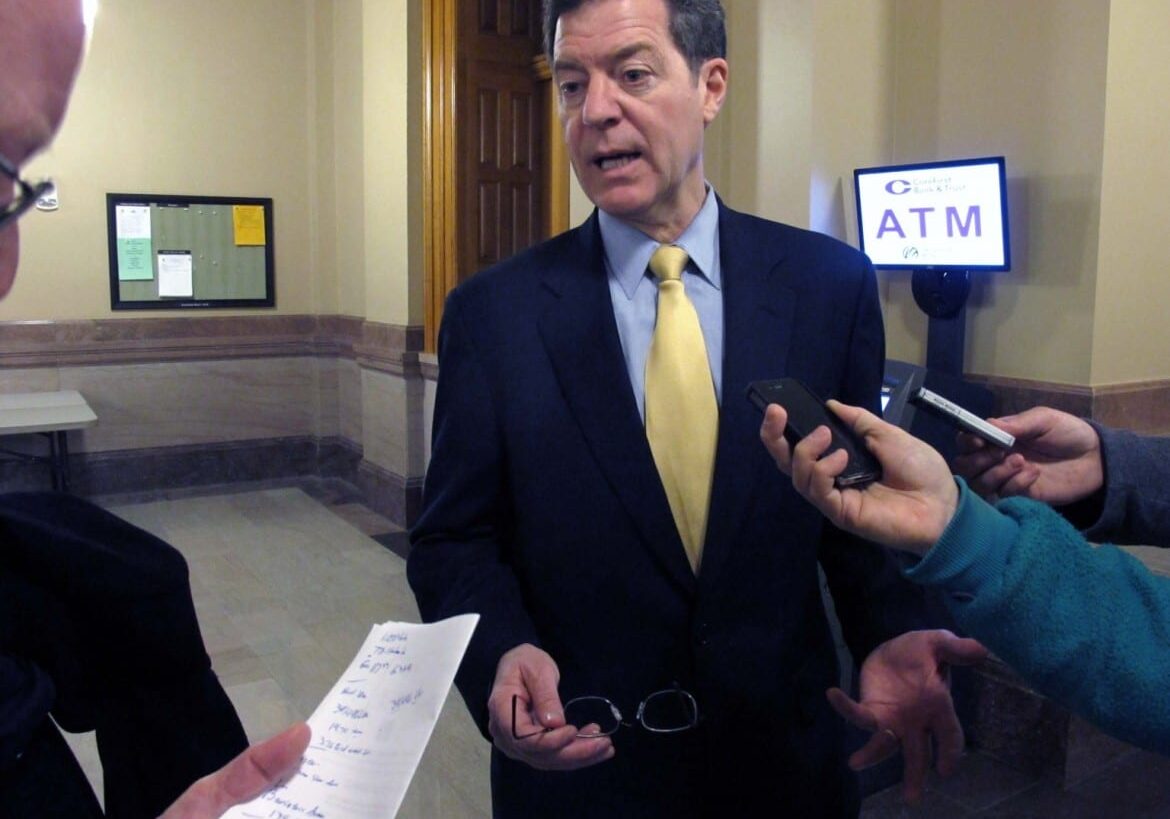
Brownback signs controversial health care compact bill
April 28, 2014 | | 6 min read
By Dave Ranney — KHI News Service
TOPEKA — Gov. Sam Brownback has signed into law a bill that might make it possible for Kansas to join a compact of states that want the power to run Medicare and Medicaid within their borders.
The new law also creates the possibility that the compact states could circumvent several key provisions in the Affordable Care Act, also known as Obamacare.
“The Health Care Compact will allow states to restore and protect Medicare for generations to come,” Brownback said in a prepared statement today announcing that he had signed the measure. The actual signing was Tuesday.
The compact couldn’t come into being without approval by Congress, which is considered unlikely as long as Democrats control at least one of its chambers. Democrats currently control the Senate and Republicans are pushing hard in this year’s elections to regain the majority. The GOP already controls the U.S. House.
Kansas Insurance Commissioner Sandy Praeger and AARP Kansas had earlier urged the governor not to sign House Bill 2553, calling the initiative frivolous and misguided.
‘Really twisting things’
In a statement released today, the governor accused Obamacare of “cutting $700 billion out of Medicare,” a claim being used by Republicans across the nation as they continue to fight the law and campaign for election. Politifact, a fact-checking project of the Tampa Bay Times has labeled the claim a half-truth.
According to Politifact, the law doesn’t actually cut Medicare spending but is expected to reduce future growth in the program’s costs mostly by reducing Medicare Advantage, “a small subset of Medicare plans that are run by private insurers.”
“The governor is really twisting things,” said Dave Wilson, a past volunteer president of AARP Kansas.
Wilson also said he doubted Brownback’s assurances that he would oppose any reduction in Medicare benefits, if the compact were enacted and state officials gained control over Medicare, which currently is administered solely by the federal government.
“That’s what he says and that’s what legislators who support this say,” Wilson said. “But the reality is they can’t do it now, but with this bill they could do it and that could have a tremendous impact on seniors, on the disabled and on veterans.”
Federal officials run the Medicare program, which provides health coverage for seniors. But Medicaid, which serves poor children, the frail elderly and the disabled, is a shared state-federal program with the federal government paying the majority of its cost (about 60 percent) and imposing various basic requirements on the states.
But Medicaid also gives state significant latitude in the ways they manage the program, including the determination of eligibility standards. For example, Kansas operates its KanCare program with a waiver exempting it from many of the standard Medicaid rules. And Kansas also is allowed to keep thousands of people out of Medicaid who would qualify for the program in other states.
One of nine
Kansas is one of nine states that have enacted laws expressing the desire to join the so-called “health care compact.” The others are Alabama, Georgia, Indiana, Missouri, Oklahoma, South Carolina, Texas, and Utah.
“All nine states that are now in this compact are states that have turned their backs on Medicaid expansion,” Praeger said. “On the one hand you’re saying you want to bring those federal (Medicare) dollars back to Kansas but on the other hand you’re saying we’re not going to take those (Medicaid) federal dollars.”
It’s unclear whether Kansas seniors will support the governor’s decision to sign the bill, she said.
“If it ain’t broke don’t fix it,” Praeger said. “And the Medicare program, while it needs to rein in costs, is a reliable source of health care services for our senior population and I would not want to be putting those folks at risk.”
Americans for Prosperity, a political action group tied to the billionaire brothers Charles and David Koch, has spent millions of dollars fighting Obamacare.
“Health care decisions should be made by Kansas officials, not the federal government,” said Jeff Glendening, state director of Americans for Prosperity-Kansas. “With Congressional approval, the Health Care Compact will transfer control of federal health care funding from Washington, D.C., to Kansas. It supports the state’s ability to control its own health care system.
Glendening said the compact wouldn’t require the states to take over Medicare or Medicaid but would allow them the option. “Under the compact, we can set standards and reimbursement rates rather than handing those important decisions over to the federal government,” he said.
‘Path out of Obamacare’
The Libertarian Party of Kansas also endorsed the new law.
“We believe in government at its most local level,” said Al Terwelp, chairman of the state party. “So we support the compact idea in general, having the state of Kansas be in as much control over health care issues as possible.
In the Legislature, the bill’s primary sponsors were Rep. Brett Hildabrand and Sen. Mary Pilcher-Cook, both Republicans from Shawnee and opponents of Obamacare.
“By signing the health care compact, the governor has agreed Kansas needs to protect Medicare for seniors, while also providing a path for Kansas citizens and businesses out of Obamacare, giving Kansans more economic stability, freedom and choices for their health care needs,” Pilcher-Cook wrote in an email to KHI News Service.
House Minority Leader Paul Davis, a Lawrence Democrat who is running for governor, said Brownback should have killed the bill.
“Gov. Brownback has put his own politics ahead of Kansans yet again. I agree with Kansas seniors and our state insurance commissioner: the right decision was to veto this irresponsible health compact. We should not threaten the care of hundreds of thousands of seniors. In his effort to score political points, Gov. Brownback ignored these calls for commonsense leadership. That’s not the type of leadership Kansans–especially our seniors–deserve.”
Major Funding for Health coverage on KCPT provided by Assurant Employee Benefits and the Health Care Foundation of Greater Kansas City.

Reading these stories is free, but telling them is not. Start your monthly gift now to support Flatland’s community-focused reporting.

Related Stories

Nick’s Picks | Roads, Bathrooms, Costco and More …
New Toll Road Opens Kansas City’s first toll road opens this week. Starting Saturday, you’ll pay up to $3.50 to travel the new express lanes on U.S. Highway 69 from 103rd to 151st streets in Overland Park. There are no toll booths — cameras scan your license plate, and a bill arrives by mail. KTAG…

Up From the Ashes: Warwick Theatre Revival Draws Applause
Two years ago, John Cleary met a fellow Kansas City actor for drinks. Their conversation centered on the fate of the Metropolitan Ensemble Theatre. A large portion of the ensemble’s home, the Warwick Theatre, was ash, charred timbers and soot-saturated costumes and props — remnants from a recent massive fire. The destruction was so great…

Nick’s Picks | Baseball, Drones, Romance and More …
Royals Reveal Next week, the Kansas City Royals head to Arizona for Spring Training. And that’s the mayor’s self-imposed deadline to lock in a stadium deal. So, is this finally the week owner John Sherman steps to the plate and unveils where the Royals will build their next home? At last week’s council meeting, Mayor…