
A Battle Over Bringing Local Renewables To Rural Electric Co-ops
October 16, 2016 | | 6 min read
In the 1930s, rural electric cooperatives brought electricity to the country’s most far-flung communities, transforming rural economies. In Western Colorado, one of these co-ops is again trying to spur economic development, partly by generating more of their electricity locally from renewable resources, like water in irrigation ditches and the sun.
Local leaders say that’ll be good for the economy and the environment. The electricity will be clean and affordable, and the revenue from generating it will stay in their communities. But this prospect has started a high-stakes legal battle. It’s pitted renewable energy advocates against traditional wholesale power providers, and it’s a fight that could help define the future of electricity generation in rural communities nationwide.
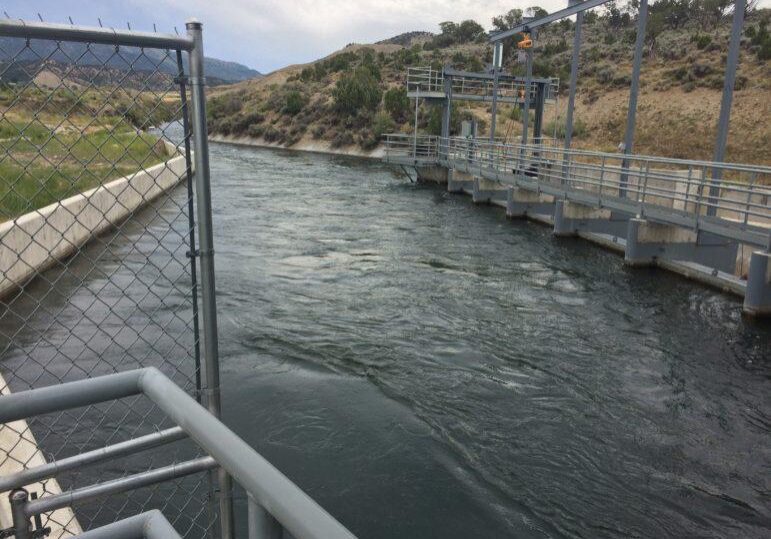
Outside Montrose, Colorado, Jim Heneghan and I stood on a catwalk over the South Canal. It was a warm August afternoon, and swallows darted across the water. The canal delivers irrigation water from the Gunnison River to local farmers. But Heneghan is not a farmer. He is an engineer with the Delta Montrose Electric Association, or DMEA, the local electric co-op. And he harvests something else from the water: electricity.
“It’s a pretty simple process, tried and true,” Heneghan says.
Water enters a pipe just below us, and flows a quarter-mile downhill, where it spins a turbine and generates power. This plant, Heneghan explained, makes enough electricity to power about 2,200 homes for a year.
There are a few more like it on the canal, and plenty more irrigation ditches in the area to plug turbines into. There are more rooftops and vacant land to blanket with solar panels. There’s even methane seeping out of a defunct coal mine that can be turned into electricity. DMEA leaders want to tap more of these resources, said board president and local businessman Bill Patterson. They think this kind of power, generated in small doses across the local landscape, is the future.
But DEMA has a contract that commits them to buying power from Tri-State Generation and Transmission until 2040. DMEA doesn’t want to wait that long to ramp up local generation. So they’ve gone to the Federal Energy Regulatory Commission to ask for permission to start now.
Joseph Goodman of the Rocky Mountain Institute, a clean energy think tank, says the case could remove a major barrier to small-scale renewable energy in rural areas.
“DMEA is really taking one for the co-op family as a whole by bringing this case forward,” he says.
DMEA is one of 43 rural utilities in Colorado, New Mexico, Wyoming and Nebraska that buy power from Tri-State. The co-ops actually created Tri-State decades ago because none of them could afford to build big power plants on their own.
“There’s an economy of scale that small rural co-ops get by combining together and forming organizations like Tri-State,” says Lee Boughey, Tri-State’s communications manager.
Boughey explained that co-ops’ contracts commit them to buying 95 percent of their power from Tri-State. Much of that power comes from large, centralized power plants, often fired with coal. The co-ops are allowed to generate the other 5 percent of their own. The contracts ensure that each co-op pays its fair share of fixed costs — for maintaining transmission lines, or paying off power plants. If one co-op buys less from Tri-State, thereby reducing its revenues, other members will have to make up the difference, Boughey said. Their costs could rise.
Patterson, though, says DMEA’s members believe local power generation is key to keeping rates low in the long-run. With the cost of coal becoming increasingly uncertain, and the cost of renewables like solar falling, it makes sense for the co-op to develop the resources in its own backyard.
“We’ve been trying to negotiate with Tri-State on this without success,” Patterson says.
So last year, DMEA went to the Federal Energy Regulatory Commission, or FERC, to ask if they could buy more than 5 percent of their power from local sources — despite their contract. FERC said they could. In fact, a federal law called the Public Utilities Regulatory Policies Act of 1978 required it to. The law, passed during the 1970s energy crisis, was intended to promote small-scale renewable energy development.
Tri-State wasn’t happy, and went back to FERC. It wants to recoup costs by charging co-ops like DMEA for buying more local power. In June, FERC rejected the request. Tri-State is appealing, with support from a number of the other co-ops it serves, which worry about rising costs. And because many wholesalers like Tri-State have similar contracts with rural co-ops, Boughey says the outcome could affect rural utilities nationwide.
“What’s happening in Colorado could play out across the country with other cooperatives,” Boughey says.
The ruling could effectively lift local generation caps for rural co-ops, explained Kevin Brehm, with the Rocky Mountain Institute. He estimates that if the nation’s rural co-ops were to transition completely to renewable energy, it would create a 200 gigawatt market — the equivalent of at least 100 Hoover Dams.
That’s all theoretical, of course. Still, some locals are nearly giddy at the prospect of independence.
“I felt as if I were six years old and I just got a pony,” says former DMEA board member Ed Marston, of his reaction to FERC’s decision.
Marston is an advocate for renewable energy, and for local economic development. He lives in Delta County, where coal mines have long provided the best paying jobs. But two of three mines closed recently.
“We’ve lost tens of millions of dollars in public tax revenue,” Marston says.
A smattering of small-scale power plants could help rebuild the tax base. But they’re only a piece of the economic puzzle. They won’t bring back the 700-plus jobs lost from the mines. Take the modern hydro plants on the South Canal: They’re affordable, efficient — and automated.
This story was produced by Inside Energy, a public media collaboration focused on America’s energy issues.
— Harvest Public Media, based at KCUR 89.3, reports on farm and food issues in collaboration with public media stations across the Midwest. For more information, visit www.harvestpublicmedia.org.

Reading these stories is free, but telling them is not. Start your monthly gift now to support Flatland’s community-focused reporting.
Related Stories
Nick’s Picks | Roads, Bathrooms, Costco and More …
New Toll Road Opens Kansas City’s first toll road opens this week. Starting Saturday, you’ll pay up to $3.50 to travel the new express lanes on U.S. Highway 69 from 103rd to 151st streets in Overland Park. There are no toll booths — cameras scan your license plate, and a bill arrives by mail. KTAG…
Up From the Ashes: Warwick Theatre Revival Draws Applause
Two years ago, John Cleary met a fellow Kansas City actor for drinks. Their conversation centered on the fate of the Metropolitan Ensemble Theatre. A large portion of the ensemble’s home, the Warwick Theatre, was ash, charred timbers and soot-saturated costumes and props — remnants from a recent massive fire. The destruction was so great…
Nick’s Picks | Baseball, Drones, Romance and More …
Royals Reveal Next week, the Kansas City Royals head to Arizona for Spring Training. And that’s the mayor’s self-imposed deadline to lock in a stadium deal. So, is this finally the week owner John Sherman steps to the plate and unveils where the Royals will build their next home? At last week’s council meeting, Mayor…