
Race has been a part of the jazz conversation for much of its history. The genre’s origins are owed to African American culture, but it was adopted and perhaps catapulted — some would say appropriated — into the mainstream by white consumers.
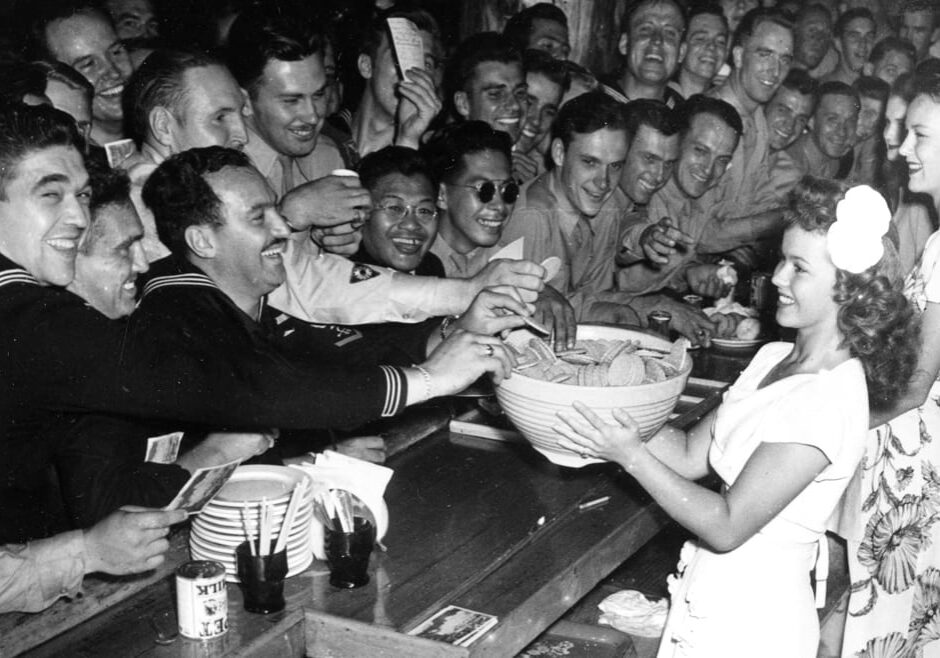
During the heyday of the Hollywood Canteen, a serviceman’s nightclub open during World War II, jazz was undoubtedly the most popular genre in mainstream music. And while many of the Canteen’s patrons came from all over the country to chase the fantasy of meeting and dancing with celebrities, their experiences at the club illustrate how a shared appreciation of jazz and swing dance was capable of transcending perceived social and cultural boundaries.
Tonight, in Kansas City’s jazz district, The American Jazz Museum will bring together these conversations on race, the Greatest Generation, dance, and of course, music, when it hosts author and University of Kansas professor Sherrie Tucker to speak about her 2014 book, “Dance Floor Democracy: The Social Geography of Memory at the Hollywood Canteen.”
[FLEX-CONTENT]
“Sometimes swing is considered African American, sometimes it’s colorblind, sometimes it’s considered the moment of white appropriation of black music,” Tucker said. “There is something about the slipperiness of swing that really encapsulates a lot of the contradictions of American democracy.”
Tucker, who has taught at KU for 16 years, sees the book as a continuation of her career-long study of the interplay between jazz and American culture.
Over the years, as she continued to research the concept, Tucker noticed that much of the written history of jazz fails to focus on the role of the dancefloors born out of the swing and big band jazz genres. So she set out to find a dancefloor that would help her examine the topic, with a specific goal in mind.
“I wanted to find a dancefloor and interview people who had been there to find out how they remembered their bodies moving on the dancefloor. And I wanted to get multiple perspectives of a diverse group of dancers to see how each of them remembered it,” Tucker said. “I finally found it when I realized that swing and big band were tied up with the nostalgia of World War II, the concept of the ‘good war’, and the Greatest Generation. So the Hollywood Canteen was a perfect fit.”
The origin of the club, which was open between 1942 and 1945, is in dispute. According to Tucker, the club was founded by the combined efforts of Hollywood actors John Garfield and Bette Davis, the Los Angeles musicians’ unions, as well as guilds and unions from the Hollywood motion picture industry. The idea was to provide a USO-like nightclub that would be operated by “volunteers” – members of the various entertainment unions, ranging from behind-the-scenes office staff to music and film stars.
[FLEX-CONTENT]
It existed as Hollywood’s take the “Home Front” effort. Volunteers would serve the soldiers food, sign autographs, perform, and dance. And the club hosted servicemen from across the armed services as well as the Allied Nations.
However, the club also raised eyebrows in Hollywood and around the U.S. for being known as an integrated dancefloor. Tucker explained that at the time, segregated clubs and cities were commonplace, and that many of the best jazz bands of the era were frequently playing clubs where African American patrons were not allowed entry.
The Hollywood Canteen intended to serve as a stark contrast to that – a move that drew a healthy dose of detractors. And Tucker noted that while her interviews with the club’s attendees may not paint a consistent picture of the all-inclusive, integrated nightclub utopia that history seems to favor, the dancefloor itself offered some glimpses into how dance had the power to cross racial lines.
In one interview, Tucker spoke with a female African American volunteer that was tasked with dancing with African American soldiers at the Canteen – a job that she resented due to the implication that white volunteers were not allowed or willing to do so.
“She broke the rules one night and danced with a white soldier. She talked about how they danced so well and how they danced not because of their race but because they liked the way each other danced,” Tucker said. “There are a lot of stories about the dancefloor and they are all very different. But taken together, they are an interesting way to study swing dance as a place where people could experiment.”
Yet despite the wide range of first-person accounts presented by Tucker in her book, the national memory of the Canteen has always been the affable image of a white soldier and a white female movie star, jitterbugging together with blinding smiles, hinting at yet another dissociation in perception. Tucker’s book attempts give that image more context and understand what caused the expansive gap between the memory and the reality of the locale, as explained by those who experienced it.
Ultimately, this is Tucker’s democracy – a mass of participants twirling around one another on the same dance floor with differing memories of the same events and differing views on race, culture, gender, and class. Though no two people are ever in full unison, they are never really that far apart from one another.
[FLEX-CONTENT]
— Dan Calderon is Kansas City native, an attorney, and contributor to Flatland. You can contact him by emailing pdancalderon@gmail.com, or on twitter @dansascity.
Reading these stories is free, but telling them is not. Start your monthly gift now to support Flatland’s community-focused reporting.

Related Stories
A Better Big Blue Battlefield in Kansas City | Part II
Editor’s note: This is the second installment of a three-part series on the restoration of the Big Blue Battlefield in Kansas City, Missouri. In the mid-19th century, overland trail teamsters driving wagons west sometimes followed a branch of the Santa Fe Trail out of Independence, using the shortcut to reach fields where the animals used…
A Better Big Blue Battlefield | Part I
Editor’s note: This is the first installment of a three-part series on the restoration of the Big Blue Battlefield in Kansas City, Missouri. It was cold for late October in Kansas City. In 1864 Lt. Patrick Henry Minor, then leading an artillery battery against Confederate forces, would die the following March, from what likely had…
Historic Earthquakes Accounts Guide Modern First Responders
On December 16, 1811, a U.S. Army officer stationed in the soon-to-be-established Missouri Territory woke just after 2 a.m. reacting to what he described as a “great agitation”, an earthquake. Several of the officer’s guards, he soon wrote to a friend, “could scarcely keep their feet” during the shaking, which he said lasted about eight…