
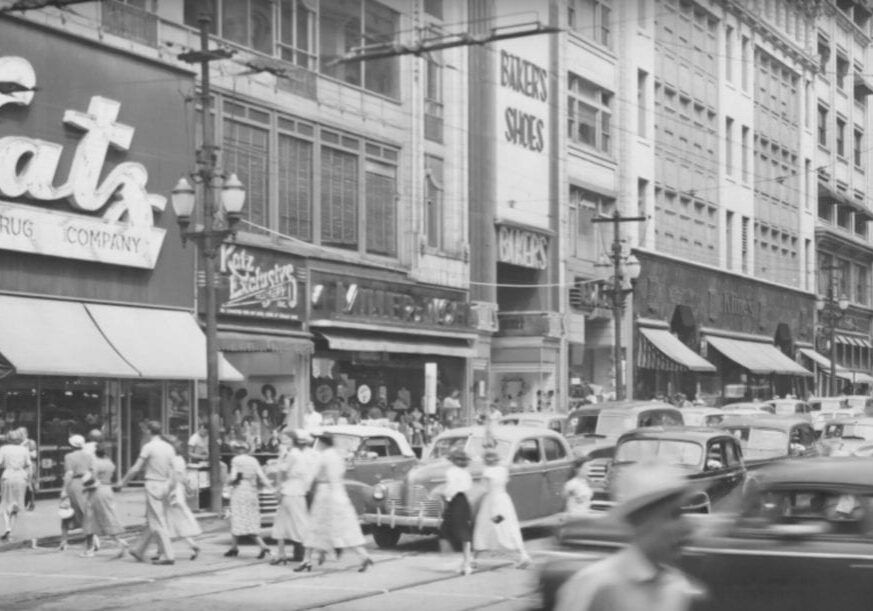
Do You Know Twelfth Street’s (Famous) Past?
October 30, 2018 | Vicky Diaz-Camacho, Mike Sherry | 3 min read
If there’s a street that defines Kansas City, Missouri, which one would you say it is?
Obvious candidates include Ward Parkway, The Paseo and Southwest Boulevard. But what would you say to the dark horse selection of 12th Street?
It’s a relatively pedestrian thoroughfare now, but it has a bawdy history that reaches back to Kansas City’s stockyard roots and its raucous music and arts scene. The eight-mile, east-west street runs between the West Bottoms and the eastern edge of the city near the Blue River.
The street, once famed for its burlesque houses and ties to the Pendergast clan, was drab by the 1970s. But a curiousKC inquirer remembered enough about the drag’s last hurrah to ask us for a review of the “old 12th Street strip from the 1950s and 1960s.”
And that’s what led us to take this enlightening trip down memory lane, with a trove of historical material we sifted through at the Kansas City Public Library’s Missouri Valley Special Collections.
The “12th Street …” poem appeared in a Sept. 22, 1950 issue of TOWN magazine.
[FLEX-CONTENT]
Accounts of happenings along 12th Street from the late 1800s up through the 1930s described it variously as “the center of society, from tailcoats to tarts” and “a playground, social stage and the fairyland” that included peddlers, politicians, pimps, sex workers and speakeasy bartenders selling bootleg hooch.
Anchors of the district that still exist today include the Folly Theater, a one-time vaudeville and burlesque house, and the nearby Muehlebach Hotel at 12th and Wyandotte streets.
But there was a constant hum to the street.
[FLEX-CONTENT]
“Twelfth Street was always known for music,” said vocalist David Basse, who is part of “12th Street Jump,” a weekly jazz, blues and comedy program broadcast by radio station KCUR-FM from the Black Dolphin Lounge in Kansas City, Missouri.
Well-known 12th Street jazz bands included the Coon-Sanders Nighthawks Orchestra, and clubs along the strip also hosted prominent jazz artists like Count Basie and Charlie Parker. The hotspots included the Reno Club and the Orchid Room.
Some accounts say that, amidst the racial tensions of the 1950s and 1960s, 12th Street stood out as a melting pot where Black and white patrons mixed easily at “black and tan clubs.” Other recollections, however, described it more as a curated area where Black bands played for mixed audiences that sat separately.
Once a strip that featured “female impersonators,” 12th Street was also home to gay bars at that time.
Over time, 12th Street lost steam along with other parts of downtown. As was happening elsewhere around the country in the late 1960s and early 1970s, City Hall tried to revitalize the area by tearing down old buildings through the controversial urban renewal policies established by the federal government.
But 12th Street and downtown really didn’t bounce back until today’s renaissance, driven largely by the establishment of the Kansas City Power & Light District and the wave of people moving downtown.
Its rebirth proves a point that one of Kansas City’s most prominent storytellers made in the mid-1970s. Twelfth Street might have grown outdated with time, said legendary broadcaster Walt Bodine. “Yet it just won’t ever really die.”
Reading these stories is free, but telling them is not. Start your monthly gift now to support Flatland’s community-focused reporting.

Related Stories
New Perspectives Emerge on Hyatt Regency Skywalks Collapse
Two new books offer fresh perspectives on the Hyatt Regency skywalks collapse, regarded as the most devastating structural collapse in U.S. history.
‘Canceled, Censored, Banned’ Sparks Questions About Government, Books and Public Libraries
Missouri Secretary of State Jay Ashcroft’s proposed rule addressing material at public libraries has sparked questions about book restrictions. Here are answers.
curiousKC | What Questions Do You Have Since HIV/AIDS First Emerged 40 Years Ago?
This month, Flatland reporters focus on the implications the HIV epidemic has had on health equity. What questions should we cover?