
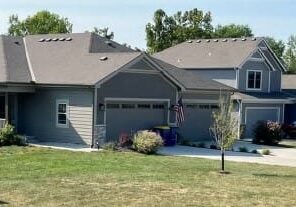
Almost $20M Allocated for Rural Kansas Housing
April 13, 2023 | | 4 min read
Michael Webb, city manager of Edwardsville, Kansas, said his community is largely transient. Most folks commute to work at industrial facilities, then leave to go home.
One reason, Webb noted, is that Edwardsville hasn’t had substantial subdivision development in almost 20 years. He hopes recent funding for a 50-unit moderate-income townhouse project will encourage more folks to stay in town after work.
“The primary goal is to be able to provide housing to the workforce,” Webb said. “The goal long term (is to) develop a balanced neighborhood.”
The townhome development in Edwardsville is one of 16 moderate-income housing (MIH) projects recently awarded funding by the Kansas Housing Resources Corp. (KHRC).
It was the first of three funding rounds in 2023, allocating $4.9 million in state MIH funds, $8.5 million in MIH American Rescue Plan Act (MIH-ARPA) funds and $6.4 million in Kansas Housing Investor Tax Credits (KHITC).
KHRC recently ballooned the program from about $2 million in MIH funding each year, to $62 million, thanks to increased support from the state and the American Rescue Plan Act.
More on Flatland
Moderate income housing funds help to subsidize the development of houses and rental units for households earning between 60% and 150% of their area median income.
Often teachers, nurses and social workers, this population tends to fall through the cracks — earning too much for Section 8 housing support, but still struggling to afford market-rate housing.
The funding is also dedicated to rural communities with populations of fewer than 60,000 people. Towns with lower populations tend to be less attractive to developers — assistance like MIH funding or the KHITC help entice developers to small towns.
The project in Edwardsville won $1.25 million in MIH-ARPA funding for the construction of 25 townhomes, adding a total of 50 units to the community just west of Kansas City.
Under the agreement, Webb said 30 of the units will be reserved for moderate income households. The 2–3-bedroom units will be priced between $275,000 and $300,000.
It’s a start, which Webb hopes will drive additional development in the community.
“This is just one (way),” Webb said, noting that even newly hired city staff have a hard time finding housing in town. “There’s a need for housing across the board.”
Edwardsville is far from the only community in Kansas searching for housing development assistance.
Alissa Ice, the director of housing development at KHRC, said just this first round of expanded funding attracted as many applications as the program would previously receive in a year.
“So that’s already significant,” Ice said.
The 76 total applications requested more than $21 million in state MIH funding, more than $22 million for KHITC tax credits and about $30 million in MIH-ARPA.

KHRC awarded funding to 16 projects in its first of three rounds of funding. Combined, those projects will create 544 affordable units across the Sunflower State.
Ice hopes that applicants who were not awarded this round will re-apply in future rounds. KHRC liaisons will host informational sessions to help cities and developers amend and prepare new applications.
Ice said KHRC is excited about the larger projects, like the Edwardsville development, that have come on board and taken advantage of the expanded MIH-ARPA funding.
State MIH funding is capped at $650,000 per project, but the federal MIH-ARPA allocation can fund up to $3.5 million per project.
“We’re trying to do larger impact projects with that money,” Ice said, adding that American Rescue Plan Act funding must be spent by 2025.
Many of the recipients leveraged both MIH/MIH-ARPA funding and the tax credits. Ice said developers have learned which funding is applicable to them and are trying to maximize available assistance.
“We have seen developers really use all the puzzle pieces we have to meet the community’s needs,” Ice said. “That’s exciting for us to see.”
MIH projects in the past have utilized other funding sources, such as historic tax credits, to renovate older buildings into housing units. Ice said she was happy to see several applicants in this round propose similar developments.
Other allocations near Kansas City include $1.18 million for the construction of multifamily homes in Wellsville, Kansas, and $650,000 for construction and rehabilitation of duplexes in Wamego, Kansas.
Applications for the next round of funding will open later this month and close in June.

Reading these stories is free, but telling them is not. Start your monthly gift now to support Flatland’s community-focused reporting.
Related Stories
Nick’s Picks | Roads, Bathrooms, Costco and More …
New Toll Road Opens Kansas City’s first toll road opens this week. Starting Saturday, you’ll pay up to $3.50 to travel the new express lanes on U.S. Highway 69 from 103rd to 151st streets in Overland Park. There are no toll booths — cameras scan your license plate, and a bill arrives by mail. KTAG…
Up From the Ashes: Warwick Theatre Revival Draws Applause
Two years ago, John Cleary met a fellow Kansas City actor for drinks. Their conversation centered on the fate of the Metropolitan Ensemble Theatre. A large portion of the ensemble’s home, the Warwick Theatre, was ash, charred timbers and soot-saturated costumes and props — remnants from a recent massive fire. The destruction was so great…
Nick’s Picks | Baseball, Drones, Romance and More …
Royals Reveal Next week, the Kansas City Royals head to Arizona for Spring Training. And that’s the mayor’s self-imposed deadline to lock in a stadium deal. So, is this finally the week owner John Sherman steps to the plate and unveils where the Royals will build their next home? At last week’s council meeting, Mayor…